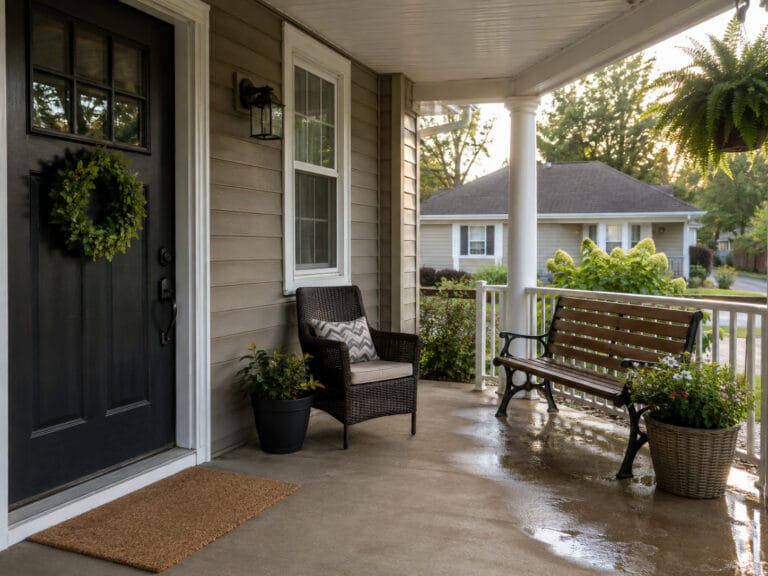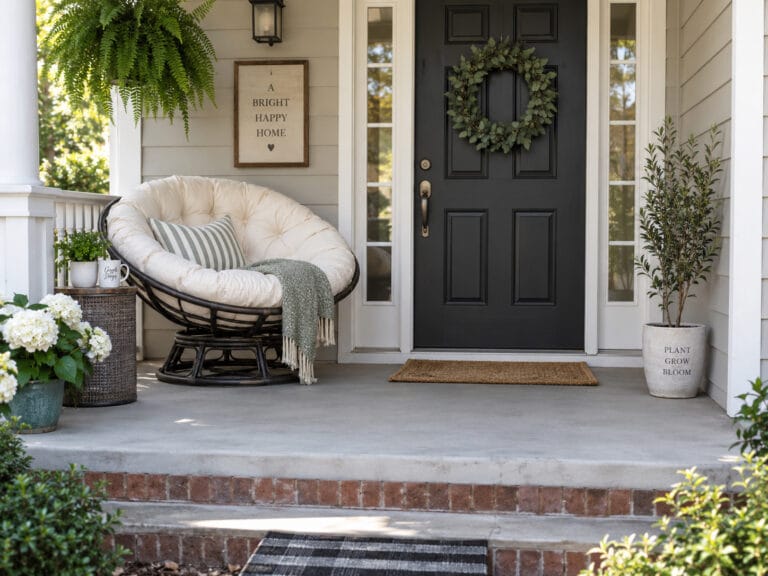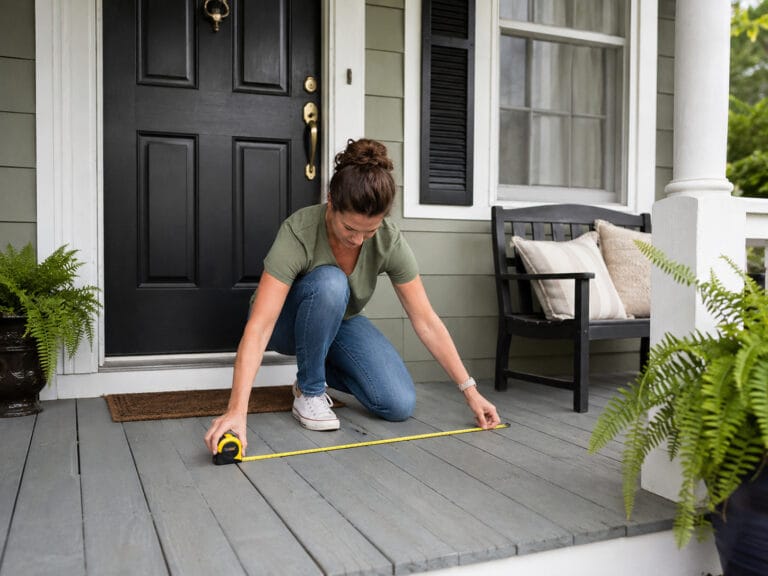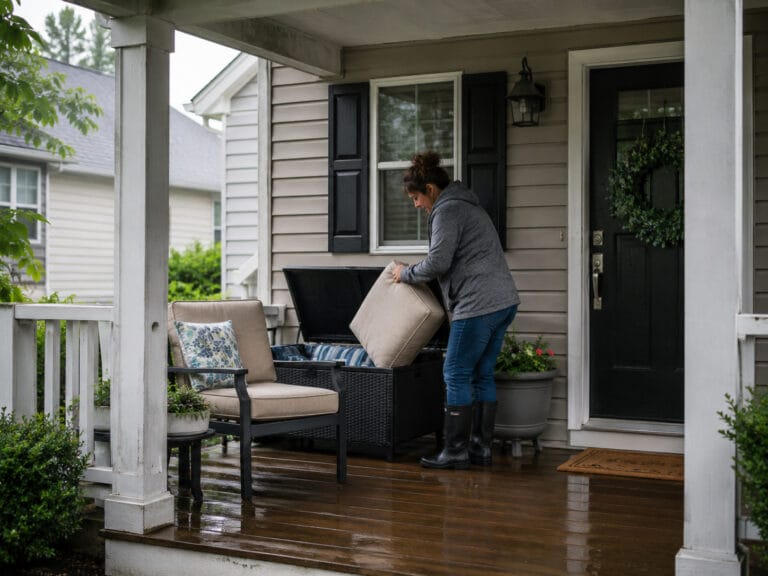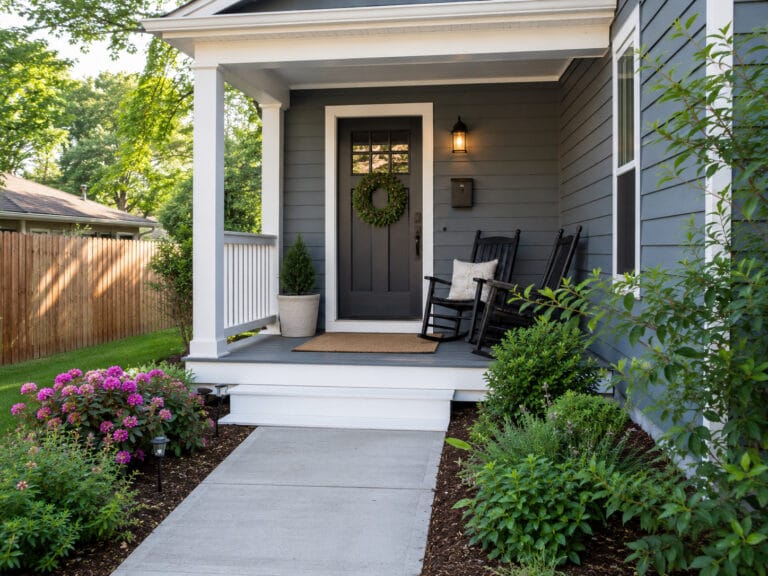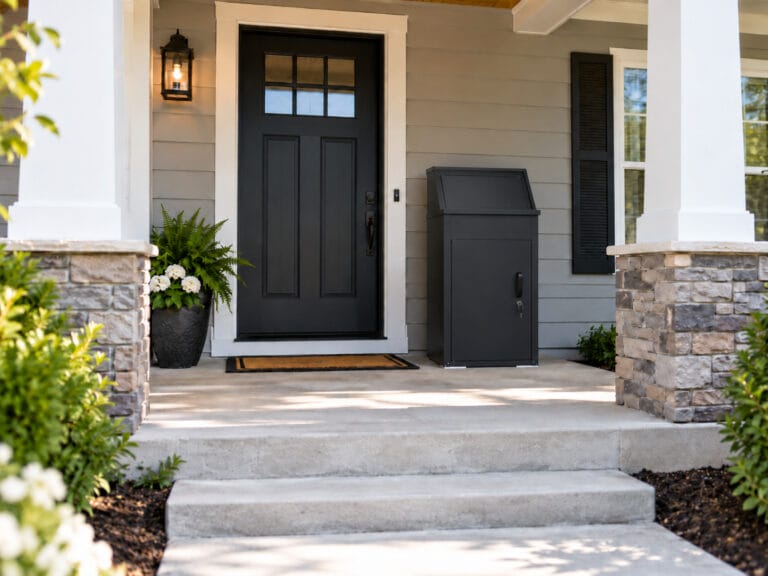
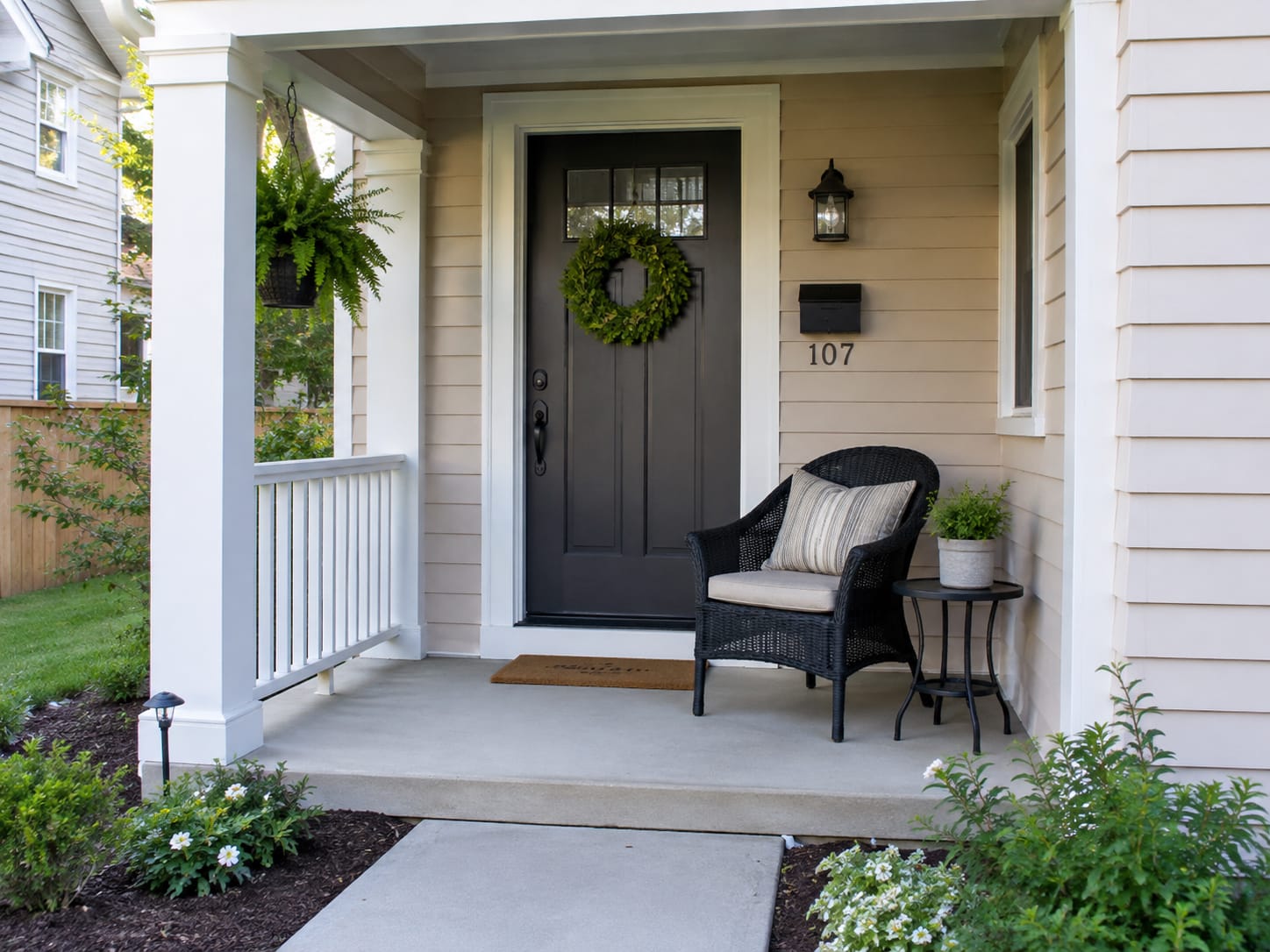
Choosing furniture for a small front porch should not start with color, style, or whatever happens to look best in a product photo.
It should start with a simpler question:
What does this porch actually need to do?
Some small porches only need one place to sit for a few minutes. Others need two seats for conversation, a storage bench for shoes or cushions, or a small coffee setup tucked away from the entrance.
The right furniture is not the piece that fills the most space or creates the most dramatic arrangement.
It is the furniture that solves the porch’s main job without making the front door, walking path, or everyday entry harder to use.
That is also what makes front-porch furniture selection different from choosing furniture for a larger patio or backyard.
A front porch is still an entrance first.
Table of Contents
Quick Answer: What Furniture Works Best on a Small Front Porch?
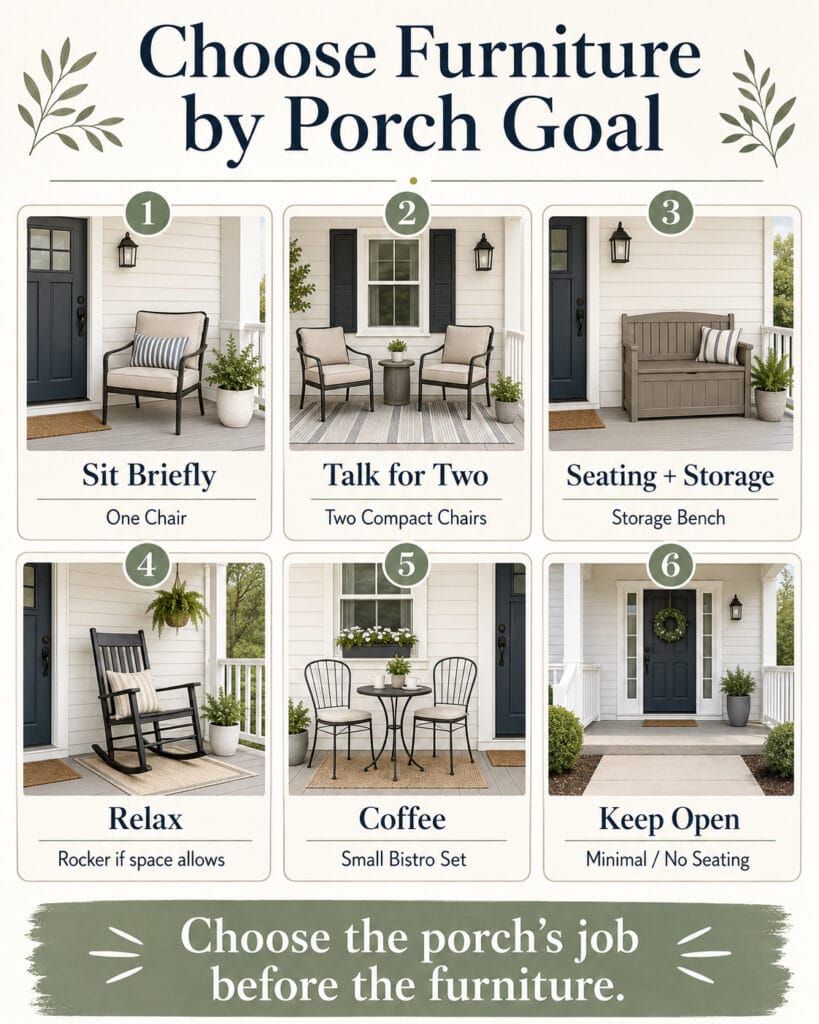
Start with the porch’s main purpose, then choose the smallest furniture setup that performs that job well.
| Porch Goal | Better Starting Point | What to Check |
|---|---|---|
| Sit briefly | One compact chair | Depth and door access |
| Two-person conversation | Two compact chairs | Combined footprint and walking path |
| Seating + storage | Storage bench | Depth and opening space |
| Relaxation | Rocker, if space allows | In-use movement zone |
| Coffee for one or two | Small bistro set | Full group footprint |
| Keep the entrance open | Minimal or no seating | Whether furniture is needed at all |
Do not start by asking:
“What furniture can I fit here?”
Ask instead:
“What is the smallest furniture setup that gives this porch the function I actually need?”
Before Style, Pass Three Tests
Before style becomes part of the decision, a piece of porch furniture should pass three more important tests.
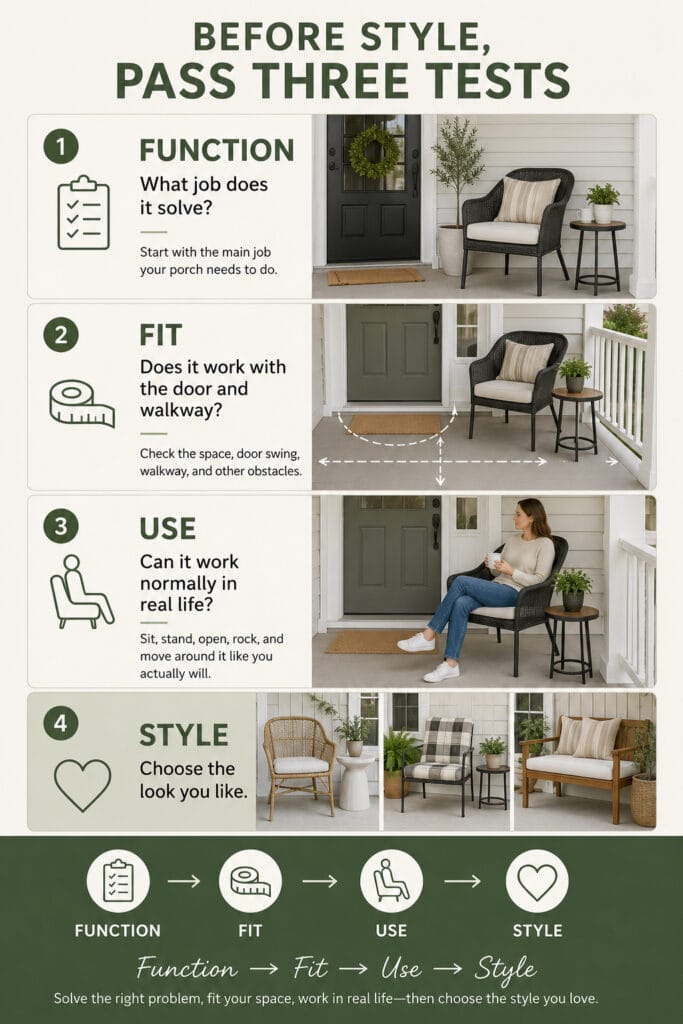
1. Function Test
Does the piece solve a real porch need?
Does it provide the seat, storage, coffee spot, or relaxation space you actually plan to use?
2. Fit Test
Does it work with:
- the front door;
- the walking path;
- the steps;
- the usable floor area;
- nearby railings or walls?
3. Use Test
Can the furniture work normally once someone actually uses it?
That means sitting, standing, rocking, opening storage, moving around it, and carrying packages through the entrance.
Only after a piece passes all three should style become the deciding factor.
Function → Fit → Use → Style
1. Decide What the Porch Needs to Do
Before measuring furniture, decide what the porch’s main job should be.
A small front porch usually works best when it has one primary function and, at most, one secondary function.
Common goals include:
- creating a welcoming entrance;
- having one place to sit briefly;
- giving two people somewhere to talk;
- creating a small coffee spot;
- adding shoe or cushion storage;
- providing a defined place for packages.
Trying to make a very small porch do all of these things at once usually creates more furniture than the entrance can comfortably handle.
For example:
- If the porch is mainly a transition space, one compact chair may be enough.
- If two people regularly sit outside, two smaller chairs may work better than oversized lounge seating.
- If seating and storage are both important, a storage bench may make more sense than a separate seat and storage box.
- If the porch is extremely narrow, keeping most of it open may be better than forcing in furniture.
A useful rule is:
Choose the porch’s job before you choose the furniture.
For broader layout ideas, see our small front porch ideas guide.
2. Measure the Usable Space, Not Just the Porch
Once the main function is clear, measure the space that can actually hold furniture.
Do not assume the entire porch width and depth are available.
Part of that space may already belong to:
- the front door;
- a storm or screen door;
- steps;
- railings;
- porch posts;
- utility access;
- the natural walking route to the entrance.
You should identify:
- overall porch width and depth;
- usable wall length;
- front-door swing;
- main walking route;
- fixed obstacles;
- the floor area that remains practical for furniture.
A chair may fit along a wall and still project too far into the path.
Likewise, two chairs may each fit individually but stop working once a side table is added.
That is why you should think about the full setup, not just individual products.
For a complete measuring process, see our front porch furniture size guide.
3. Pick One Seating Strategy
One of the easiest ways to overcrowd a small porch is to keep adding seating.
A better approach is to choose one clear seating strategy.
Also, do not decide in advance that the porch “needs” two or three seats.
On a small porch, the usable layout should determine the realistic seating capacity—not the other way around.
One Compact Chair
A single chair works well when:
- the porch is narrow;
- one person usually uses it;
- the front door and walking path take up most of the floor;
- you want seating without creating a full outdoor room.
A compact, relatively upright chair often fits better than a deep lounge-style seat.
If there is room left, a very small side table or planter may be enough to complete the setup.
Two Compact Chairs
Two chairs make sense when:
- two people regularly use the porch together;
- the porch has a side area separate from the main route;
- the combined layout still leaves the entrance easy to use.
Smaller chairs are often more flexible than oversized outdoor lounge seating.
They also do not always need to sit side by side. Slightly angling them toward each other can work well when that preserves more open floor area.
When comparing this type of setup, shop the arrangement, not just the individual pieces.
Two chairs that each fit on their own may stop working once you add the sitting area, a side table, and space to stand up.
A Bench
A bench can be very space-efficient when there is a useful wall available.
Compared with several separate chairs, one continuous piece may create less visual clutter while providing seating for more than one person.
Before choosing one, ask:
- Is the wall long enough?
- Is the bench shallow enough?
- Can the front door still operate comfortably?
- Can someone sit without blocking the main walking route?
If bench sizing is your main concern, see what size bench fits a small front porch.
A Rocking Chair
A rocking chair can work beautifully on a small porch, but it should not be treated like fixed furniture.
It needs additional movement space during normal use.
A rocker may look compact while empty but become a problem if its movement zone:
- enters the main walkway;
- approaches the steps;
- comes too close to the wall;
- interferes with a railing or nearby table.
Rockers work best when the porch has enough depth to separate their movement from the entrance.
A Small Bistro Set
A compact bistro set can work when the porch has a distinct side seating area.
It is less suitable when:
- the table sits in the main walking path;
- chairs need to be moved every time someone enters;
- the porch is too shallow for both seating and circulation.
Think of the bistro set as one furniture group, not three separate pieces that happen to fit individually.
4. Pay Close Attention to Furniture Depth
On many small front porches, depth is the first product dimension worth comparing.
Width tells you whether a piece fits along a wall.
Depth tells you how far the furniture projects into the porch.
That projection affects:
- walking space;
- front-door access;
- sitting space;
- package handling;
- nearby furniture.
This is why two pieces with the same width can behave very differently.
A compact upright chair may fit comfortably where a deep lounge chair feels oversized.
A shallow bench may preserve the main route better than a heavily cushioned seat.
A narrow storage piece may solve the same problem as a much larger deck box without dominating the entrance.
Product titles often emphasize width or seat count, while depth is buried farther down the specifications.
On a shallow porch, that less-prominent number may matter more.
Always compare the complete footprint:
width × depth
For more detailed planning around usable space, see our front porch furniture clearance guide.
5. Choose Multi-Purpose Furniture Only When Both Functions Matter
Multi-purpose furniture can be useful in a small space, but only when you actually need both functions.
A storage bench is a good example.
It may provide:
- seating;
- hidden storage;
- a cleaner overall look.
But if you do not need storage, a simpler bench may be:
- shallower;
- visually lighter;
- easier to place.
The same applies to storage side tables or other combination pieces.
A product does not become a better small-space choice just because it has more features.
Ask:
If one of these functions disappeared, would I still want this piece?
If the answer is no, the multi-purpose design may genuinely be solving two needs.
If the answer is yes, you may simply be adding extra bulk.
For more detailed storage planning, see our front porch storage ideas guide.
6. Consider the Porch’s Real Weather Exposure
Do not treat porch exposure as a simple covered-versus-uncovered question.
Exposure exists on a spectrum.
A covered porch may reduce direct rain and strong sun, but furniture near the outer edge can still receive:
- wind-driven rain;
- afternoon sun;
- splash;
- humidity;
- wind-blown snow or debris.
A useful way to think about it is:
“Covered” describes the roof. It does not fully describe the conditions where the furniture sits.
A chair against the house wall may experience very different conditions from another chair only a few feet away near the railing.
So choose furniture for the actual location where it will sit, not just the general porch type.
For a fuller comparison, see our covered vs. uncovered porch furniture guide.
7. Match Materials and Maintenance to the Porch
Material choice matters, but it does not need to become the entire shopping decision.
For a small front porch, focus on practical questions:
- Is the frame designed for outdoor use?
- Can the finish handle the sun and moisture this location receives?
- Will cushions drain and dry reasonably well?
- Are metal components protected against corrosion?
- Can water escape instead of collecting on the furniture?
- Is the maintenance level something you are realistically willing to keep up with?
The best material is not automatically the most expensive or premium-sounding one.
It is the material that fits:
weather exposure + maintenance tolerance + everyday use
Weight matters too.
Lighter furniture can be easier to reposition, clean around, or move temporarily on a small porch.
But extremely light furniture may be less suitable in a windy, exposed location.
Choose for both day-to-day handling and actual porch conditions.
8. Do Not Overcrowd the Porch
A small porch does not become more useful simply because every corner contains furniture.
In fact, leaving part of the floor intentionally open often improves the porch more than adding one more piece.
Common signs of overcrowding include:
- walking around furniture instead of directly to the door;
- moving chairs before bringing in a package;
- a side table sitting in the natural route;
- storage and seating competing for the same area;
- a rocker entering the walkway when used;
- difficulty carrying groceries or a large box through the entrance.
Open floor space is not wasted space.
On a front porch, it is part of the layout.
A good small-space rule is:
Every piece should earn its footprint.
Ask three questions:
- What job does this piece perform?
- How often do I use that function?
- Would the porch work better without it?
If the porch becomes noticeably easier to use after removing one piece—and no important function is lost—that piece probably did not need to be there.
9. Use Visual Weight as a Tie-Breaker
Physical measurements tell you how much floor space furniture occupies.
Visual weight tells you how crowded that furniture feels.
Furniture often looks lighter in a small porch when it has:
- open legs;
- slim arms;
- visible floor beneath the seat;
- simple frames;
- relatively low backs.
Furniture often looks heavier when it has:
- wide arms;
- thick cushions;
- solid bases;
- oversized backs;
- bulky enclosed storage underneath.
Two chairs with nearly identical dimensions can therefore create very different visual impressions.
But visual weight should never replace proper fit.
Visual weight is a tie-breaker, not a substitute for fit.
If two products fit equally well, the visually lighter one will often feel more natural in a tight entrance.
HomyEntry Small Porch Furniture Fit Check
Before ordering furniture for a small front porch, run through this checklist:
- Define the porch’s main job.
- Measure the usable area, not just the full porch.
- Mark the front-door swing and main walking path.
- Choose one seating strategy instead of several competing pieces.
- Compare complete furniture depth as well as width.
- Evaluate the furniture in normal use, not just while empty.
- Test any movement from rockers, storage lids, drawers, or movable tables.
- Match the furniture to the porch’s real weather exposure.
- Use painter’s tape to mark the full footprint before buying.
- Walk through the layout carrying a bag or package before making the final decision.
The HomyEntry approach is:
Need → Measure → Fit → Use → Buy
The furniture should work with the entrance, not force the entrance to work around the furniture.
Frequently Asked Questions
What furniture is best for a very small front porch?
Usually one compact chair, a shallow bench, or no seating at all. The best choice depends on how much usable space remains after protecting the front door and walking path.
Is a bench or two chairs better for a small porch?
Neither is automatically better. A bench can use wall space efficiently and create a simpler visual layout, while two chairs offer more flexibility. The better option depends on wall length, porch depth, and how many people regularly use the space.
Can a rocking chair fit on a small front porch?
Yes, if the porch has enough room for its movement zone. A rocker should be judged while moving, not just by its static footprint.
What dimensions should I check before buying porch furniture?
Check overall porch width and depth, usable wall space, front-door swing, the main walking path, furniture width and depth, and any additional space needed for movement or opening features.
Final Thoughts: Choose for the Porch You Actually Have
The best furniture for a small front porch is not the trendiest set, the largest bench, or the arrangement with the most pieces.
It is the setup that gives you the function you actually need while keeping the entrance easy to use.
Start with the porch’s job.
Measure the usable space.
Choose one clear seating strategy.
Pay close attention to depth.
Evaluate furniture in its real in-use state.
Choose multi-purpose pieces only when both functions matter.
Match materials to the porch’s actual weather exposure and the maintenance you are willing to do.
And leave enough open space that the front door still feels like the most important part of the porch.
The standard is simple:
Furniture should make the porch more useful without making the entrance harder to live with.
When you are ready to compare options, Explore Front Porch Furniture →