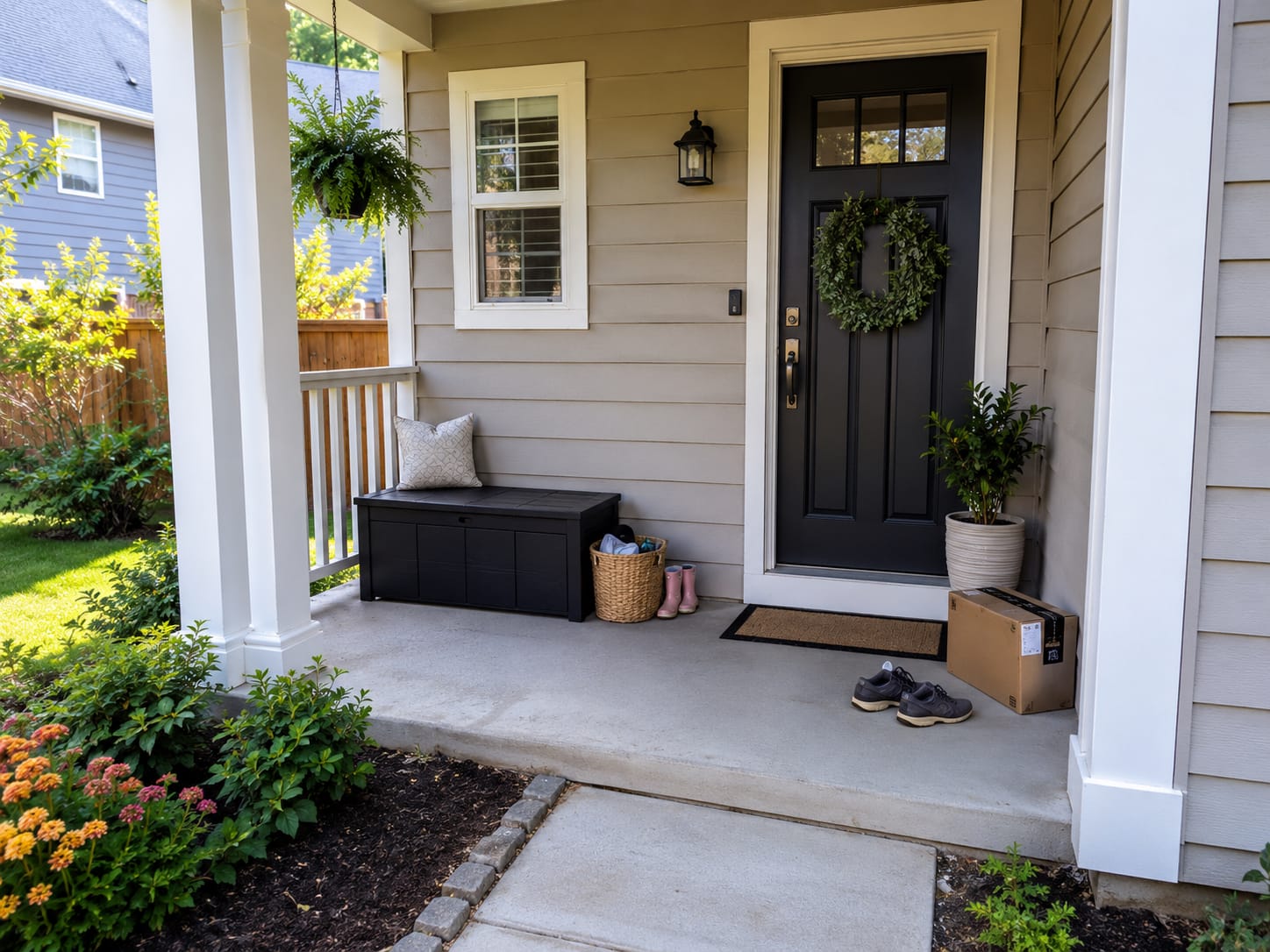
A small front porch can become cluttered surprisingly fast.
A few shoes collect near the door. Packages arrive. Outdoor cushions need somewhere to go. Dog leashes, umbrellas, garden gloves, and seasonal items slowly start competing for the same limited floor space.
The natural reaction is often to add more storage.
But on a small front porch, more storage furniture can easily become part of the problem.
A better question is:
What actually needs to stay near the front door, and what is worth using porch space to store?
Good porch storage should make the entrance easier to use—not turn it into an outdoor overflow closet.
That means choosing the smallest storage solution that solves a real daily problem, keeping the door and walking path open, and matching the storage method to the weather conditions in that particular part of the porch.
Store for convenience, not for capacity.
Table of Contents
Quick Answer: How Do You Add Storage to a Small Front Porch?
Start with the items you actually use near the entrance.
For many households, that may include:
- a few pairs of frequently used outdoor shoes;
- porch cushions;
- dog-walking gear;
- umbrellas;
- packages waiting to be brought inside;
- a small amount of gardening or porch equipment.
Then choose a storage solution based on the problem you are trying to solve.
| Storage Type | Best For | Main Advantage | Main Trade-Off |
|---|---|---|---|
| Storage bench | Seating + hidden storage | Two functions in one footprint | Needs sitting and opening space |
| Compact storage box | Cushions and outdoor items | Enclosed storage without adding seating | Can feel bulky if oversized |
| Shoe storage | Frequently used footwear | Keeps shoes organized near the door | Weather and ventilation matter |
| Wall hooks / baskets | Leashes, umbrellas, small gear | Uses vertical space | Must stay shallow near the doorway |
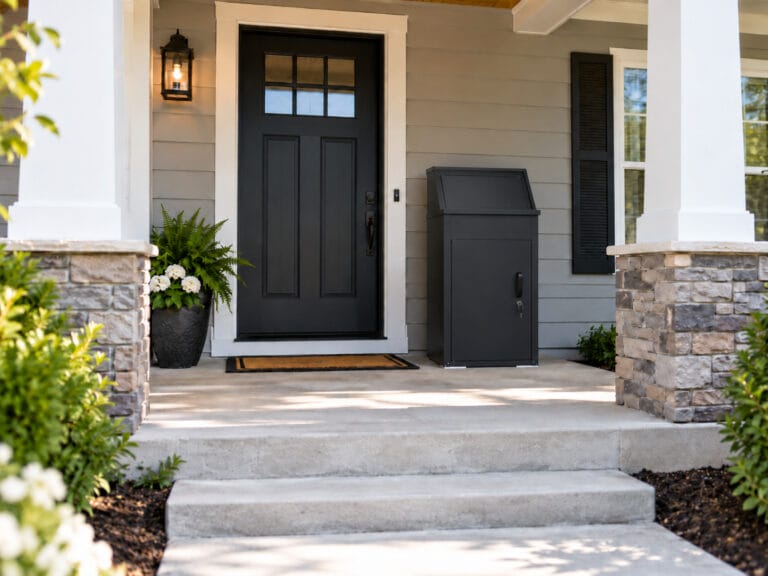
| Package box / drop zone | Frequent deliveries | Creates a defined delivery location | Should remain temporary storage |
The goal is not to use every available corner.
It is to find the smallest practical solution that makes the porch easier to live with.
For broader planning ideas before you add storage, see our small front porch ideas guide.
What Actually Belongs on a Front Porch?
Before buying a storage bench, shoe cabinet, or outdoor box, decide what deserves permanent porch space.
A front porch works best as a daily-use transition zone, not a miniature garage or long-term storage room.
An item generally makes sense on the porch when all three of these are true:
- You use it regularly near the front door.
- It can handle the conditions in that specific porch location.
- Keeping it there makes coming and going easier.
That might include gardening shoes, a dog leash, an umbrella, or cushions used on porch seating.
It probably does not include a box of decorations that has not been opened in six months.
A useful test is to ask:
Would I still keep this item here if the porch had half as much storage space?
If the answer is no, the item may belong in a garage, shed, closet, or larger outdoor storage area instead.
Good organization begins by reducing what the porch is expected to hold.
Use a Storage Bench When You Need Seating Too
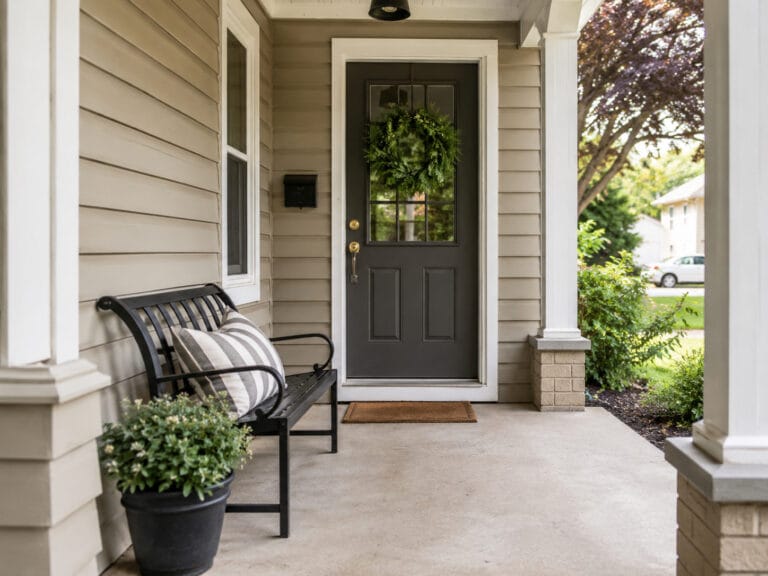
A storage bench can be one of the most efficient choices for a small porch because a single footprint provides both seating and hidden storage.
It may give you:
- a place to sit while changing shoes;
- storage for cushions or small outdoor accessories;
- a cleaner appearance than several exposed baskets or bins.
Wayfair’s current small-front-porch guidance also highlights storage furniture as a useful way to combine seating and hidden storage in limited space.
But a storage bench is not automatically the right answer.
It still needs enough room for:
- the bench itself;
- someone to sit and stand comfortably;
- the lid, doors, or drawers to operate;
- another person to use the entrance when necessary.
Always evaluate both:
closed footprint
and
in-use footprint.
A bench may fit perfectly along the wall but still be frustrating if you have to stand in the main entrance path every time you open the lid.
On a very tight porch, a smaller storage box or wall-mounted system may be more practical than forcing in a full-size bench.
Choose a Compact Storage Box When Seating Is Not Needed
If you need enclosed storage but not another seat, a compact outdoor storage box can be a better fit.
It works well for items such as:
- small gardening tools;
- porch cleaning supplies;
- lightweight cushions;
- pet accessories;
- outdoor odds and ends used regularly.
The key word is compact.
Large deck boxes are typically designed for patios, decks, and backyards where floor area is less constrained.
On a front porch, an oversized box can quickly dominate the entrance.
Before choosing one, check:
- overall width;
- total depth;
- lid-opening direction;
- whether it needs space behind it;
- where you will stand while opening it.
The best box is usually not the one with the most capacity.
It is the smallest one that comfortably stores the items you genuinely need there.
Keep Porch Shoe Storage Small and Practical
Shoes are one of the fastest ways to make a small porch feel disorganized.
But the answer is not necessarily a larger shoe rack.
Open storage offers easy access, but shoes may be exposed to:
- wind-driven rain;
- direct sun;
- dust;
- insects;
- visual clutter.
Closed storage can look cleaner and provide more protection, but it may need ventilation and extra space for doors or lids to open.
For many households, the most practical approach is to keep only frequently used outdoor footwear near the entrance, such as:
- gardening shoes;
- dog-walking shoes;
- rain boots;
- one or two everyday pairs.
Do not design porch storage around every pair of shoes the household owns.
Also remember that closed storage is not always automatically better.
Wet shoes, damp gloves, or umbrellas may need airflow or drying time before being shut inside an enclosed cabinet or box.
Make Package Storage Temporary
Package storage is different from most porch storage because deliveries are not intended to stay outside long term.
A package box or sheltered drop zone can be useful when:
- deliveries are frequent;
- the porch is exposed to rain;
- packages are highly visible from the street;
- there is unused side space that does not interfere with the entrance.
Location matters more than capacity.
A package box should not sit:
- directly in front of the door;
- at the top of the steps;
- in the main walking path;
- somewhere that forces the delivery driver to reach around furniture.
A package solution should make delivery easier.
If it creates another obstacle at the entrance, it is solving the wrong problem.
On a very small porch, a protected corner may work better than adding another large box.
Protect Outdoor Cushions From Moisture
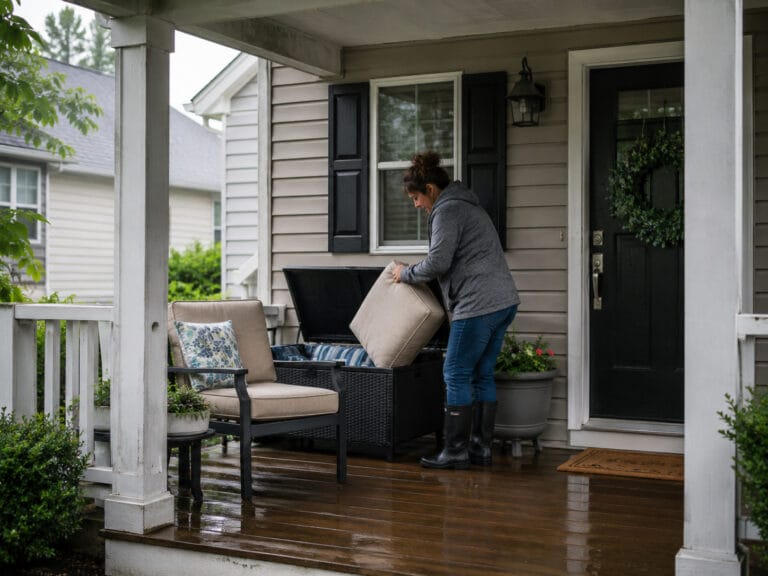
Outdoor cushions take up more storage volume than many people expect.
If they need to stay on the porch, enclosed storage is usually more practical than an open shelf or basket.
The container should be large enough that cushions can fit without being aggressively compressed, but not so oversized that the storage box becomes the biggest object on the porch.
There is another important distinction:
Roof coverage and weather protection are not the same thing.
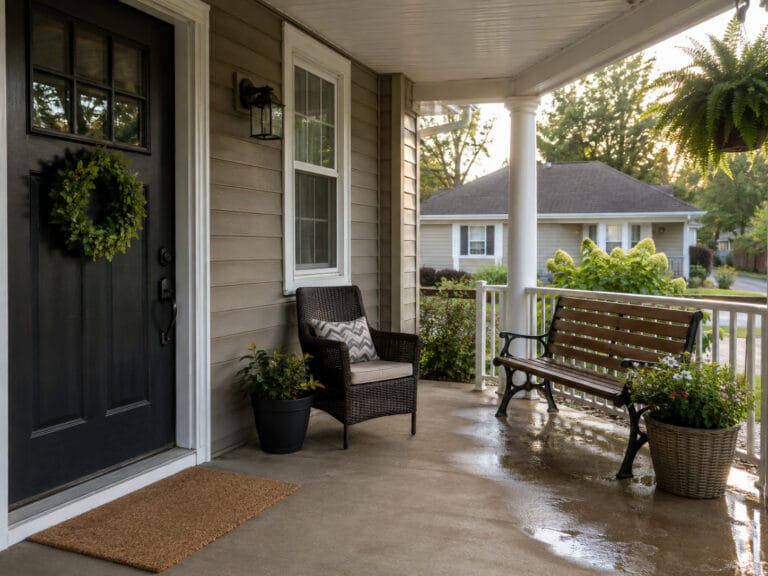
A storage bench placed against the house wall may stay relatively sheltered, while another piece under the same porch roof but near the outer railing may receive wind-driven rain, splash, direct sun, and more humidity.
So cushion storage should be selected based on the actual storage location, not simply whether the porch is described as covered.
For a deeper comparison, see our covered vs. uncovered porch furniture guide.
Use Wall-Mounted Storage to Save Floor Space
When floor space is scarce, vertical storage can be more valuable than another freestanding cabinet.
Useful options may include:
- outdoor hooks;
- narrow wall baskets;
- small weather-resistant shelves;
- leash hooks;
- umbrella hooks;
- lightweight hanging organizers.
The advantage is straightforward:
You gain organization without taking more floor space from the walking path.
But wall storage can still become an obstacle.
A deep basket mounted at shoulder height beside the door may be just as annoying as a floor-standing object.
Keep wall-mounted storage relatively shallow and avoid blocking:
- door trim;
- doorbells;
- exterior lighting;
- outlets;
- utility panels;
- vents.
Installation should also match the wall construction and the manufacturer’s mounting instructions.
Store Firewood Only Where It Makes Sense
Firewood is a conditional porch-storage item, not a default recommendation.
A small amount may make sense when:
- the home actually uses a wood-burning fireplace or stove;
- there is a separate side area available;
- the wood does not interfere with the entrance;
- local fire, pest, property, or HOA rules allow it.
A covered porch should not automatically become a firewood storage area.
If the stack fills the wall beside the entrance, crowds the walking path, traps debris, or creates maintenance concerns, a dedicated storage location elsewhere is usually more appropriate.
For HomyEntry, firewood belongs in the category of:
store it here only when the space and household actually call for it.
Match Storage to Real Weather Exposure
Two storage locations on the same porch can experience very different conditions.
One may sit close to the house wall and stay fairly sheltered.
Another may be only a few feet away near the railing and receive direct afternoon sun, blowing rain, roof runoff, splash, or wind-driven snow.
Before selecting porch storage, observe:
- where rain actually reaches;
- whether water collects on the floor;
- where strong sunlight falls;
- whether stored items need airflow;
- whether the storage piece is rated for outdoor use.
Do not assume every square foot under a porch roof offers equal protection.
For more detailed weather planning, see our guide on protecting front porch furniture from rain and weather.
What to Store Where
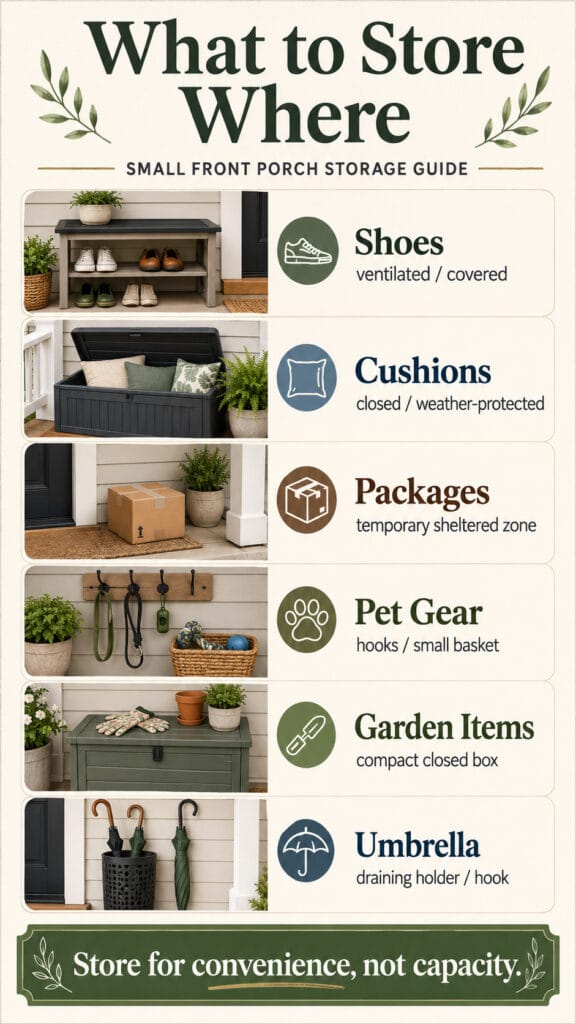
Different porch items need different levels of enclosure and weather protection.
| Item | Best Storage Approach | Open Storage? | Weather Sensitivity |
|---|---|---|---|
| Everyday outdoor shoes | Ventilated or covered shoe storage | Sometimes | Medium–High |
| Outdoor cushions | Enclosed outdoor storage | Usually no | High |
| Packages | Temporary sheltered drop zone or package box | Temporary only | Medium |
| Dog leash / pet gear | Wall hooks or small basket | Yes, if sheltered | Low–Medium |
| Garden gloves / small tools | Compact closed box | Sometimes | Medium |
| Umbrellas | Hook, stand, or draining holder | Yes | Medium |
| Seasonal decor | Closed storage elsewhere when off-season | Limited | Medium–High |
This is not an industry storage standard.
It is a practical way to compare three questions:
How often do you use the item?
How sensitive is it to weather?
Does it deserve permanent porch space?
That is the idea behind:
Store for convenience, not for capacity.
Where Front Porch Storage Should Never Go
Storage can be useful and still be placed in the wrong location.
On a small front porch, some areas should remain dedicated to the entrance itself.
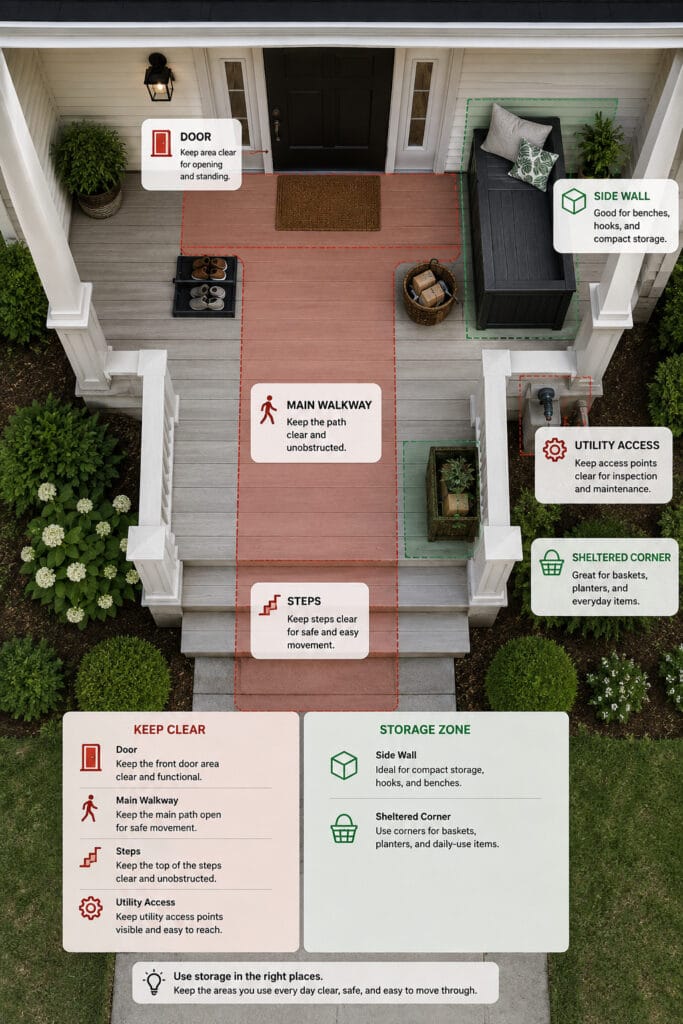
In the Door-Use Zone
Do not place storage where it interferes with:
- the main door;
- storm or screen doors;
- the handle area;
- the place where you naturally stand while unlocking the door.
A box does not have to physically hit the door to make the entrance uncomfortable.
In the Main Walking Path
People should not have to weave around a shoe rack, storage box, or bench every time they go through the front door.
If storage makes the natural route less direct, it is probably using the wrong piece of porch real estate.
At the Top of the Steps
The transition from the steps onto the porch should remain easy to use.
Large boxes, planters, shoe racks, and package containers can create awkward pinch points here.
In Front of Utility Access
Keep storage away from things that may need to be inspected, operated, or maintained, including:
- outdoor outlets;
- hose connections;
- shutoffs;
- service panels;
- vents;
- drainage points.
If you have to move a heavy storage box every time maintenance is needed, that is a strong sign the location is wrong.
The broader rule is:
Storage belongs in leftover usable space—not in space the entrance already needs.
For more detailed door, walkway, and furniture-use planning, see our front porch furniture clearance guide.
HomyEntry Small Porch Storage Fit Check
Before adding storage to a small front porch:
- List only what truly needs to stay near the front door.
- Choose open or closed storage based on weather exposure, ventilation, and visual clutter.
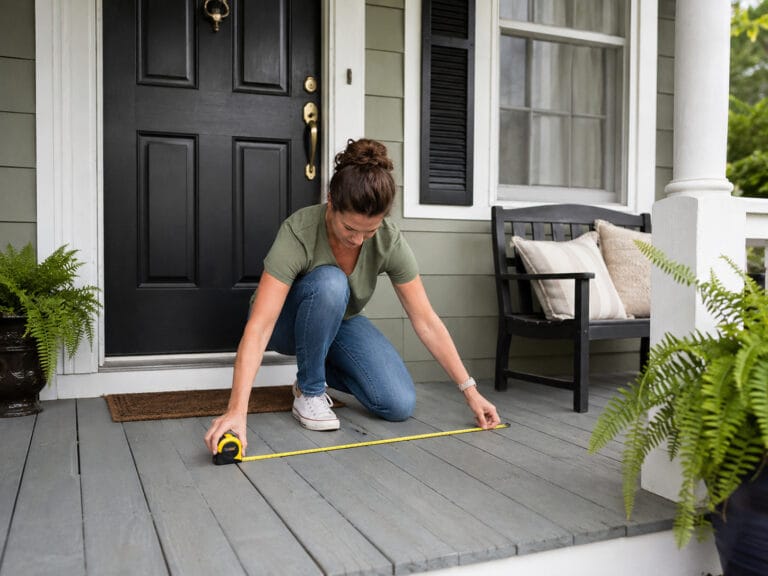
- Measure the full footprint, including depth.
- Open every relevant door fully and make sure the storage does not interfere.
- Protect the direct walking route from the steps to the entrance.
- Open lids, drawers, cabinet doors, and baskets completely.
- Test whether one person can use the storage while another person still passes comfortably.
- Remove items that belong in the garage, shed, closet, or a larger outdoor storage area instead.
A good small-porch storage plan solves a specific problem without creating a new space problem.
Frequently Asked Questions
What is the best storage for a small front porch?
There is no single best option. A storage bench works well when you also need seating, a compact storage box works for enclosed storage without another seat, and wall hooks are useful for lightweight everyday items.
Can you store shoes on a front porch?
Yes, if the porch location and storage method offer appropriate protection from rain, sun, moisture, insects, and dirt. It is usually better to keep only frequently used outdoor shoes near the door.
How should you store outdoor cushions on a porch?
If cushions need to stay on the porch, enclosed outdoor storage is usually the more practical option. Pay attention to moisture, airflow, and the actual weather exposure of the storage location.
Is a storage bench good for a small porch?
It can be very efficient because it combines seating and storage. However, its depth, sitting space, and lid or door opening area must not crowd the front door or main walking path.
Final Thoughts: Store Less, but Store It Better
A small front porch does not need to hold everything that might someday be useful outdoors.
It needs to hold the few items that make everyday entry and porch use easier.
Start by deciding what genuinely belongs near the front door.
Then choose the smallest storage solution that solves that need—whether that is a storage bench, compact box, shoe organizer, wall hooks, or a simple sheltered package area.
Most importantly, protect the spaces that storage should never take over:
the front door, the steps, the main walking path, and utility access.
Good porch storage is not about fitting more things outside.
It is about keeping the right things near the door without taking space away from the entrance.
When you are ready to compare practical storage and protection options for your entrance, Explore Porch Storage & Protection →