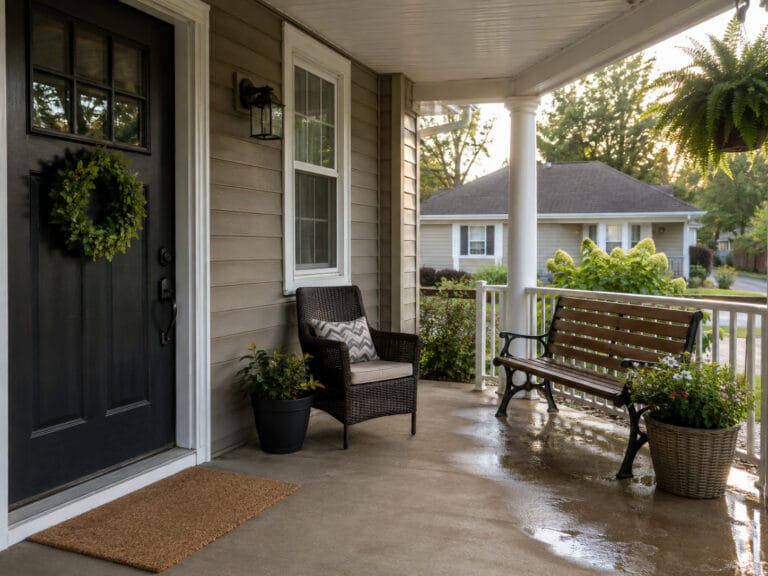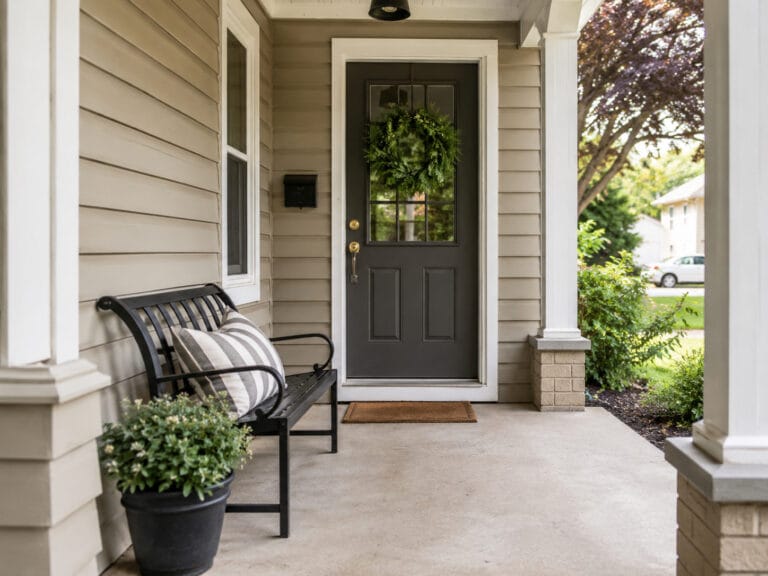
Choosing front porch furniture should start with the porch itself, not with a product page.
A chair, bench, rocker, or storage piece may fit along a wall and still make the entrance harder to use.
The reason is simple: front porch furniture has to share space with the front door, walking route, steps, packages, and everyday entry traffic.
That is what makes measuring a front porch different from measuring a patio.
A patio is often arranged around open recreational space. A front porch has another job: it still has to function as an entrance.
So before buying anything, measure the porch as a functional entry zone rather than as an empty rectangle.
Table of Contents
Quick Answer: What Should You Measure Before Buying Front Porch Furniture?
Before shopping, record these measurements and checks:
- total porch width;
- total porch depth;
- usable wall width;
- front-door movement area;
- main walking route;
- maximum practical furniture depth;
- full chair or bench footprint;
- movement space for rockers or other movable seating;
- full footprint of the seating group;
- opening space for storage lids, doors, or drawers;
- the difference between roof-covered space and the area that is actually protected from weather.
The goal is not simply to ask:
“Will this furniture fit on the porch?”
A better question is:
“Will the porch still work normally after the furniture is there?”
Measure Porch Width and Depth
Start with the basic dimensions.
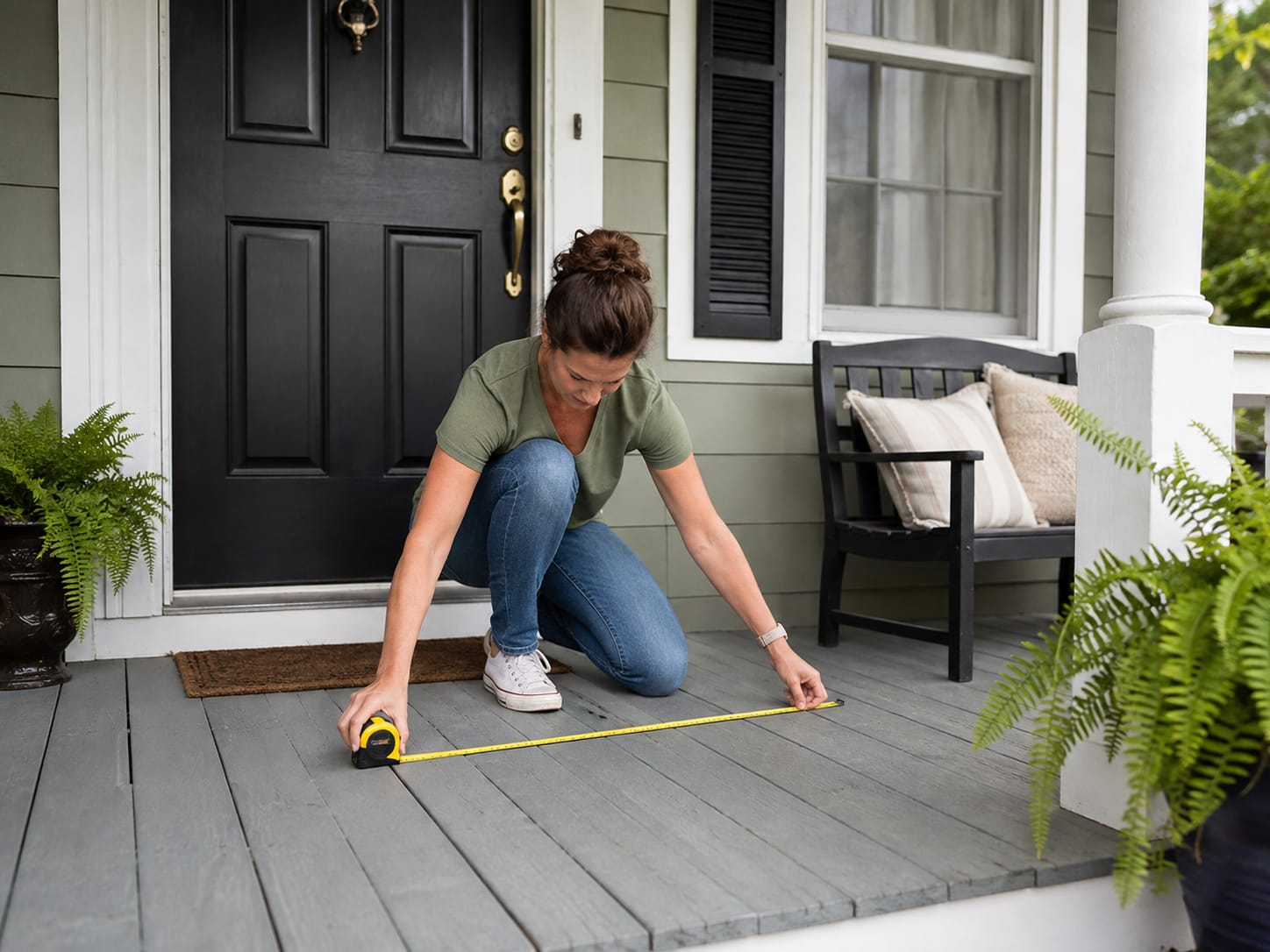
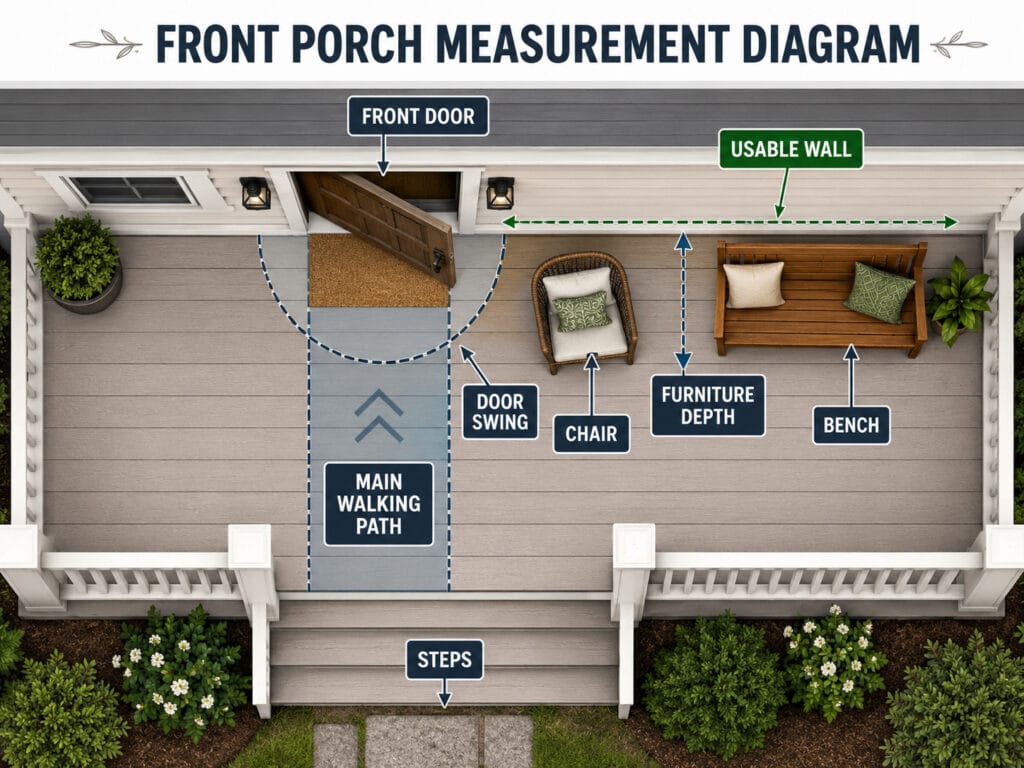
Measure the porch from side to side for the total width, then measure from the house wall or front-door area to the porch edge, railing, steps, or other fixed boundary for the total depth.
These numbers tell you the overall size of the porch, but they are only the starting point.
Do not assume the full rectangle is usable furniture space.
Part of the porch may already be occupied by:
- the front door;
- a storm or screen door;
- steps;
- railings;
- columns;
- posts;
- wall-mounted fixtures;
- planters;
- package-drop areas;
- the route people naturally use to reach the door.
The more useful question is:
How much floor area remains after the entrance still works properly?
Total Porch Size vs. Usable Furniture Area
| Measurement | What It Tells You |
|---|---|
| Total porch width | Overall side-to-side space |
| Total porch depth | Overall distance from the house to the porch edge |
| Usable wall width | Where furniture can actually sit |
| Door-use area | Space needed for the door and the person operating it |
| Main walking route | The natural route from steps or walkway to the entrance |
| Maximum furniture depth | How far furniture can project without crowding the porch |
That distinction matters more than total square footage.
For broader layout planning, see our small front porch ideas guide.
Measure the Usable Wall, Not Just the Total Wall
If you plan to place a bench, storage piece, or chair against the house, measure the actual usable wall.
Check for:
- door trim;
- siding details;
- exterior outlets;
- hose connections;
- vents;
- downspouts;
- columns;
- wall lights;
- doorbells;
- railing connections.
A wall may look long enough for a bench, but a fixed feature can reduce the practical placement area by several inches.
Also look at how the furniture meets the wall.
Some pieces can sit nearly flush, while others may project slightly farther because of trim, siding, feet, or a back panel.
On a small porch, even a small change in projection can affect the walking area.
Map the Door Swing — and the Space Around the Door
This is one of the most important parts of front porch measurement.
It is also one of the clearest differences between porch planning and ordinary patio furniture planning.
Open the front door fully and observe the complete movement area.
Check:
- which direction the door swings;
- where the door stops;
- how far the handle projects;
- where you naturally stand while unlocking or opening it;
- whether a storm or screen door also moves through the porch;
- how people move between the door and the steps.
The door arc is only part of the space you need.
The person operating the door also needs room to stand, turn, carry bags, move around packages, and pass between the porch and the interior.
A chair can sit outside the door arc and still interfere with the entrance.
Use Painter’s Tape to Mark the Door Area
You do not need to draw a perfect arc.
Use painter’s tape to roughly mark:
- the outer edge of the door movement;
- the handle area;
- the space beside the lock;
- any storm- or screen-door movement.
Then open and close the door several times.
Carry a shopping bag through the entrance.
Set down a package.
The layout should work without forcing you to shift furniture, turn sideways, or step around obstacles.
Identify the Main Walking Route
Next, identify the natural route people take from the walkway or steps to the front door.
Do not begin with an ideal line drawn on a floor plan.
Walk the route yourself several times and notice where your feet naturally go.
That real path is usually more useful than an abstract layout line.
A good front porch arrangement should not force anyone to weave around:
- chairs;
- side tables;
- planters;
- storage boxes;
- benches;
- decorative pieces.
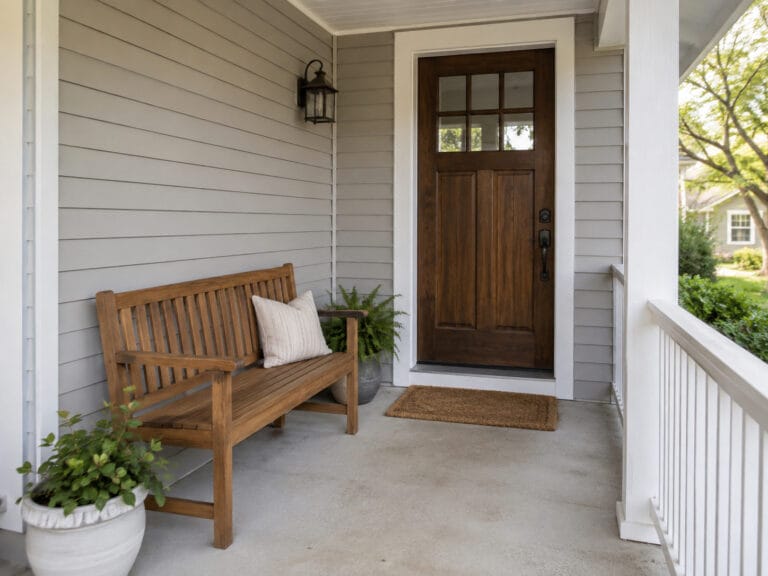
On a narrow porch, furniture often works best along one side.
On a wider porch, you may be able to separate the seating zone from the arrival route.
The principle is simple:
Protect the walking route first, then size the furniture around what remains.
For accessibility context, applicable accessible walking surfaces in U.S. Access Board standards generally use a 36-inch minimum clear width, with limited exceptions. That is not a universal furniture-clearance rule for every private porch, but it is a useful reminder that circulation deserves deliberate space.
For more detailed clearance planning, see our front porch furniture clearance guide.
Measure Furniture Depth
For a small or shallow front porch, depth is often one of the most important furniture measurements.
A piece can fit perfectly along a wall and still project too far into the porch.
A useful way to think about it is:
Width tells you whether furniture fits along the wall. Depth tells you whether the porch still works after it is there.
Chairs
For chairs, check the full front-to-back dimension.
Do not rely only on seat depth.
Overall chair depth may include:
- backrest angle;
- rear legs;
- arms;
- cushions;
- reclined or relaxed seating geometry.
Also consider the person using the chair.
Knees, feet, and the motion of standing up extend beyond the furniture’s static footprint.
A compact upright chair may work better than a deeper lounge chair even if both have similar widths.
Benches
A bench can use wall space efficiently, but depth still matters.
Check:
- total bench depth;
- how far the seat projects from the wall;
- whether someone sitting on it leaves room for another person to pass;
- whether the bench affects the door or package area.
A wall that is long enough for a bench does not automatically mean the porch is deep enough for one.
For a more focused guide, see what size bench fits a small front porch.
Rocking Chairs
Rocking chairs need extra attention because they move.
Do not judge one by its resting footprint alone.
Check whether normal rocking movement:
- approaches the wall behind the chair;
- moves into the main walking route;
- gets too close to a railing or step edge;
- interferes with another chair or table.
A rocker that fits perfectly while still may be awkward once someone actually uses it.
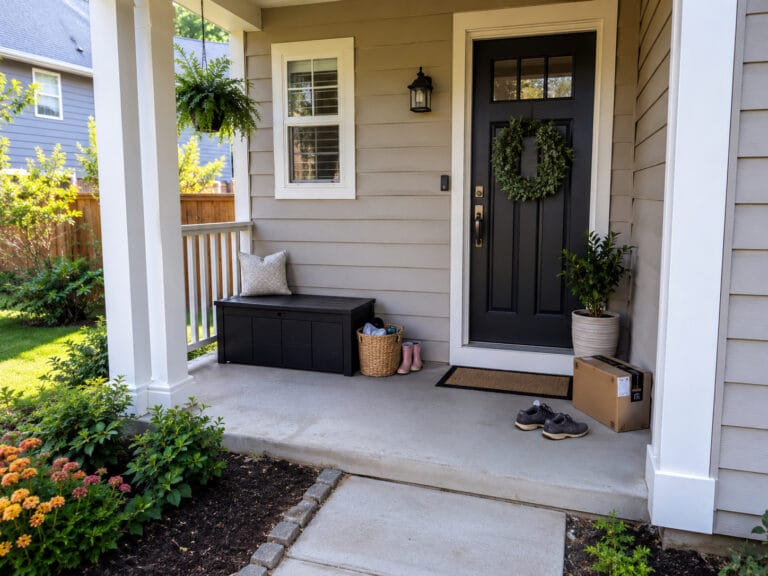
Storage Benches
A storage bench adds another layer to the measurement.
You need to check both:
- the bench itself;
- the storage opening zone.
A lid, drawer, cabinet door, or basket may require extra usable space beyond the closed furniture footprint.
Allow for Furniture Movement
Some porch furniture changes position during normal use.
That includes:
- rocking chairs;
- swivel chairs;
- recliners;
- folding chairs;
- movable side tables;
- lift-top storage;
- pull-out baskets.
For these pieces, measure two conditions:
- Static footprint
- In-use footprint
This difference matters a lot on a front porch because movement can cross into the route to the door.
Static Footprint vs. In-Use Footprint
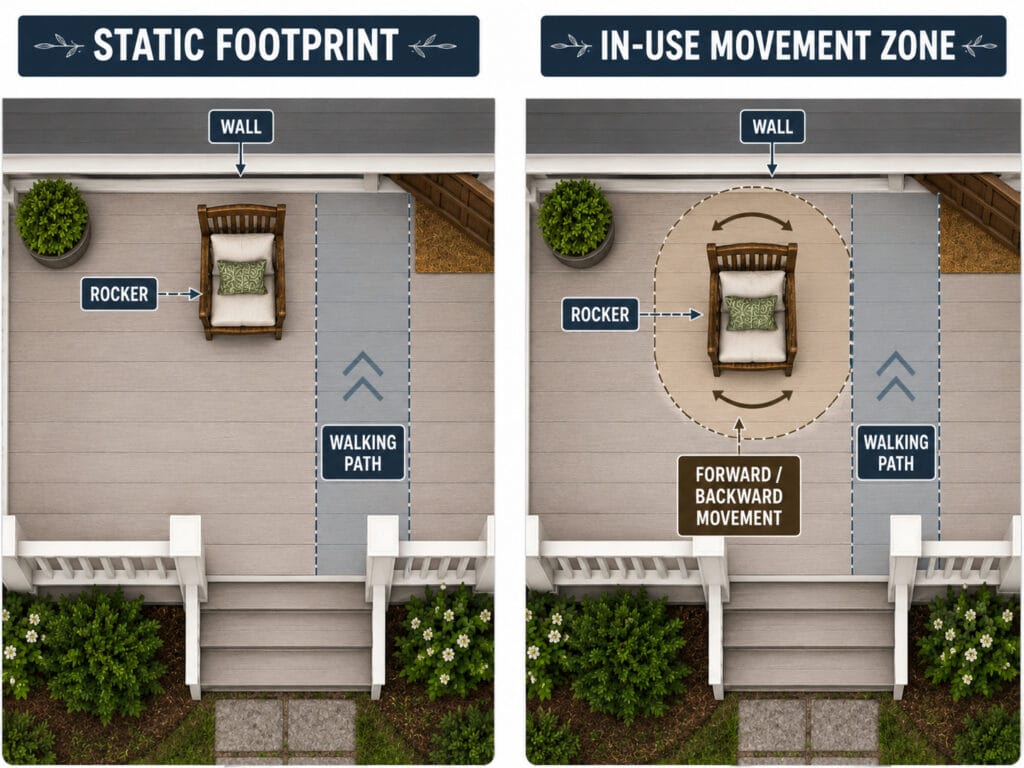
A rocking chair is the clearest example.
If you only mark the rocker while it is still, the porch may appear to have enough room.
Once the chair moves, both the furniture and the user’s body occupy a larger zone.
You do not need an engineering drawing.
Use painter’s tape to mark the resting position, then estimate the normal movement area and test whether it affects the entrance.
The goal is practical fit, not mathematical perfection.
Measure Seating Groups, Not Individual Pieces
One of the most common porch-sizing mistakes is checking every piece separately.
A chair fits.
A side table fits.
A second chair fits.
But the group does not.
Furniture fit should be tested as a layout, not as a product list.
Chair + Side Table
Treat a chair and side table as one unit.
The table needs its own footprint and should still be reachable from the chair without sitting in the main walking route.
Two Chairs
Two-chair arrangements require more than the combined chair widths.
You may also need room for:
- a gap between the chairs;
- slight angling;
- sitting down and standing up;
- a shared table;
- normal body movement.
Two compact chairs can be easier to fit than two oversized lounge chairs even if the listed widths seem similar.
Bench + Planters
A bench may fit neatly along the wall, but large planters at both ends can quietly consume the clearance you intended to preserve.
Measure the whole setup.
Do not let decorative pieces reduce the practical space without being counted.
For help choosing among different seating types, see how to choose furniture for a small front porch.
Check Furniture Openings
Storage furniture should always be measured in both closed and open positions.
A piece can fit perfectly when closed and still be frustrating to use.
| Furniture Feature | Extra Space to Check |
|---|---|
| Lift-top bench | Vertical clearance above the lid |
| Cabinet doors | Door-swing area in front or beside the unit |
| Drawers | Full extension distance |
| Pull-out baskets | Space to remove the basket completely |
| Open cubbies | Room to bend and reach inside |
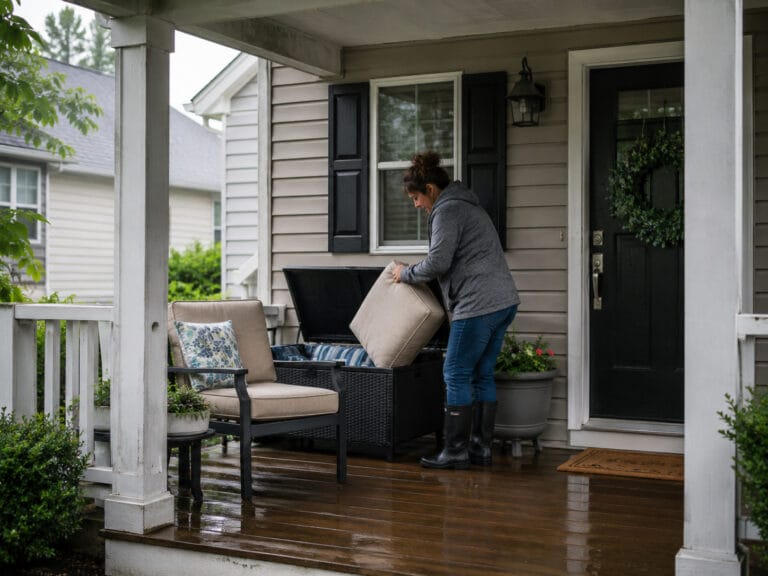
Lift-Top Storage
Check whether the lid can open fully without hitting:
- the house wall;
- railing;
- nearby decor;
- another furniture piece.
Also make sure someone can comfortably stand near the bench while opening it.
Cabinet Doors
Check how far the doors swing into the porch.
If the door opens directly into the main route, the storage may become annoying to use.
Drawers
Measure the full extension.
Then consider the person standing in front of the drawer.
The actual in-use zone is larger than the drawer itself.
Covered Space Is Not Always Protected Space
A roof makes a porch look like one defined area, but every square foot under it may not experience the same weather.
Furniture near the porch edge may still be affected by:
- wind-driven rain;
- angled sunlight;
- roof-edge dripping;
- splash near steps;
- blowing snow or moisture.
That is why it helps to distinguish between:
covered space and usable protected space.
A chair may technically sit under the roof but still get wet during storms.
A storage bench near the outside railing may be more exposed than one closer to the house wall.
When possible, observe the porch during rain and strong sun before deciding where furniture will go.
That can affect both placement and the type of furniture you choose.
For a fuller comparison, see our covered vs. uncovered porch furniture guide.
Front Porch Furniture Measurement Worksheet
You do not need a professional floor plan.
Record these measurements before comparing products:
| Measurement | Your Porch |
|---|---|
| Total porch width | ______ in |
| Total porch depth | ______ in |
| Usable wall width | ______ in |
| Door-use area checked | Yes / No |
| Main walking route checked | Yes / No |
| Maximum practical furniture depth | ______ in |
| Seating group footprint | ______ in × ______ in |
| Rocker or movement zone checked | Yes / No |
| Storage opening space checked | Yes / No |
| Weather exposure checked | Yes / No |
Keep this worksheet beside you while shopping.
It is easier to eliminate furniture that does not fit before comparing colors, materials, or styles.
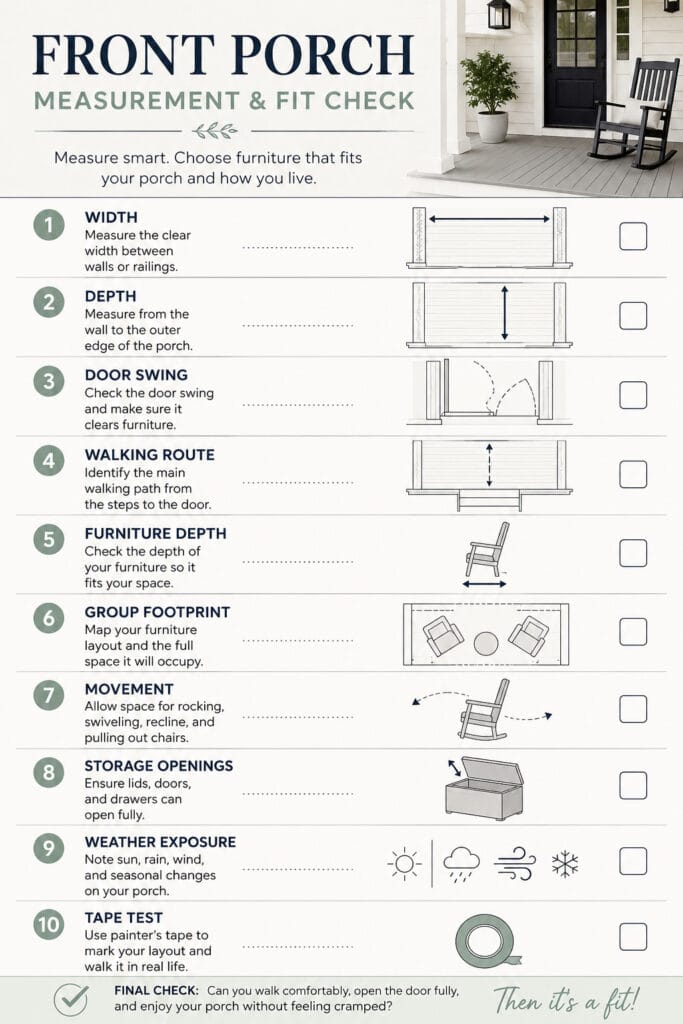
HomyEntry Porch Fit Check
Use this process before buying a chair, bench, rocker, or storage piece.
1. Measure the Porch
Record the total width and depth.
2. Mark the Usable Wall
Exclude trim, posts, outlets, fixtures, railings, and other fixed obstacles.
3. Open the Front Door
Map the door movement, handle area, and the space a person uses while entering.
4. Mark the Main Walking Route
Keep the natural path from the steps or walkway to the door clear.
5. Set a Maximum Furniture Depth
Decide how far furniture can project without making the porch difficult to use.
6. Mark the Full Furniture Group
Measure chairs, tables, benches, and planters together.
7. Test Movement
Allow space for rocking, swiveling, reclining, folding, or other normal movement.
8. Test Storage Openings
Open lids, doors, drawers, and baskets to their normal full-use position.
9. Check Weather Exposure
Notice which parts of the porch actually stay protected during rain and sun.
10. Do a Painter’s-Tape Test
Mark the complete footprint on the floor.
Then use the porch normally.
Open the door.
Carry a package.
Sit down.
Stand up.
Let someone else walk past.
If the flat taped outline already makes the porch feel crowded, the real furniture will usually feel larger.
That is the HomyEntry approach:
Measure → Fit → Buy.
Common Front Porch Measuring Mistakes
Measuring Only the Total Porch Size
The full rectangle is not all usable furniture space.
The door, steps, path, and fixed features already occupy part of it.
Ignoring Furniture Depth
A chair or bench may fit along the wall while still projecting too far into the porch.
Measuring With the Door Closed
The entrance must work while the door is open and while someone is standing near it.
Ignoring Movement
Rockers, swivel chairs, recliners, and other movable seating need more space during use than while still.
Measuring Pieces Separately
A chair, table, and planter may each fit individually but overcrowd the porch when grouped together.
Forgetting Storage Openings
Lids, doors, drawers, and baskets need their own operating space.
Assuming Covered Means Protected
Weather exposure can vary significantly across the same covered porch.
Skipping the Tape Test
Furniture dimensions are difficult to visualize accurately.
A full-size floor outline makes the true footprint much easier to judge.
Frequently Asked Questions
How Do You Measure A Front Porch For Furniture?
Measure the total porch width and depth, then account for usable wall space, the front-door movement area, main walking route, furniture depth, movement zones, and storage openings.
What Furniture Dimension Matters Most On A Small Front Porch?
Depth is often especially important because it determines how far furniture projects into the walking and door-use areas.
Do Rocking Chairs Need Extra Space On A Front Porch?
Yes. A rocking chair should be evaluated for both its resting footprint and the additional space used during normal rocking.
Should Chairs And Side Tables Be Measured Together?
Yes. Check each product’s dimensions, but measure the complete seating group because the finished arrangement uses more space than one piece alone.
How Much Walking Space Should You Leave On A Front Porch?
There is no single furniture-clearance number for every private porch; keep the main route comfortably usable while accounting for door movement, household needs, and any accessibility requirements that apply.
Final Thoughts: Measure the Porch Before Choosing the Furniture
The best time to discover that a porch chair, bench, or rocker is too large is before it arrives.
Start with the porch.
Measure the real usable wall.
Map the front door and the space around it.
Protect the natural walking route.
Then decide how much depth the furniture can use without making the entrance harder to live with.
Measure furniture in the way it will actually be used, not just the way it appears in a product photo.
That means checking:
- rocking movement;
- the entire seating group;
- storage openings;
- weather exposure.
Finally, mark the complete layout with painter’s tape and use the porch normally for a few minutes.
A good front porch layout does not simply fit furniture.
It keeps the entrance easy to use after the furniture is in place.
When you’re ready to compare seating and storage options for your space, Explore Porch Solutions →