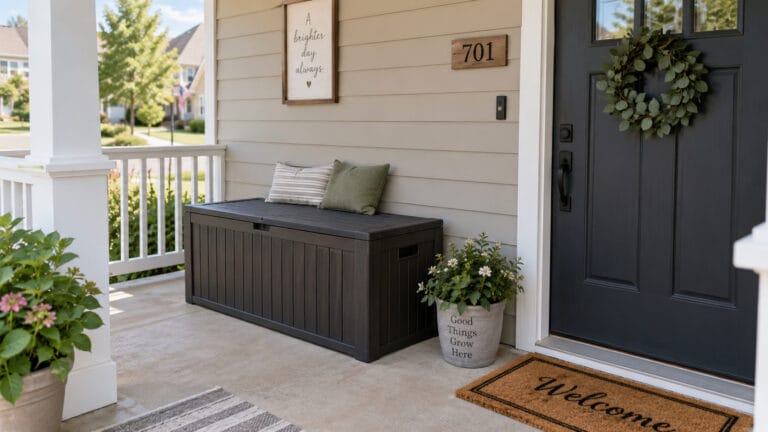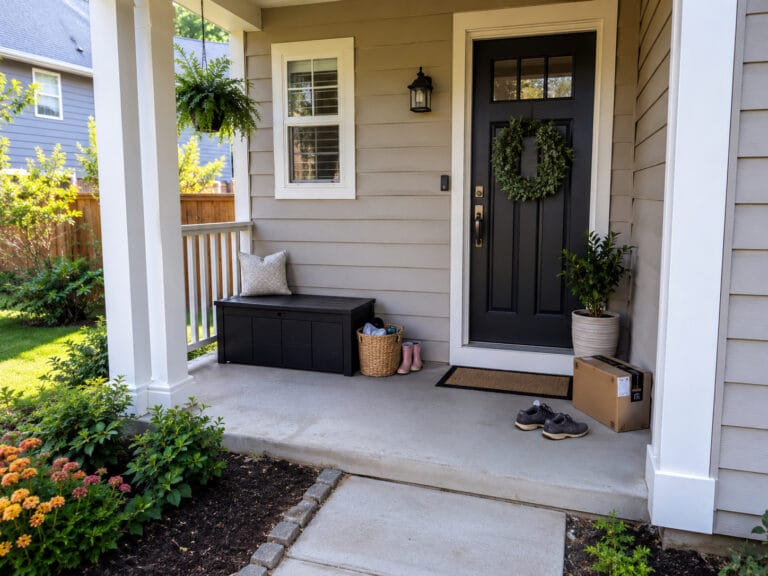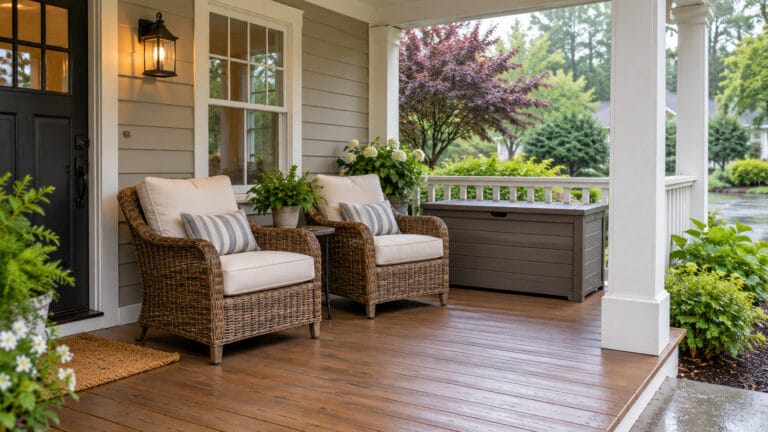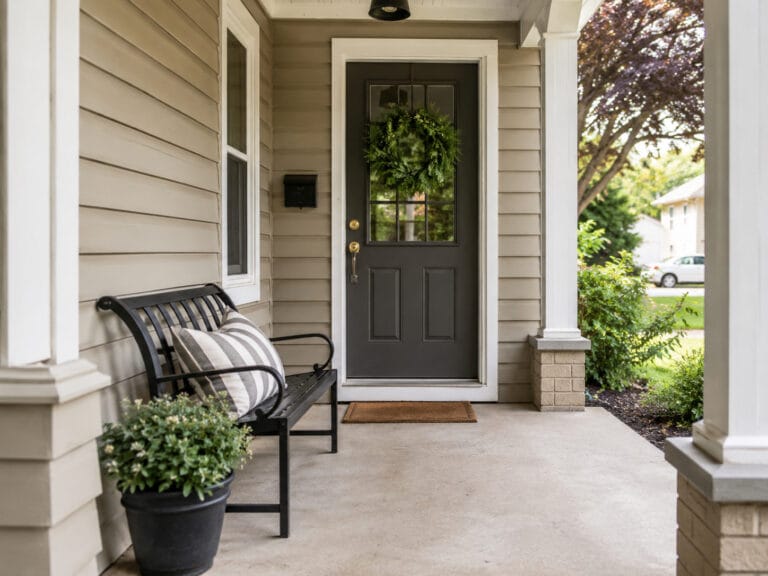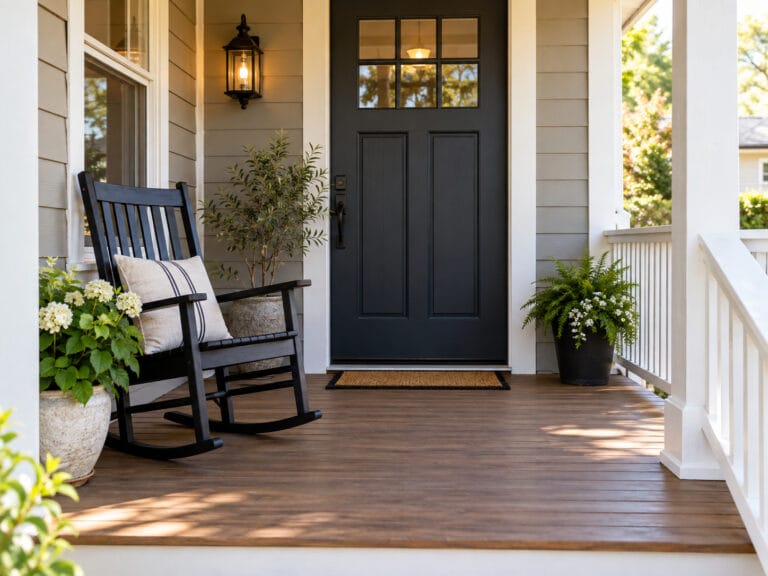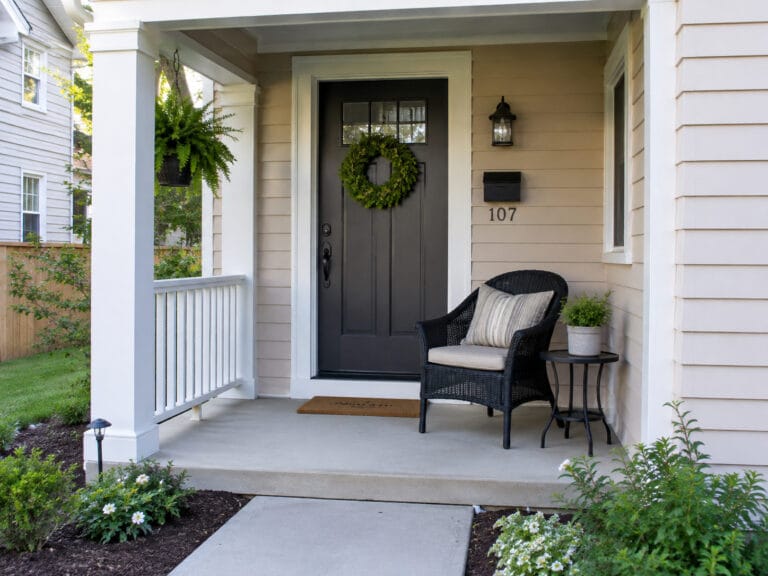
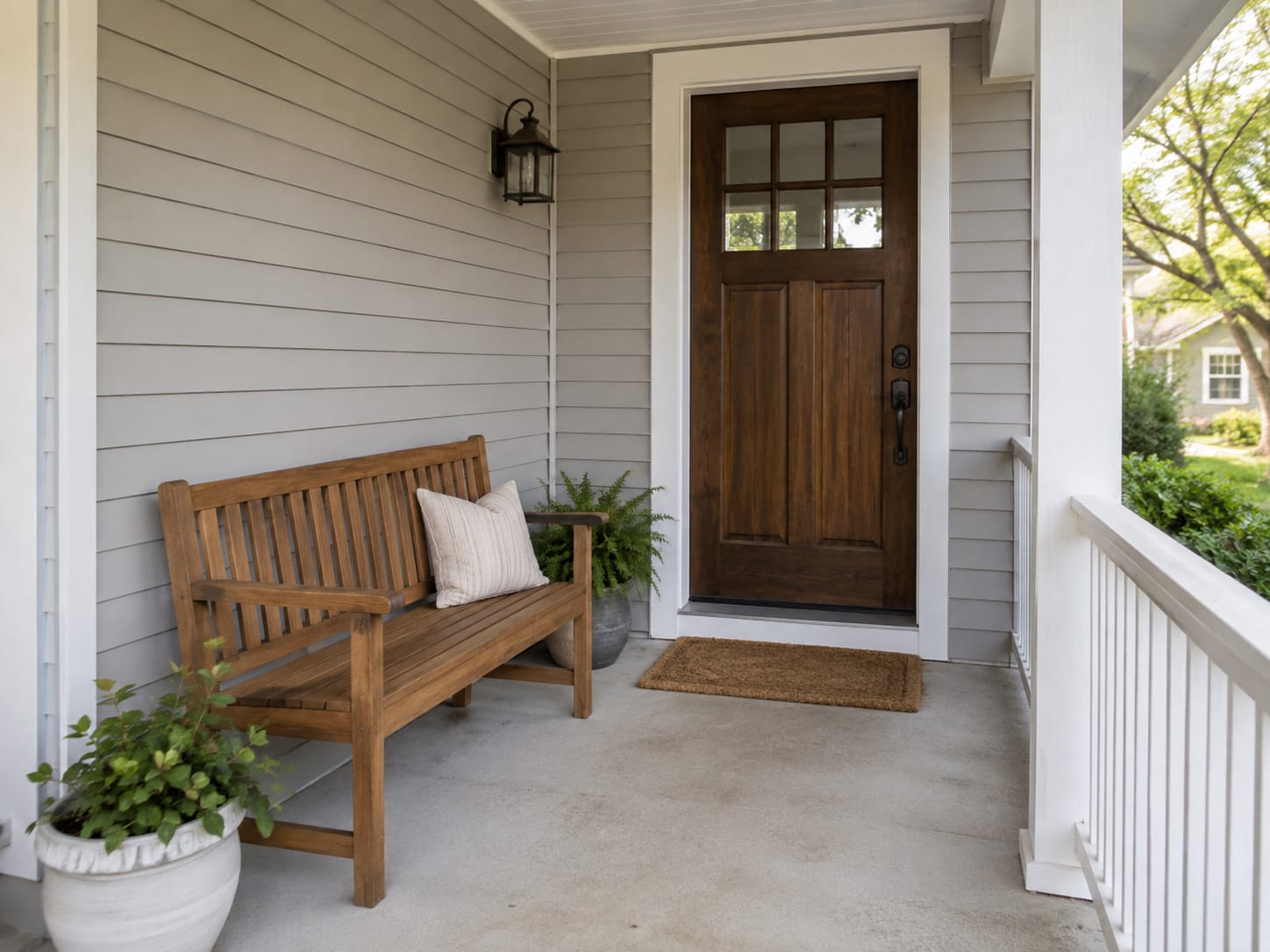
A porch bench can fit neatly against a wall and still make a small front porch feel crowded.
That is because bench width is only one part of the fit.
You also need to consider how far the bench projects into the porch, where the front door opens, where people naturally walk, and whether someone sitting on the bench will interfere with the entrance.
So instead of asking only:
“What size bench should I buy?”
ask:
“What bench footprint gives me enough seating without taking away the space my porch still needs to work?”
For most small front porches, the answer comes down to three things:
- usable wall width;
- bench depth;
- the position of the front door and main walking route.
Table of Contents
Quick Answer: What Size Bench Fits a Small Front Porch?
There is no single bench width that works for every small porch.
As a practical shopping reference:
| Bench Width | Typical Use | What to Check |
|---|---|---|
| Around 36 in. | Compact seating | Short usable walls and full bench depth |
| Around 48 in. | Common two-person size | Depth, door position and remaining walking space |
| Around 60 in. | Wider two- to three-person seating | Porch depth, doorway area and overall visual bulk |
These are shopping reference sizes, not porch-design standards.
A familiar width label does not tell you the full footprint.
Current U.S. retail examples show how much bench depth can vary. A 36-inch acacia bench sold by Home Depot is about 36″ W × 13″ D, while a 60-inch POLYWOOD bench with a back and arms is about 60.5″ W × 24.2″ D.
That difference matters a lot on a shallow porch.
The best bench is not necessarily the smallest one.
It is the one that gives you the seating you need while keeping the doorway and walking route easy to use.
Measure the Usable Wall First
Start with the wall where you want the bench to sit.
Do not measure from corner to corner and assume that the entire wall is available.
Check for anything that reduces the usable area:
- door trim;
- porch columns;
- railings;
- downspouts;
- exterior outlets;
- hose connections;
- wall lights;
- doorbells;
- siding details;
- nearby planters or fixed features.
For example, a wall may measure 60 inches overall, but the continuous space between the door trim and a porch column may be only 49 inches.
In that case, a 48-inch bench may physically fit, while a 60-inch bench clearly will not.
It is also usually better to leave some visual and practical margin instead of filling the entire wall edge to edge.
A slightly shorter bench is easier to position and often looks less crowded.
For the full porch-measuring process, see our Front Porch Furniture Size Guide.
Bench Width vs. Wall Width
Bench width tells you whether the furniture fits along the wall.
But the widest bench that fits the wall is not automatically the best choice.
Consider what happens around it.
Do you need space near the door trim?
Will a planter sit beside the bench?
Does someone stand near the lock while opening the door?
Is there a railing post at one end?
A useful rule is:
Choose enough bench width for the seating you actually need, not the maximum width the wall can hold.
A 36-inch bench may be enough for occasional seating on a compact porch.
A 48-inch bench is a common two-person shopping size.
A 60-inch bench can work when the porch has both a long usable wall and enough depth to support the larger footprint.
Bench Depth Matters More on a Shallow Porch
On a small front porch, depth is often the dimension that determines whether a bench actually works.
Width runs along the wall.
Depth projects directly into the porch.
That means a deeper bench competes with:
- the walking route;
- the front-door area;
- knees and feet when someone is seated;
- package space;
- nearby chairs or planters.
A good way to think about it is:
Bench width tells you whether it fits the wall. Bench depth tells you how much porch space it actually consumes.
And the bench does not stop taking up space at the front edge of the seat once someone sits on it.
A seated person adds a temporary in-use zone in front of the bench.
That is why a bench can look compact while empty but feel much larger during normal use.
Current products also show why width alone is misleading. A 48-inch backless acacia bench sold by Lowe’s is about 48″ W × 14″ D, while a full-back 48-inch POLYWOOD bench is around 48.5″ W × 24″ D.
The nominal width is nearly the same.
The porch footprint is not.
Two-Person vs. Three-Person Benches
Retailers commonly describe benches as two-person or three-person seating, but those labels are not standardized dimensions.
Many 48-inch benches are marketed for two people.
Many 60-inch benches are marketed for two to three people.
For a small front porch, the better order is:
fit first, seating count second.
If two people rarely sit on the porch at the same time, a compact bench may be more useful than a wider three-person model.
If two adults regularly use the bench together, a wider model may make sense—provided the porch still has enough usable depth.
Treat seating labels as a shopping clue, not as a guarantee of fit or comfort.
Storage Benches Need Opening Space
A storage bench can work well on a small porch because it combines seating and storage in one footprint.
But storage adds another measurement:
the space needed to open it.
| Storage Type | Extra Space to Check |
|---|---|
| Lift-top | Vertical clearance and sometimes rear clearance |
| Cabinet doors | Forward swing space |
| Drawers | Full extension distance |
A storage bench may fit perfectly while closed but become awkward when opened.
If the lid, doors, or drawers extend into the main walking route, the storage function may be inconvenient even though the bench itself fits.
For more complete storage planning, see our front porch storage ideas for small spaces.
Check the Front Door Before Choosing the Bench
The bench should fit around the entrance.
The entrance should not have to work around the bench.
Open the front door fully and check:
- the door movement area;
- the handle;
- where you naturally stand while unlocking it;
- whether there is a storm or screen door;
- the route from the steps to the entrance.
A bench does not have to physically touch the door to cause a problem.
If it sits too close to the lock side, the entrance may feel cramped when you are carrying groceries or handling a package.
If it projects too far toward the door, the whole entry can feel closed in.
For more detailed spacing guidance, see our front porch furniture clearance guide.
Three Porch Bench Placement Examples
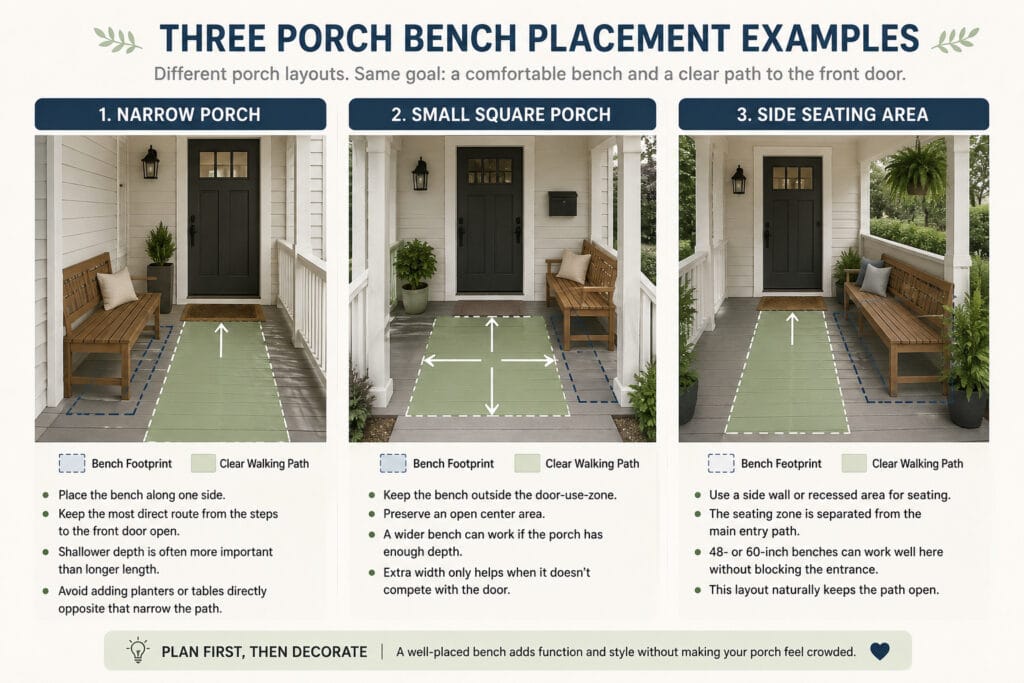
Narrow Front Porch
Place the bench along one side and keep the most direct route from the steps to the front door open.
Here, shallower is often more useful than longer.
Avoid putting a planter or side table directly opposite the bench if it narrows the path.
Small Square Porch
A compact square porch may have enough depth for a wider bench even if the total area is small.
Keep the bench outside the main door-use area and preserve an open center zone.
The extra width is useful only if the bench does not compete with the entrance.
Side Seating Area
If the porch has a separate side wall or recessed seating area, a 48- or 60-inch bench may work well because the seating zone is naturally separated from the arrival route.
This is one of the easiest layouts for using a wider bench without crowding the door.
For broader porch layout ideas, see our small front porch ideas guide.
36-, 48- and 60-Inch Bench Footprints: Why Width Is Only the Start
The easiest way to understand bench size is to compare the whole footprint, not just the width in the product title.
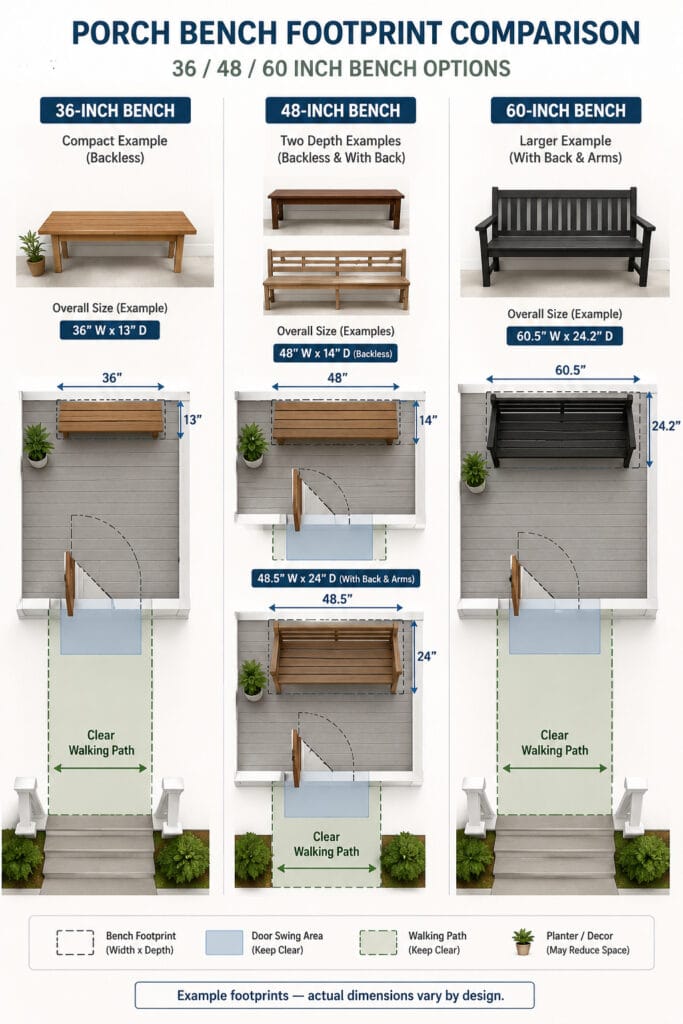
Here are a few current U.S. retail examples:
| Example | Overall Size | Design |
|---|---|---|
| 36 in. Home Depot bench | about 36″ W × 13″ D | Backless acacia |
| 48 in. Lowe’s bench | about 48″ W × 14″ D | Backless acacia |
| 48 in. POLYWOOD bench | about 48.5″ W × 24″ D | Back + arms |
| 60 in. POLYWOOD Vineyard | about 60.5″ W × 24.2″ D | Back + arms |
Source note: The product dimensions above are based on current U.S. retailer and manufacturer listings and are included as real-world examples, not as industry-standard bench sizes. See the 36-inch acacia bench at Home Depot, the 48-inch acacia bench at Lowe’s, and POLYWOOD’s 48-inch bench dimensions and Vineyard 60-inch bench. Product dimensions can vary by model and may change over time.
These examples are not industry standards.
They simply show how much depth can change even when the width label looks familiar.
A “48-inch bench” can be fairly shallow or much deeper depending on its back, arms, seat angle, and overall construction.
That is why the safest comparison is always:
Width × Depth + the space needed around the bench.
HomyEntry Porch Bench Fit Check
Before buying a porch bench, run through this bench-specific check:
- Measure the usable wall, not the full wall.
- Record the porch depth from the house to the nearest fixed boundary.
- Open the front door and mark the door-use area.
- Identify the main walking route from the steps or walkway.
- Compare the full bench width × depth, not width alone.
- Add seated-use space in front of the bench.
- Test storage openings, if the bench has a lid, doors, or drawers.
- Mark the full footprint with painter’s tape, then sit in the planned position and let someone walk past.
If the taped outline already feels crowded, choose a shorter or shallower bench.
The HomyEntry principle stays the same:
Measure → Fit → Buy.
Frequently Asked Questions
What Is A Good Bench Size For A Small Front Porch?
There is no single best size; 36-, 48- and 60-inch widths are common shopping references, but usable wall width, bench depth, and doorway position determine the fit.
Is A 48-Inch Bench Big Enough For Two People?
Many 48-inch benches are marketed for two people, but usable seating width and overall design vary by product.
How Deep Should A Porch Bench Be?
There is no single required depth; compare the complete bench depth with the porch walking route and the space needed when someone is seated.
Can A Storage Bench Work On A Small Front Porch?
Yes, if both the closed footprint and the space needed to open the storage fit without blocking the doorway or main path.
Final Thoughts: Choose the Bench That Leaves the Porch Working
The right porch bench is not the widest one that fits against the wall.
It is the one that gives you the seating you need without taking over the entrance.
Start with the usable wall width.
Then check:
- bench depth;
- the front-door area;
- the natural walking route;
- seated-use space.
A compact 36-inch bench may work well on a narrow porch.
A 48-inch bench is a common two-person option.
A 60-inch bench can work when the porch has both the wall length and the depth to support it.
But the number in the product title is only the starting point.
The real fit is the complete bench footprint plus the space your porch still needs to function.
When you are ready to compare seating options for your entrance, Explore Porch Solutions →