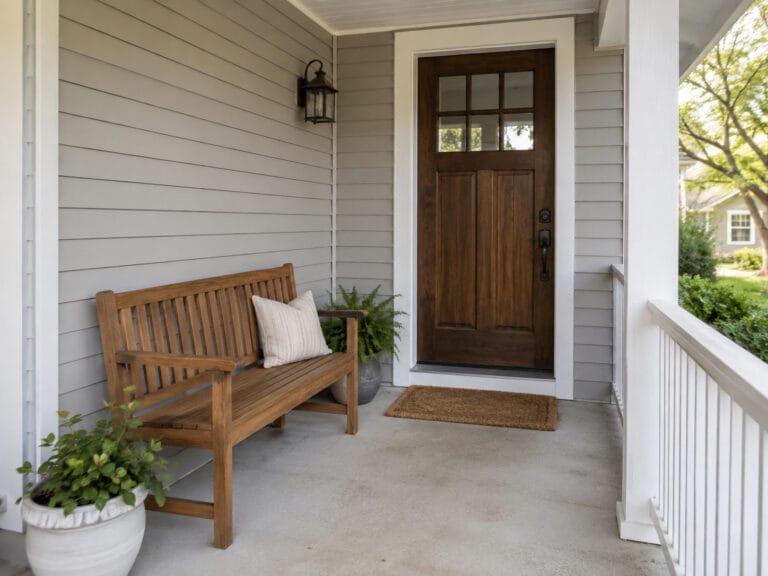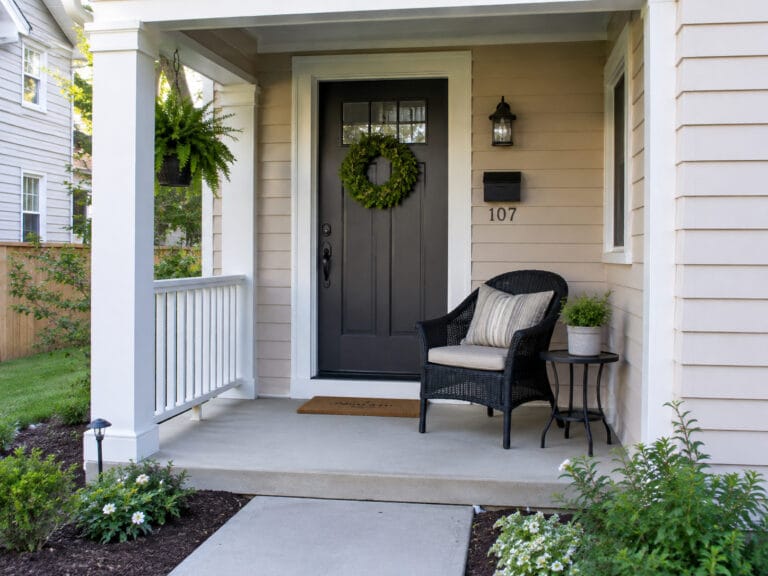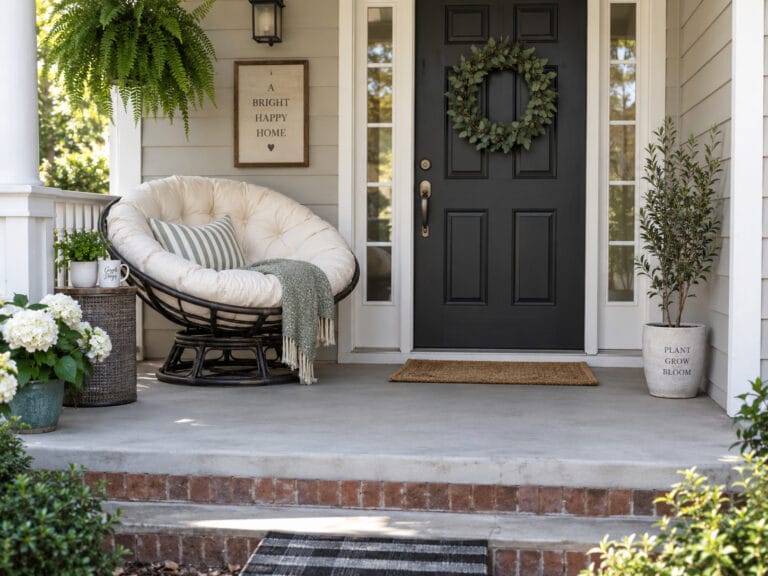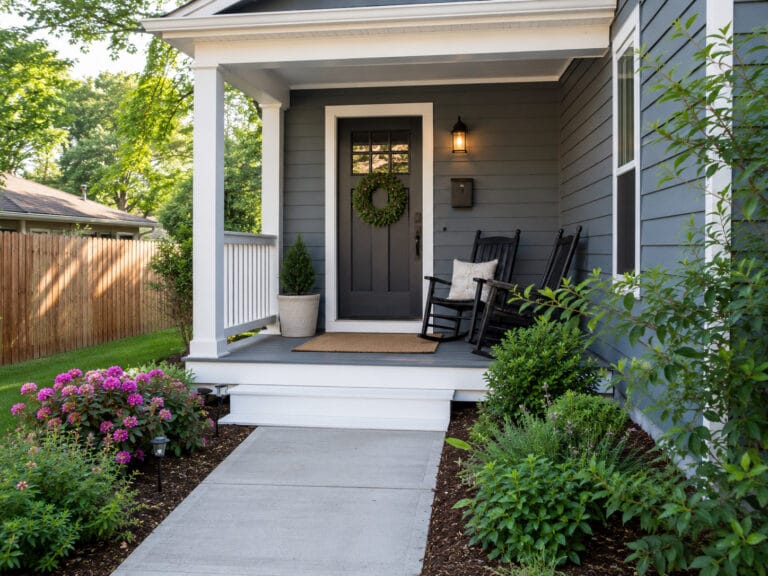
A rocking chair can fit neatly against your porch wall and still leave too little room to use it comfortably.
Unlike a stationary porch chair, a rocker needs space to move forward and backward. You also need room to sit down, stand up, open the front door, and walk past the chair without entering its rocking path.
That makes the most useful question:
How much usable porch space will remain when the rocking chair is actually in motion?
This guide covers typical outdoor rocking chair dimensions, front and back rocking clearance, walkway space, door swing, and practical layouts for small front porches.
Table of Contents
Quick Answer: How Much Space Does a Porch Rocking Chair Need?
Many traditional outdoor rocking chairs measure approximately 26–30 inches wide and 32–37 inches deep, although dimensions vary by design. These ranges are also reflected in POLYWOOD’s outdoor rocking chair buying guide. POLYWOOD
However, the chair’s listed dimensions are only the starting point.
| Space to Measure | What to Check |
|---|---|
| Overall width | Widest point, including armrests |
| Overall depth | Full length of the chair, including its curved runners |
| Rocking clearance | Extra space in front of and behind the moving chair |
| Walking path | Unobstructed space beside the chair |
| Door swing | Full opening area of the front door and any storm door |
| Side-table space | Room for a table without interfering with rocking |
As a manufacturer reference, POLYWOOD recommends approximately 2–3 feet of open space around its rocking chairs and gliders to accommodate movement and avoid collisions. This is a planning recommendation, not a universal residential building-code requirement. POLYWOOD Customer Service & Help Center
For a small front porch, always check the movement requirements of the specific chair you intend to buy.
Typical Outdoor Rocking Chair Dimensions
Outdoor rocking chairs come in several shapes, from traditional upright wooden rockers to wider, cushioned lounge designs.
Overall product dimensions help you compare models, but they do not represent the entire space needed during use.
A Real-World Size Example
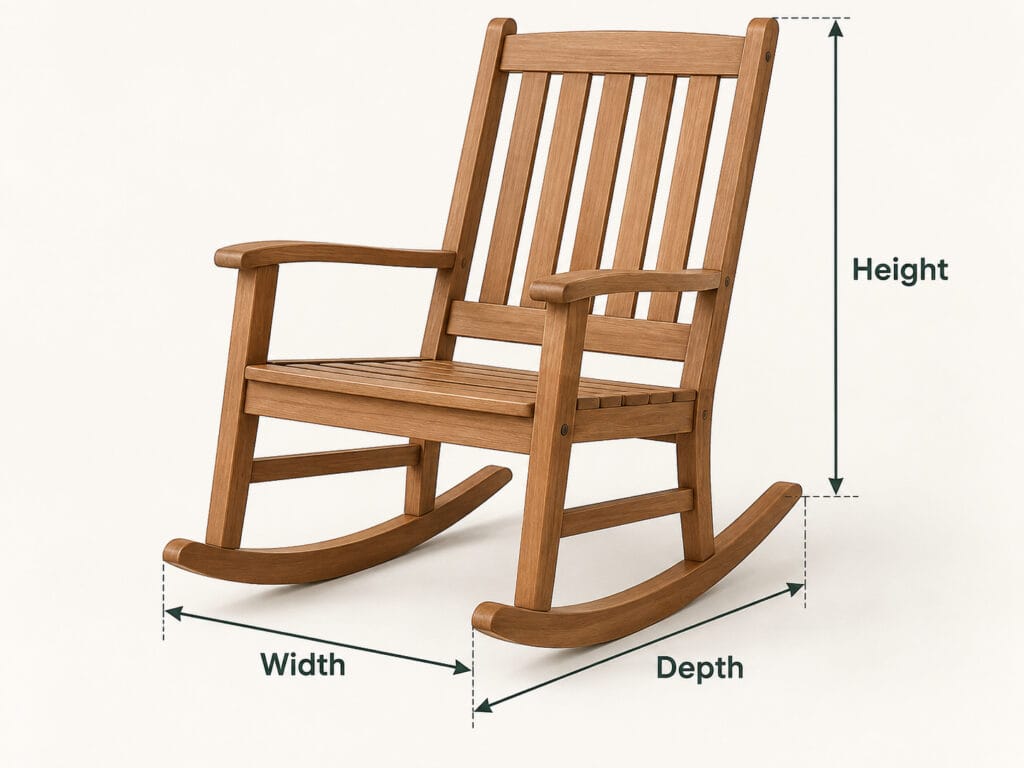
The POLYWOOD Presidential Rocking Chair has the following published dimensions:
| Measurement | Manufacturer Specification |
|---|---|
| Overall width | 26.1″ |
| Overall depth | 33.8″ |
| Overall height | 44.2″ |
| Seat height | 16.1″ |
| Seat depth | 18.6″ |
Notice the difference between the 18.6-inch seat depth and the 33.8-inch overall chair depth.
The curved runners and supporting frame extend well beyond the seating area. Measuring only the seat would underestimate how much porch space the chair occupies.
Width: Measure the Widest Point
Overall chair width includes the outer edges of the armrests and frame.
Wide armrests, outward-curving frames, and oversized cushions can all affect the space needed.
If you plan to place two rocking chairs side by side, use their overall widths rather than their seat widths.
Also account for the gap between them and any shared side table.
Depth: Include the Full Curved Runners
Depth is particularly important on a small front porch.
The chair’s backrest, seat, legs, and curved runners can create a footprint considerably deeper than the seat itself.
Before considering rocking clearance, compare the manufacturer’s overall depth with the available depth of your porch.
A chair that barely fits while stationary may not have enough room to rock.
Height and Seat Height
Overall height matters when positioning a rocker beneath a low window or near a railing. A tall backrest can also make a compact porch feel visually crowded.
Seat height affects how easily someone can sit down, stand up, and push against the floor to rock.
If several people will use the chair, check that the seat height and armrests suit them rather than selecting a model based entirely on its exterior dimensions.
Compare these measurements with our outdoor rocking chair to see whether its full footprint works for your porch.
Static Footprint vs. Functional Footprint
The most important difference between a rocking chair and a stationary porch chair is movement.
A stationary chair generally remains within its listed dimensions, although someone still needs space to sit down and stand up.
A rocker moves forward and backward. Its backrest, runners, and other parts of the frame can extend beyond their resting positions.
For planning purposes, separate two measurements.
Static Footprint
The floor area occupied by the chair while it is resting, based on its full overall dimensions.
Functional Footprint
The complete space needed for normal rocking movement, sitting down, standing up, and using the surrounding porch.
On a small porch, the functional footprint is what determines whether a rocking chair will actually work.
A chair may look perfectly positioned when empty, then bump against a wall or interfere with the walkway when someone starts rocking.
How Much Front and Back Rocking Clearance Do You Need?
There is no universal clearance measurement that applies to every rocking chair.
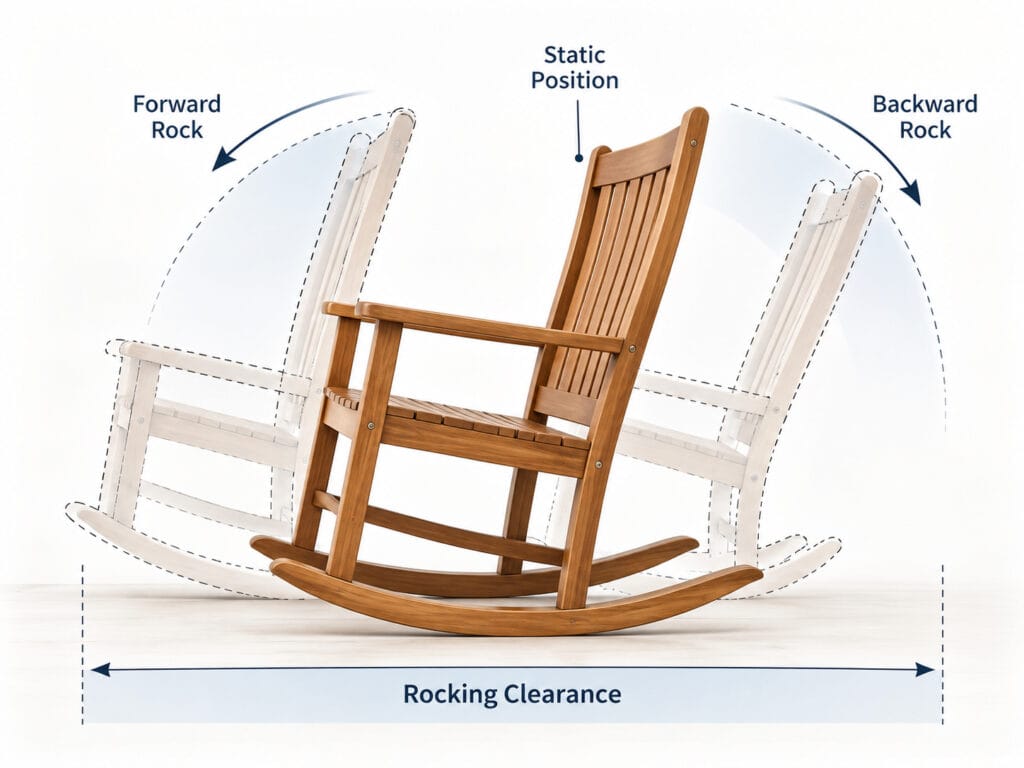
The required space depends on the curvature and length of its runners, frame design, rocking range, and how the chair is used.
For example, POLYWOOD specifies 2–3 feet of front and back clearance for its Presidential Rocking Chair. Other designs may have different requirements.
Check both directions independently.
Behind the Chair
Leave enough room between the rocker and anything its backrest or frame could strike when someone leans backward.
Common obstacles include porch walls, railings, windowsills, planters, and nearby furniture.
Do not measure the rear gap only when the chair is upright. The backrest may travel farther toward the wall as the chair rocks.
In Front of the Chair
The front rocking zone is just as important.
Avoid placing coffee tables, planters, or other furniture directly in the chair’s movement path. Keep the rocker away from steps and exposed porch edges.
On a compact porch, a small side table beside the chair is often easier to accommodate than a coffee table in front of it.
How to Measure a Rocking Chair’s Actual Movement
If you can try the chair in a showroom or already own the model, measuring its movement provides a more useful fit check than relying on static dimensions alone.
- Place the chair on a level surface and mark its resting position.
- Gently rock forward through its normal range and mark the farthest point reached by any part of the chair.
- Repeat while rocking backward, paying particular attention to the backrest.
- Measure the complete area between these marks and allow additional space to prevent contact with surrounding objects.
The full front-to-back movement envelope is your chair’s functional rocking depth.
Pay attention to the backrest as well as the runners. The top of the backrest may move toward a wall even if the runners still have room on the floor.
If you are shopping online, follow the manufacturer’s clearance guidance. Do not assume that a universal front or rear allowance will work for every model.
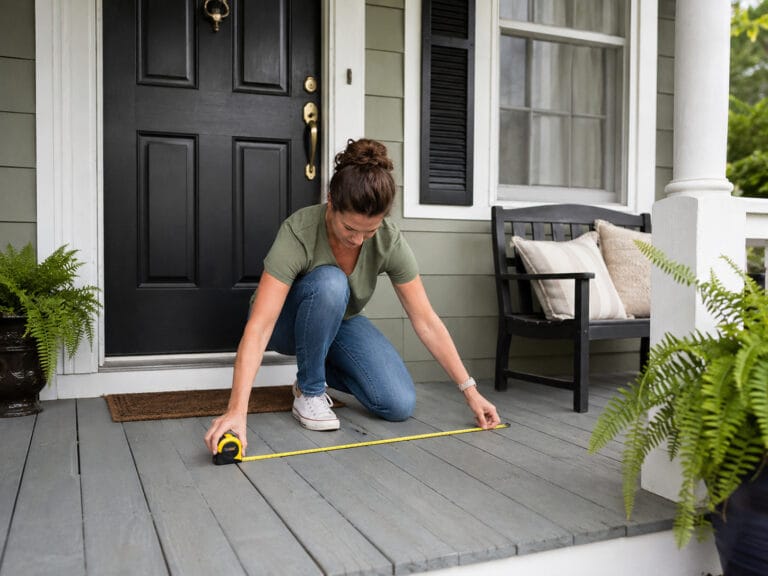
How to Measure Your Small Front Porch
Start by measuring the usable space between walls, railings, posts, steps, and other fixed features—not just the porch’s overall exterior dimensions.
For a complete measuring process, see our front porch furniture size guide.
1. Measure Available Width
Measure the usable wall or railing space where you intend to position the chair.
Compare that measurement with the chair’s overall width, including armrests.
If you plan to add a side table or second rocker, account for its width and the space needed between pieces.
A chair that fits only when tightly pressed against a post or railing may not be practical.
2. Measure Available Depth
Measure from the porch wall toward its railing or outer edge.
You need to account for the chair’s overall depth, forward and backward movement, and any nearby walking path.
Do not position a rocker so close to an exposed edge or steps that its normal movement creates a hazard.
3. Check the Front Door Swing
Open your front door fully and observe the area it travels through.
Also check any storm door or screen door. In many American homes, the main door opens inward while the storm door opens outward.
That outward-opening door may interfere with a rocking chair even if the main door does not.
The door’s full operating area should remain separate from the chair’s rocking zone.
4. Protect the Main Walking Path
Identify the route people naturally use between the porch steps and the front door.
Place the rocker outside that route wherever possible.
Someone should be able to approach the entrance without squeezing around the chair or waiting for the person sitting in it to stop rocking.
For more detailed spacing considerations, see our porch furniture clearance guide.
How Much Walking Clearance Should You Leave?
A useful starting point is to preserve a continuous walking path that does not overlap the rocking chair’s movement.
As an accessibility reference, the U.S. Access Board’s ADA Standards generally require a minimum continuous clear width of 36 inches for accessible walking surfaces, subject to specified exceptions. This is not a universal requirement for every private residential porch. “access-board.gov“
For your own porch, consider how the entrance is actually used.
Can someone walk past while carrying groceries? Is there room to handle a package? Does the front door open without forcing a visitor to step into the rocker’s movement area?
If a chair occupies the only practical route to the door, its position needs reconsideration even if the chair technically fits.
Small Front Porch Layout: Start With One Rocking Chair
On a compact front porch, plan around one rocker before adding other furniture.
Position the chair outside the main walking path and door swing. Then check the complete forward and backward movement area.
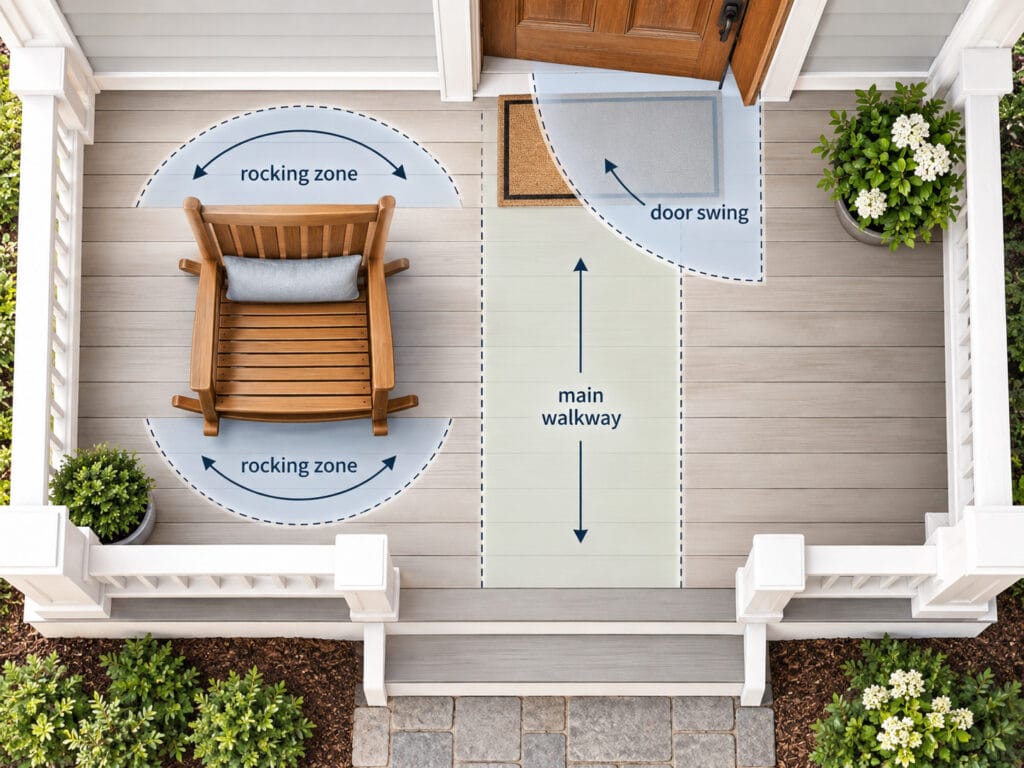
Once those requirements are satisfied, consider a small side table, planter, or other accessory.
A simple arrangement often consists of one rocker positioned along a suitable wall, a compact side table beside it, and a clear route to the entrance.
If you need to angle the chair, check that the armrests and runners do not project into the walkway.
For broader arrangement ideas, see our small front porch ideas guide.
Can Two Rocking Chairs Fit on a Small Porch?
Some compact porches can accommodate two rockers, but the combined chair width is only the beginning.
Each chair needs its own movement space, sufficient separation from the other chair, and access from the main walkway.
For example, POLYWOOD illustrates a layout with two chairs measuring 1.5 feet wide and 3 feet deep, allowing approximately 9 feet of width and 7 feet of depth for the complete arrangement. This is a manufacturer’s illustrative planning example, not a universal two-chair requirement.
Actual space needs will vary with the size and movement range of your chosen chairs.
If two rockers interfere with the entrance or each other’s movement, one chair may provide a more usable seating area.
Rocking Chair vs. Glider vs. Swivel Chair
These seating styles have different movement patterns, so their clearance requirements are not interchangeable.
| Chair Type | Movement | Main Space Concern |
|---|---|---|
| Traditional rocker | Curved forward-and-back rocking | Front and rear movement |
| Glider | Forward-and-back motion on a fixed mechanism | Full gliding travel |
| Swivel chair | Rotation around its base | Space around the rotating seat and back |
| Swivel rocker | Rotation plus rocking | Both movement zones |
| Stationary porch chair | No rocking mechanism | Seating, standing, and walking space |
A glider’s movement is generally more controlled, but that does not guarantee it will fit a smaller space. Always check the specific model’s full travel and manufacturer guidance.
A swivel chair requires clearance around its rotating frame rather than primarily in front of and behind it.
For a more detailed explanation of rotational space, see our swivel papasan chair space guide.
Test the Layout With Painter’s Tape
Before ordering, use painter’s tape to mark the rocking chair’s full dimensions on your porch floor.
Start by outlining the static footprint. Then mark the additional front and rear space required by the manufacturer’s clearance guidance or your actual movement measurements.
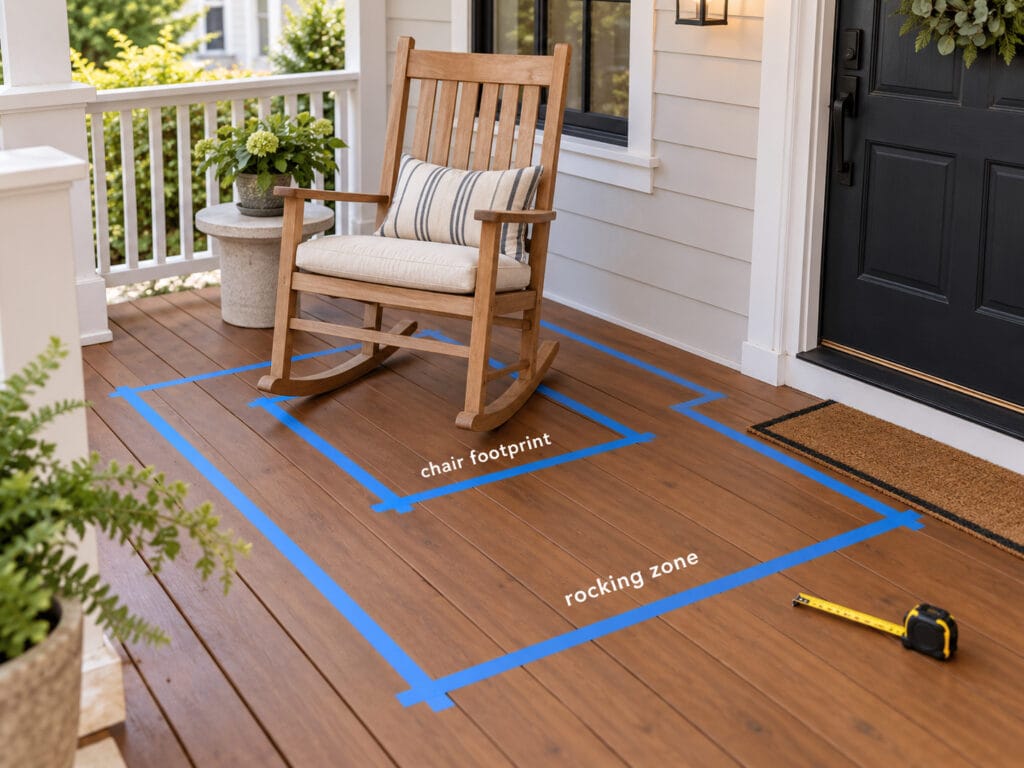
Walk through the entrance as you normally would. Open the front door and any storm door. Check whether the proposed rocking area conflicts with the walkway, railings, or nearby furniture.
Remember that tape cannot reproduce every part of a chair’s movement, particularly the backrest tilting toward a wall. Use it to identify obvious layout conflicts, not as a substitute for the manufacturer’s instructions.
Check the Porch Surface
Before placing the rocker, inspect the surface where its runners will move.
Traditional curved runners generally work best on firm, smooth, level surfaces. Uneven pavers, loose gravel, raised deck boards, or gaps can interrupt the rocking motion or affect stability.
POLYWOOD’s buying guide specifically notes that smooth, flat surfaces such as concrete and tile are better suited to curved runners than grass, sand, or uneven surfaces.
Check for loose boards, uneven transitions, or other obstacles before using the chair.
HomyEntry Rocking Chair Fit Check
Before buying, confirm these five things:
- Overall dimensions: Measure the chair’s complete width and depth, including the curved runners.
- Rocking clearance: Check the full movement area in front of and behind the chair, including the backrest.
- Door swing: Make sure the front door and any outward-opening storm door operate freely.
- Walking path: Preserve a continuous route that does not overlap the chair’s movement.
- Complete layout: Test the chair’s position before adding a side table or second rocker.
The most useful rule is simple:
Measure the space a rocking chair uses while moving, not just the space it occupies while standing still.
Common Rocking Chair Sizing Mistakes
Measuring Only the Seat
The seat width and depth do not include the entire frame.
Use the chair’s overall dimensions, including the armrests and runners.
Checking the Chair Only While Stationary
A rocker can appear to fit neatly against a wall but strike it once someone leans back.
Check the complete movement range, particularly behind the backrest.
Forgetting the Storm Door
An outward-opening storm door may collide with a chair positioned beside the entrance.
Open every relevant door fully when testing your planned layout.
Adding Too Much Furniture
A second rocker, oversized planter, or large coffee table can quickly consume the remaining functional space.
Establish the rocking zone and main walking path first. Add other furniture only after confirming that both remain usable.
Final Recommendation
A small front porch does not necessarily rule out a rocking chair, but it makes careful measuring essential.
Start with the chair’s overall width and depth, account for its actual forward and backward movement, and preserve enough room for the front door and everyday circulation.
Before purchasing, compare those measurements with the specific model you are considering rather than relying solely on general rocking chair dimensions.
A properly positioned rocker should provide a comfortable place to sit without making the entrance, walkway, or surrounding furniture difficult to use.
Explore more seating and space-saving ideas on our Front Porch page.
Frequently Asked Questions
How much space does an outdoor rocking chair need?
Many traditional outdoor rocking chairs are approximately 26–30 inches wide and 32–37 inches deep, but additional space is required for rocking and everyday access. The complete requirement depends on the specific model.
How far should a rocking chair be from a wall?
The required distance depends on its rearward rocking range. POLYWOOD recommends 2–3 feet of front and back clearance for its Presidential Rocking Chair. Other designs may have different requirements.
Can I put a rocking chair on a narrow front porch?
Possibly, provided its full footprint and rocking movement do not interfere with the doorway, main walking path, or porch edge. Test the intended position before purchasing.
How much walkway space should I leave beside a porch rocker?
Keep the entrance route separate from the chair’s movement area. Where ADA accessible-route standards apply, the general minimum continuous clear width is 36 inches, subject to specified exceptions. Requirements for individual residential properties may differ.
Can a rocking chair sit directly against a porch wall?
A rocker should not be placed where its backrest or runners could strike the wall during normal use. Check the actual movement range and follow the manufacturer’s clearance guidance.
Is a glider more space-efficient than a traditional rocker?
A glider follows a controlled forward-and-back movement, while a traditional rocker moves on curved runners. Either design may fit a compact porch, depending on its dimensions and complete movement range.
Can two rocking chairs fit on a small porch?
They can if there is enough space for both chairs to move independently while keeping the entrance and walking path open. Measure the complete layout rather than relying on the chairs’ combined widths.