A package delivery box can look large enough for your porch and still reject the packages you receive most often.
The reason is simple:
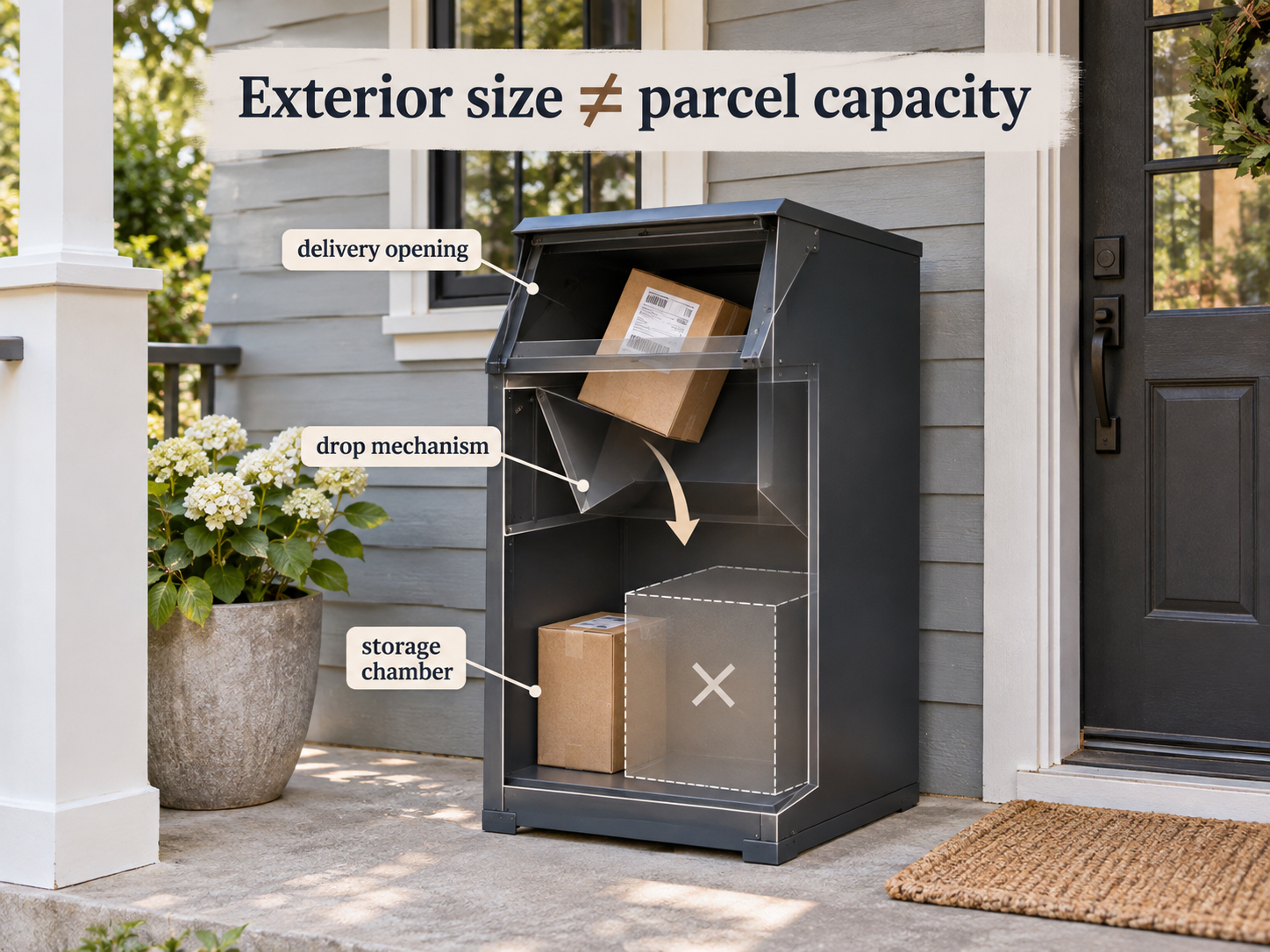
The outside dimensions of a delivery box are not the same as the size of the package it can accept.
For a parcel to work with a secure delivery box, it usually has to pass through several stages:
- the delivery opening;
- any anti-reach baffle, tray, or drop mechanism;
- the usable storage chamber;
- the retrieval opening when you take it back out.
That makes choosing a package delivery box very different from choosing an ordinary outdoor storage bin.
For most homes, the right size is not the largest box that will fit beside the front door.
It is the smallest box that accepts the packages you receive regularly while keeping the entrance easy to use.
Table of Contents
Quick Answer: What Size Package Delivery Box Do You Need?
Start with your delivery habits rather than the exterior height of the box.
| Your Typical Deliveries | What to Prioritize |
|---|---|
| Envelopes, padded mailers, and small cartons | Compact opening and small porch footprint |
| Shoe-box-size and medium parcels | Practical opening width, height, and interior depth |
| Several packages in one day | Larger usable storage chamber |
| Bulky but not oversized cartons | Maximum package dimensions, not just total capacity |
| Large household goods or long packages | Accept that some deliveries will remain outside |
A useful package box should pass three basic tests:
Opening Fit
Can your normal parcel physically enter the delivery opening?
Interior Fit
Can it pass through the internal mechanism and land inside the usable compartment?
Porch Fit
Can the box operate without interfering with your front door, walkway, steps, or delivery access?
Why Exterior Dimensions Can Be Misleading
A parcel box may be advertised as 30, 34, or 42 inches tall.
Those measurements tell you how much physical space the box occupies.
They do not tell you how large a parcel it can accept.
Inside the enclosure, usable space may be reduced by:
- a mail compartment;
- an anti-fishing baffle;
- a parcel chute;
- a drop tray;
- hinges;
- locks;
- structural panels;
- the retrieval-door frame.
A current HomyEntry example makes the distinction clear.
Our 34-inch steel parcel box has a much taller exterior enclosure, but its listed package space is approximately 13.8 × 9.8 × 9.8 inches.
So the important number for package fit is not the exterior height.
It is the parcel size the delivery path can actually accommodate.
HomyEntry Fit Check: Use exterior dimensions to judge whether the box fits your porch. Use maximum package dimensions, opening size, and usable internal space to judge whether your deliveries fit the box.
1. Think of the Box as a Package Path
The most useful way to evaluate a secure parcel box is not as a container.
Think of it as a path:
Delivery Opening → Security Mechanism → Storage Chamber → Retrieval Door
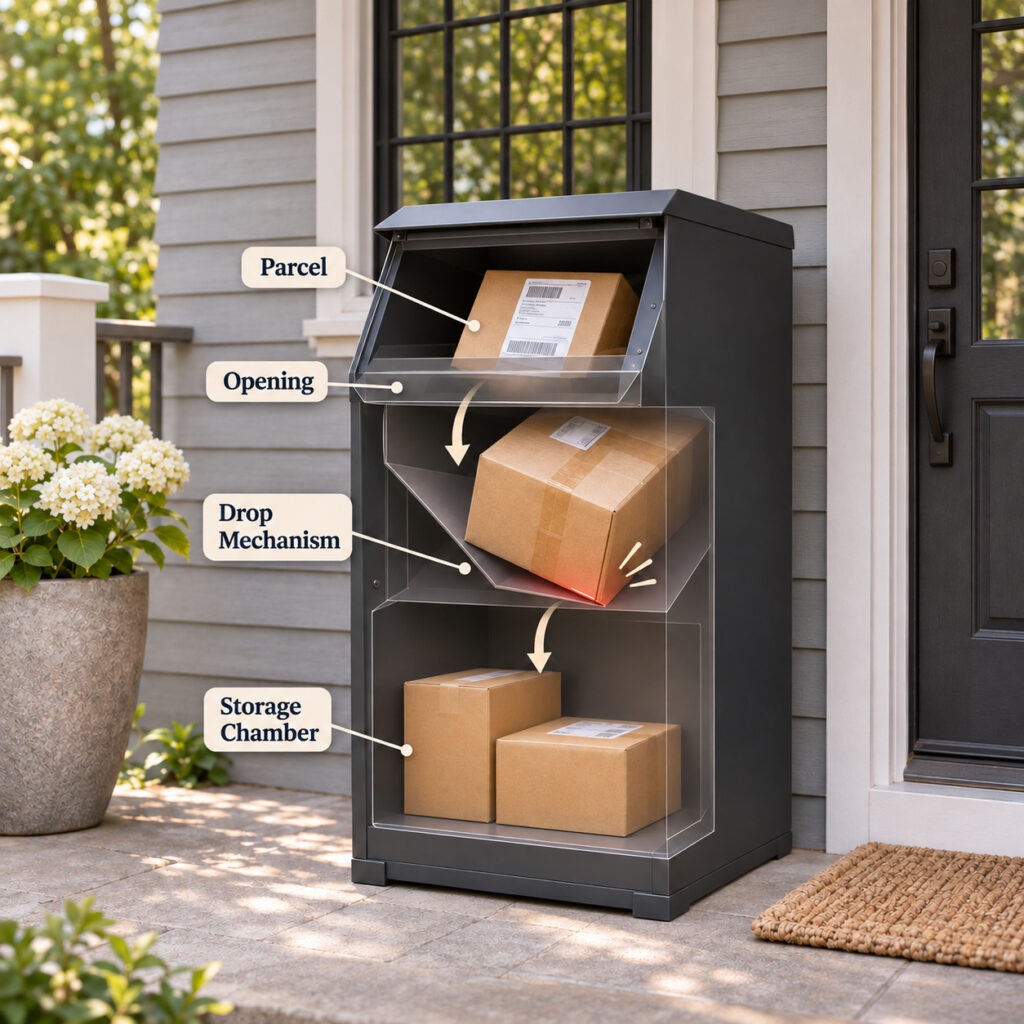
A package has to clear every stage.
That means the usable package size is effectively limited by the tightest part of the path.
This explains why a delivery box with a large lower compartment can still reject a relatively ordinary carton.
The Delivery Opening Is Only the First Check
A wide opening does not guarantee that a wide parcel will work.
The package may still be:
- too tall;
- too deep;
- too long to rotate;
- unable to clear an internal tray or baffle.
When the manufacturer provides a specification such as:
Maximum Package Size: W × D × H
that figure is generally much more useful than estimating capacity from product photos.
2. Internal Capacity Is Not the Same as Maximum Package Size
A second common mistake is assuming that a large internal compartment means the box can accept one large parcel.
It may not.
A box might have enough total volume for:
- three compact cartons;
but still reject:
- one larger carton with roughly similar overall volume.
Package shape matters.
So there are really two different capacity questions:
Maximum Single-Package Fit
What is the largest individual parcel that can pass through the complete delivery mechanism?
Multiple-Package Capacity
How much usable space remains after one or more parcels are already inside?
These are not interchangeable.
If your household regularly receives several deliveries in one day, the second question may matter just as much as the first.
3. A Real-World Example: Large Interior, Smaller Practical Opening
Independent product testing illustrates this problem well.
In a 2025 PCWorld review of the Keter Package Delivery Box, the reviewer found that the lower storage chamber had substantial space, but larger packages still could not pass through the drop mechanism.
The problem was not simply the top opening.
Long or wide cartons could contact the internal structure before dropping into the lower compartment.
That means the product’s large internal dimensions did not translate directly into equally large parcel acceptance.
This is an important lesson when comparing delivery boxes:
The largest internal dimension is not necessarily the largest usable package dimension.
If a product publishes both exterior dimensions and maximum parcel dimensions, use the parcel specification for fit decisions.
If it does not, look closely at how the drop mechanism works.
4. Use Real Carrier Boxes as Reference Points
There is no single “standard U.S. residential package size.”
Online purchases may arrive in:
- padded mailers;
- custom cartons;
- manufacturer packaging;
- carrier-supplied boxes;
- long or irregular shipping cartons.
However, real carrier packaging gives you useful reference dimensions.
USPS Priority Mail Flat Rate boxes currently include the following sizes:
| USPS Packaging Example | Inside Dimensions |
|---|---|
| Small Flat Rate Box | 8⅝ × 5⅜ × 1⅝ in |
| Medium Flat Rate Box — Top Loading | 11 × 8½ × 5½ in |
| Medium Flat Rate Box — Side Loading | 13⅝ × 11⅞ × 3⅜ in |
| Large Flat Rate Box | 12 × 11¾ × 5½ in |
These are reference cartons, not an average of U.S. home deliveries.
Their value is practical.
You can compare a manufacturer’s listed maximum package size against a real shipping-box format instead of relying on labels such as:
- Small
- Medium
- Large
- Extra Large
which can mean very different things from one product to another.
5. Your Own Packages Are a Better Benchmark
Carrier packaging is useful, but your order history is more important.
Before buying a parcel box, save a few recent shipping cartons and measure:
- length;
- width;
- height.
You do not need dozens of samples.
Pick three useful reference packages.
Small Everyday Parcel
A package you receive frequently and expect almost any parcel box to handle.
Typical Parcel
The size that best represents your normal online orders.
Large-but-Still-Routine Parcel
A larger carton that you do not receive every day but would reasonably like the box to accept.
Choose a delivery box that handles the first two comfortably.
Then decide whether accommodating the third is worth:
- a larger footprint;
- more porch space;
- potentially higher cost.
This is usually more useful than sizing the box around the largest parcel you have ever received.
6. Top-Loading vs. Front-Loading Changes the Space You Need
Two delivery boxes with similar exterior dimensions can work very differently depending on how parcels enter them.
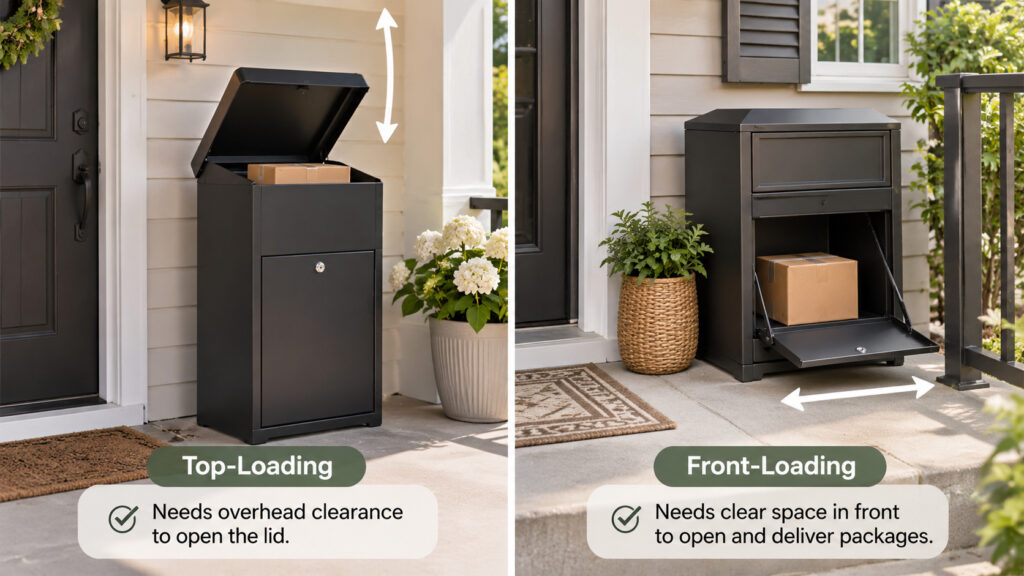
Top-Loading or Top-Drop Boxes
These typically use an upper hatch or lid that lets the courier place a parcel into a drop mechanism.
Potential advantages include:
- good use of vertical space;
- relatively compact ground footprint;
- separation between delivery access and retrieval access.
But there are two fit questions:
- Can the parcel pass through the opening?
- Can it clear the internal drop mechanism?
A large lid does not automatically mean a large carton will reach the bottom.
Top-loading boxes also need enough overhead operating clearance for the lid or hatch to open fully.
Front-Loading Boxes
A front-loading box accepts parcels through a front-facing door or hatch.
This can work well where overhead clearance is limited.
But it needs usable space directly in front of the box.
A nearby:
- planter;
- railing;
- wall corner;
- porch column;
can interfere with delivery even when the enclosure itself technically fits the location.
7. Do Not Forget Retrieval Access
Most sizing discussions focus on how the courier puts the package in.
You also need to get it back out.
A lower retrieval door may require space to:
- open fully;
- bend or kneel comfortably;
- pull a bulky carton toward you.
That means every parcel box really needs two usable access zones:
Courier delivery access + homeowner retrieval access
A box can pass the package-size test and still be inconvenient if the retrieval door opens into a railing, step, planter, or narrow walkway.
8. Front-Door Clearance: Where Size Meets Placement
A parcel box should not turn the entrance into an obstacle.
Before ordering, open the front door completely and inspect the proposed location.
Check for conflicts with:
- front-door swing;
- storm or screen doors;
- the main walking route;
- porch steps;
- railings;
- visitor standing space;
- the delivery opening;
- the retrieval door.
Also consider the courier’s position while holding a parcel.
A box may look unobtrusive when nobody is using it, but delivery requires room to approach and operate it.
If your main question is where the box should go rather than what size it should be, see our guide Where Should You Put a Package Delivery Box on a Front Porch?
9. Operating Clearance Matters as Much as Footprint
This distinction is especially useful on small porches.
Exterior Footprint
The physical area occupied by the delivery box.
Operating Clearance
The extra space required to actually use:
- the top hatch;
- front delivery door;
- lower retrieval panel.
For example, a top-opening box may physically fit beneath a window sill or shelf but still fail the fit test because the lid cannot open completely.
Similarly, a front-loading model may fit beside a railing but leave too little room to operate the hatch.
Footprint tells you where the box can sit. Operating clearance tells you whether it can work there.
10. What If You Receive Several Packages in One Day?
This is where usable interior shape becomes more important.
Ask:
What happens after the first package is already inside?
A parcel may occupy space needed by the next drop.
This matters particularly with:
- narrow storage chambers;
- multiple medium cartons;
- drop mechanisms that need a clear landing area.
Do not assume that a box advertised with a large total capacity can accept several deliveries in any combination.
A tall, narrow chamber and a shorter, wider chamber can behave very differently even when their total volumes are similar.
If multiple deliveries are common at your home, consider:
- the storage chamber’s shape;
- how parcels land;
- whether the first parcel can obstruct later drops.
11. Oversized Package Reality
No practical residential delivery box will accept every parcel that a carrier can deliver.
That is normal.
UPS currently allows many small-package shipments up to 108 inches long and 150 pounds, subject to service-specific limits.
FedEx Home Delivery similarly accepts packages up to 108 inches long and 150 pounds, with additional length-plus-girth limits.
A porch delivery box is not designed to match carrier maximums.
Its job is to protect a useful portion of your normal deliveries.
Items such as:
- furniture;
- long household products;
- bulk multipacks;
- large electronics;
- oversized manufacturer cartons;
may still need to remain outside the box.
So the goal should not be:
“Will every possible package fit?”
A better question is:
“Will the packages I receive most often fit?”
12. Wall-Mounted vs. Freestanding Boxes
Installation style can also affect the size that works best.
Wall-Mounted Parcel Boxes
These can be useful when floor space is very limited.
Check:
- mounting height;
- wall construction;
- delivery-door height;
- retrieval access;
- how far the box projects into the entry path.
Once installed, a wall-mounted box is also less flexible if you later discover the location is awkward.
Freestanding or Floor-Mounted Boxes
These give you more flexibility in positioning and often allow larger storage compartments.
But they permanently use porch floor space.
For any box that requires anchoring, follow the manufacturer’s installation instructions and use the mounting method designed for that product and surface.
13. Do a Cardboard-Box Test Before You Buy
You can test package fit before ordering the parcel box.
Find a cardboard carton close to the manufacturer’s listed maximum package size.
Then ask:
Would this actually cover a useful portion of my everyday deliveries?
If most of your regular packages are clearly larger, the delivery box may be too small regardless of how large its exterior looks.
Add a Painter’s-Tape Porch Test
Mark the delivery box’s exterior footprint on your porch with painter’s tape.
Then use the entrance normally:
- open the front door fully;
- walk through the main path;
- stand where a courier would stand;
- simulate opening the delivery hatch;
- simulate opening the retrieval door;
- imagine pulling a carton out of the box.
This separates two different questions:
Will my packages fit the box?
and
Will the box fit my porch?
A good purchase needs both answers to be yes.
HomyEntry Package Box Fit Check
Before choosing a size, check these six things.
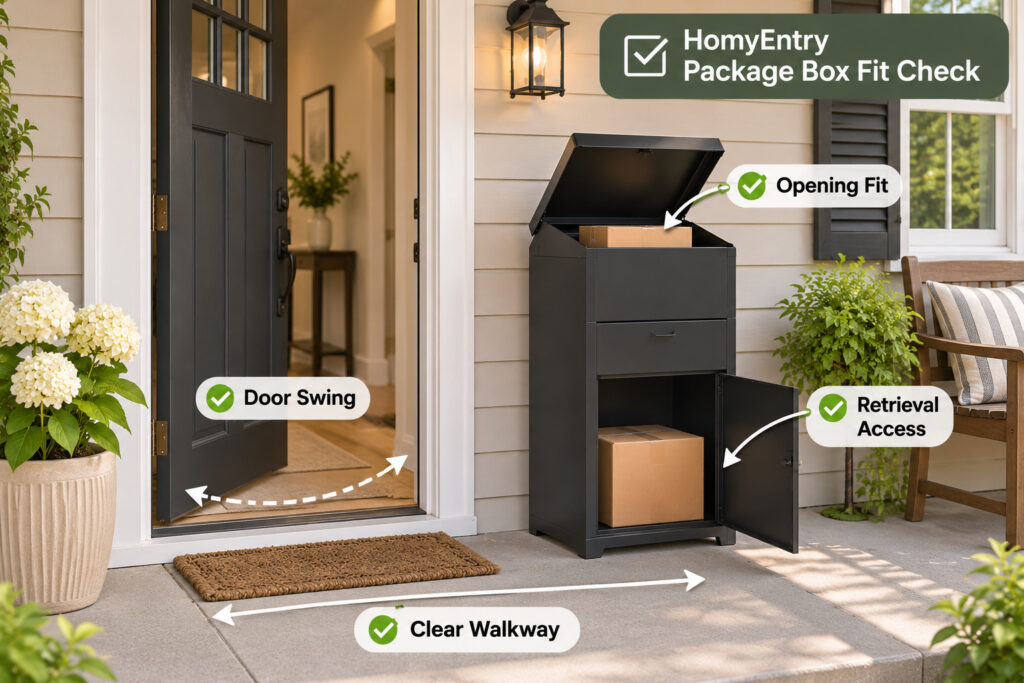
1. Delivery Opening
Can your typical parcel physically enter the box?
2. Maximum Package Size
Does the manufacturer specify the largest parcel the mechanism can accept?
When available, use this figure instead of guessing from exterior dimensions.
3. Usable Interior Space
Is there enough space for the number and shape of packages you normally receive between retrievals?
4. Loading Style
For a top hatch, is there enough overhead clearance?
For a front hatch, is there enough working room in front?
5. Retrieval Access
Can you open the secured compartment and remove a bulky parcel comfortably?
6. Porch Clearance
Can the front door, screen or storm door, and primary walking path still function normally?
If all six checks work, the box is much more likely to fit both your deliveries and your entrance.
Common Package Delivery Box Sizing Mistakes
Choosing by Exterior Height
A tall parcel box can still have a relatively small usable delivery path.
Looking at Capacity but Ignoring the Opening
Interior space does not help if the parcel cannot get through the delivery mechanism.
Sizing for the Largest Package You Have Ever Received
That can lead to a box that is unnecessarily large for a small porch.
Size for your normal delivery pattern instead.
Forgetting Multiple Deliveries
A box that accepts one medium carton may have much less room for the next delivery.
Ignoring Operating Clearance
The enclosure may fit beside the front door while the lid, hatch, or retrieval door does not.
Expecting Every Online Order to Fit
Some oversized parcels will remain outside regardless of which residential box you choose.
That does not necessarily mean you chose the wrong size.
Final Recommendation
Choose a package delivery box from the inside out, not from the outside in.
Use this order:
Typical parcel → delivery path → usable interior space → loading style → porch footprint
For most households, the goal is not maximum capacity.
It is to accept the packages you receive most often while keeping the front entrance easy to use.
If you mostly receive small and medium cartons, a compact parcel box may be enough.
If you frequently receive several deliveries or larger routine orders, prioritize:
- a practical maximum package size;
- an unobstructed delivery path;
- usable interior capacity.
And if oversized deliveries are common, accept that a residential parcel box will still cover only part of your delivery mix.
Once you know what size and loading style fit your home, browse our Package Storage options to compare parcel-box dimensions, locking designs, and installation types.
Frequently Asked Questions
What size package delivery box should I buy?
Choose a box based on the parcels you receive most often. Compare the maximum package size, delivery opening, internal mechanism, usable storage compartment, and porch footprint rather than exterior height alone.
Is the outside size of a package box the same as the package size it can accept?
No. Drop mechanisms, baffles, mail compartments, hinges, and structural panels can reduce the size of the parcel that actually passes through the box.
Is a larger package delivery box always better?
No. A larger enclosure may hold more packages but also uses more porch space. The best size balances parcel fit with door, walkway, delivery, and retrieval clearance.
Can a package delivery box hold multiple packages?
Many can, but practical capacity depends on parcel dimensions and the shape of the storage chamber. A large first delivery may reduce or block space for later packages.
Is top-loading or front-loading better?
Neither is universally better. Top-loading boxes require overhead opening clearance, while front-loading boxes need usable space in front of the hatch.
Will a package delivery box hold oversized deliveries?
Not all of them. Residential parcel boxes are intended for practical everyday deliveries, while UPS, FedEx, and other carriers can transport packages much larger than a typical porch box.