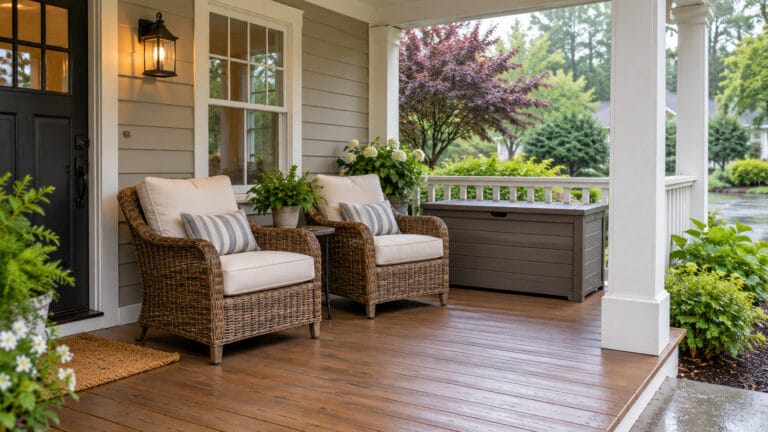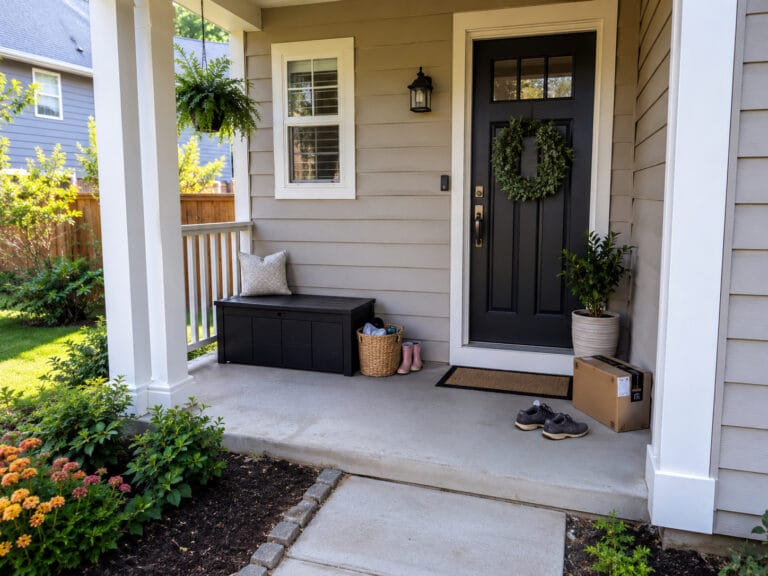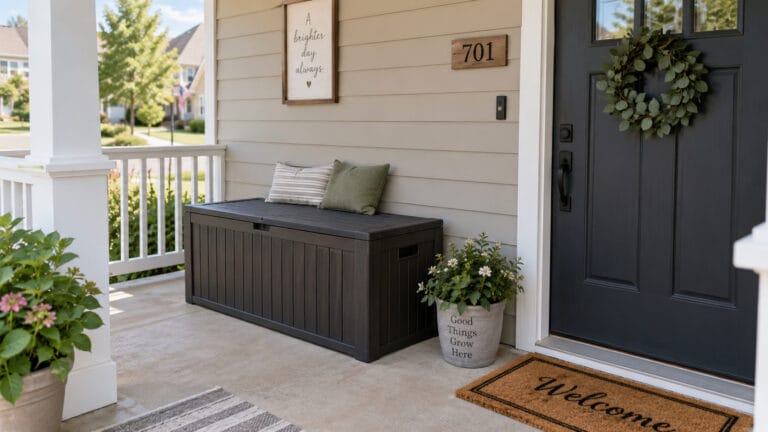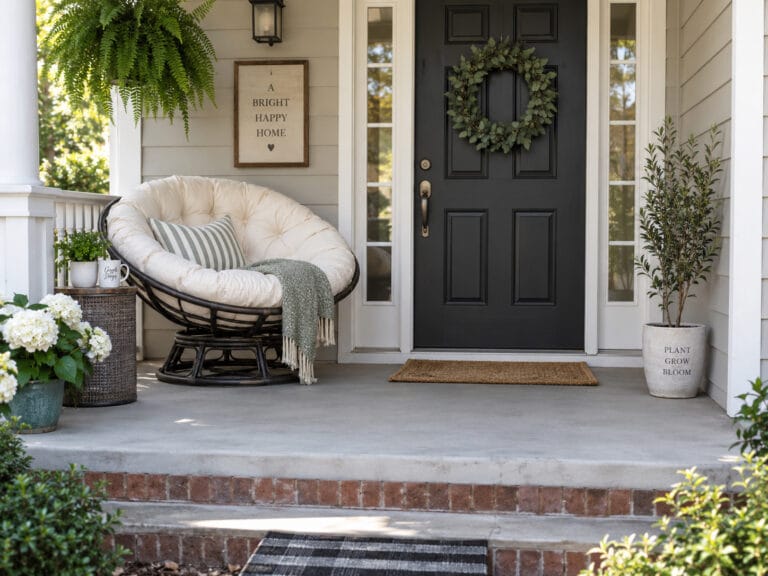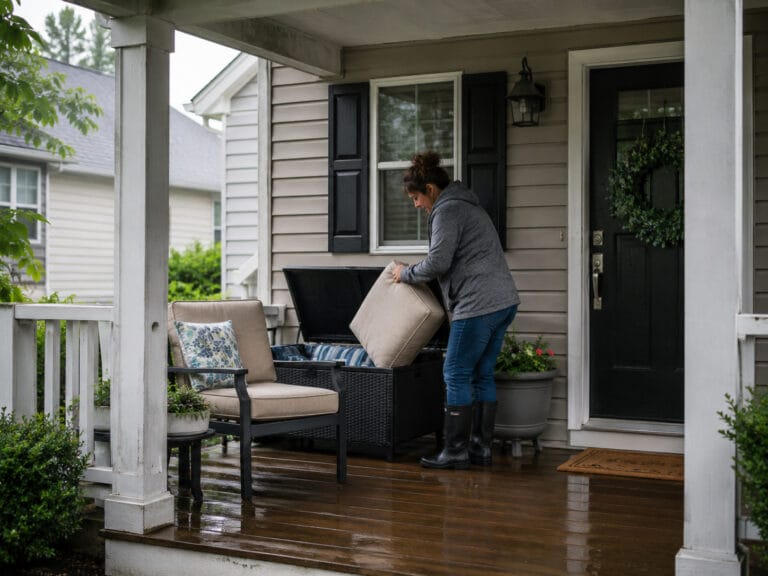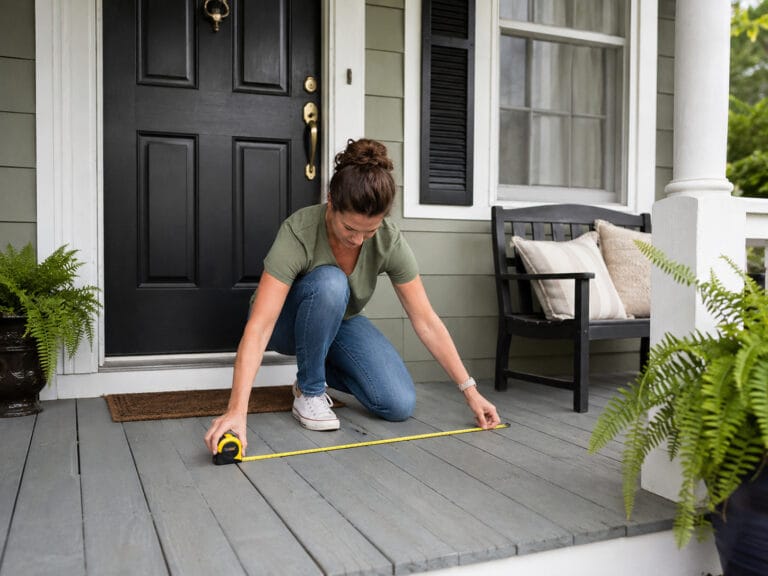
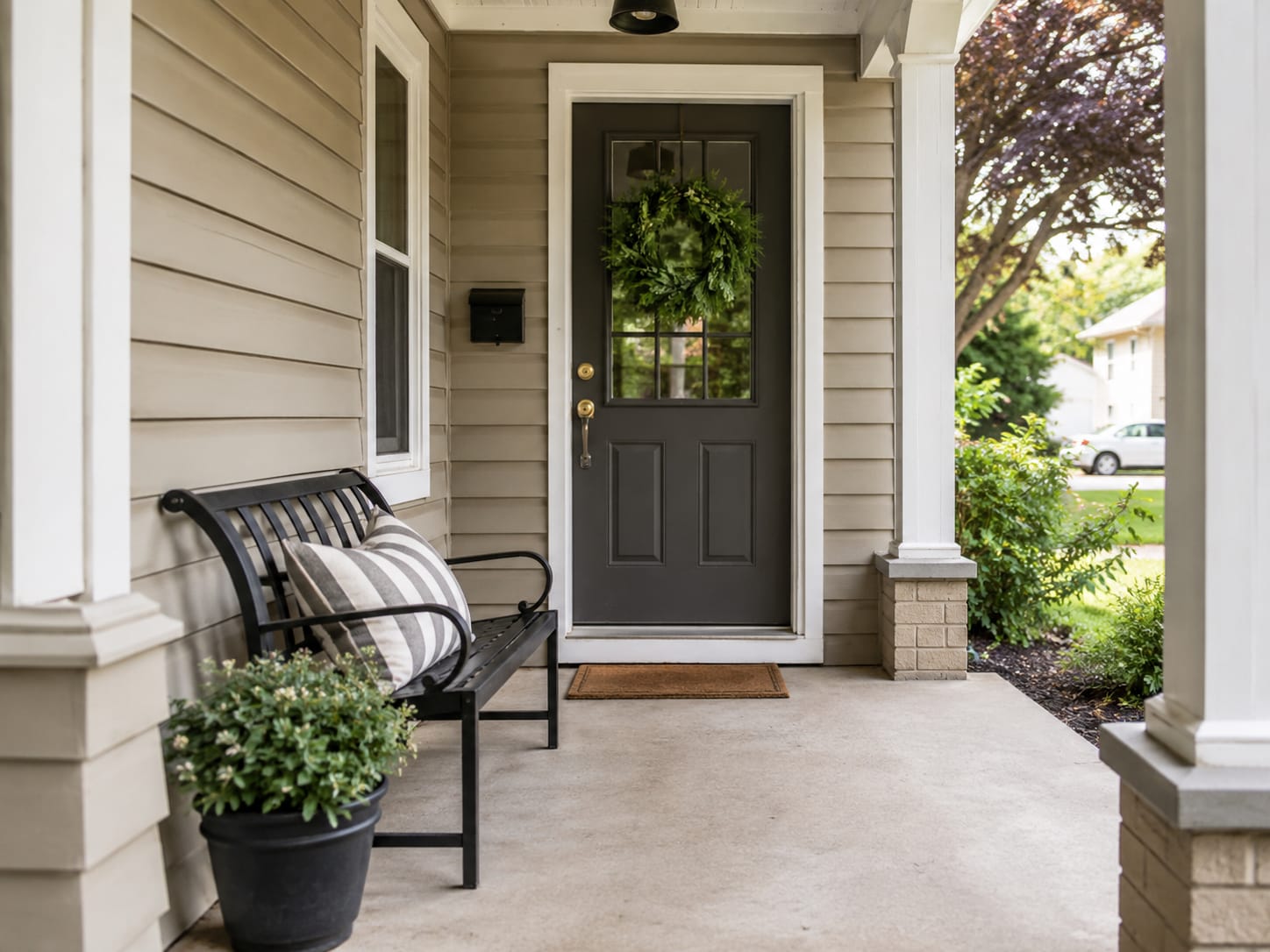
A front porch can look large enough for a chair, bench, or storage piece and still feel cramped once the furniture is in place.
The reason is simple: furniture footprint and usable clearance are not the same thing.
Your front door needs room to open. People need a clear route from the steps to the entrance. A chair needs space for someone to sit down and stand up. A rocking chair needs room to move. A storage bench may need extra space for a lid, door, or drawer to open.
So instead of asking only:
“Will this furniture fit on my porch?”
ask:
“Will the porch still work normally after the furniture is there?”
For most front porches, clearance is easier to plan when you separate it into three zones:
- door movement;
- walking path;
- furniture use.
Important: This guide provides practical planning advice for everyday residential use. It is not a substitute for local building codes, HOA requirements, or accessibility standards.
Table of Contents
Quick Answer: How Much Clearance Do You Need Around Front Porch Furniture?
There is no single clearance number that works for every porch.
Instead, protect three different types of space:
| Clearance Zone | What It Protects |
|---|---|
| Door movement | Door swing, handle area, standing and turning near the entrance |
| Walking path | Direct movement between the steps or walkway and the front door |
| Furniture use | Sitting, standing, rocking, opening storage, and reaching |
If one of these zones overlaps too heavily with another, the furniture may technically fit while the porch still feels difficult to use.
A practical layout should let you:
- open the front door without moving furniture;
- walk directly to the entrance without weaving around objects;
- sit down and stand up naturally;
- use any moving or storage features comfortably;
- carry groceries or packages through the porch without feeling squeezed.
If you have not measured the porch yet, start with our Front Porch Furniture Size Guide: How to Measure Before You Buy.
Three Different Clearance Zones
Thinking of clearance as one empty measurement around a piece of furniture can be misleading.
A front porch works better when you treat these three zones separately.
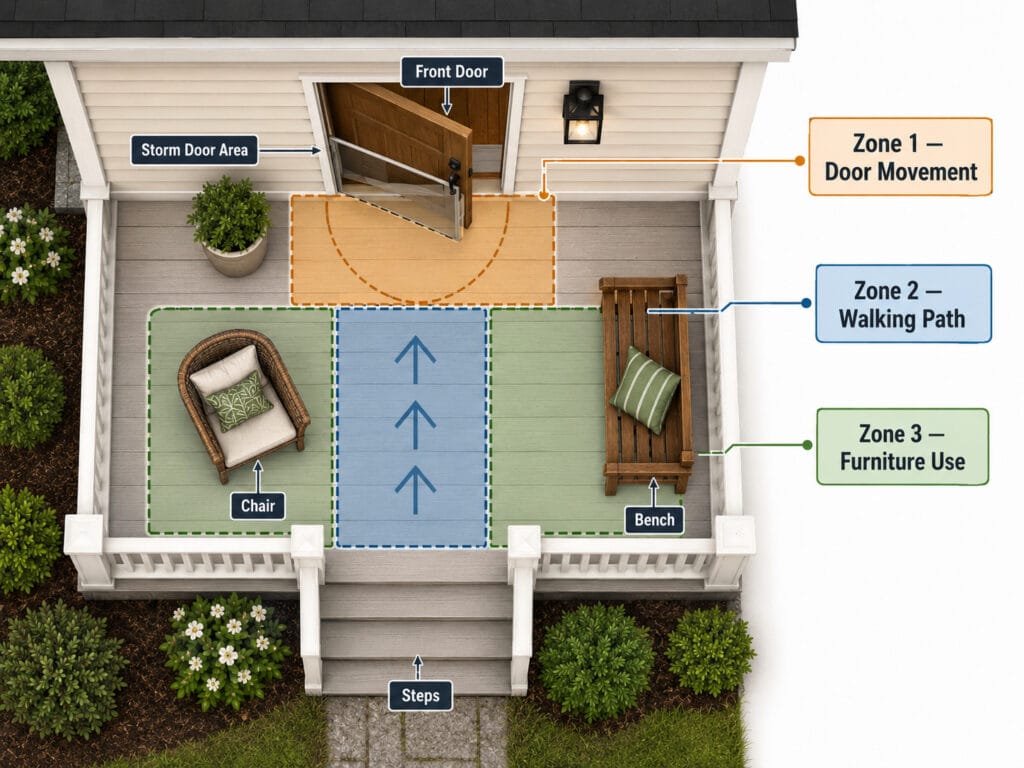
1. Door Movement Zone
This is more than the arc traced by the door itself.
It also includes the area where you naturally:
- stop to unlock the door;
- reach for the handle;
- turn toward the opening;
- step across the threshold;
- manage a grocery bag or package.
A storm door or screen door can add another movement pattern that needs to remain usable.
This zone gets first priority because the porch is still an entrance before it is a seating area.
2. Walking Path Zone
The walking path is the natural route from the steps, sidewalk, or driveway to the front door.
A good path should feel obvious.
You should not have to turn sideways around a chair, step around a planter, or squeeze between a bench and railing every time you enter the house.
3. Furniture Use Zone
Furniture needs more room in use than it does while sitting empty.
A chair needs space for feet, knees, and standing up.
A rocking chair moves beyond its resting footprint.
A storage bench may need room for a lid, cabinet door, drawer, or basket.
That extra space is part of the furniture footprint in real life, even if it is not shown in the basic product dimensions.
Furniture Beside the Door: Watch the Latch Side
Placing a chair or bench beside the front door is often one of the best ways to use a small porch.
But the latch side of the door can be more demanding than it looks.
A bench can sit completely outside the door swing and still crowd the place where you naturally stop to unlock the door, turn the handle, or shift a package from one hand to the other.
Before placing furniture beside the entrance, check:
- which direction the door opens;
- where the handle ends up;
- whether a storm or screen door changes the movement pattern;
- where you naturally stand while unlocking the door;
- whether the furniture makes the entry feel visually boxed in.
On a narrow porch, a shallower bench or upright chair will usually be easier to place than a deep lounge chair.
For broader layout strategies, see our small front porch ideas guide.
Furniture Opposite the Door: Protect the Arrival Area
Furniture directly across from the front door creates a different clearance problem.
It may not interfere with the door swing at all.
Instead, it can reduce the space available immediately after someone steps outside.
That matters when you:
- greet a visitor;
- carry a box;
- hold grocery bags;
- turn around to lock the door;
- handle a dog leash;
- let another person pass.
Ask yourself:
Can I step outside, turn, and move naturally without immediately encountering furniture?
This is one of the biggest differences between front porch and patio planning.
A patio can often tolerate a tighter seating arrangement. A front porch still needs to function as an arrival and departure zone.
Chair Clearance: Plan for the Person, Not Just the Chair
A chair’s footprint ends at its legs.
A seated person’s footprint does not.
Once someone sits down, feet and knees extend forward. Standing up usually requires leaning forward, shifting position, and taking a step.
That means the actual use zone around a chair is larger than the dimensions printed on the product page.
This becomes especially important when a chair sits:
- beside the main walking route;
- close to the door;
- opposite another piece of furniture;
- next to a side table or planter.
On a tight porch, a compact upright chair often works better than a deep lounge-style seat—not because small furniture is automatically better, but because it leaves more working space around the entrance.
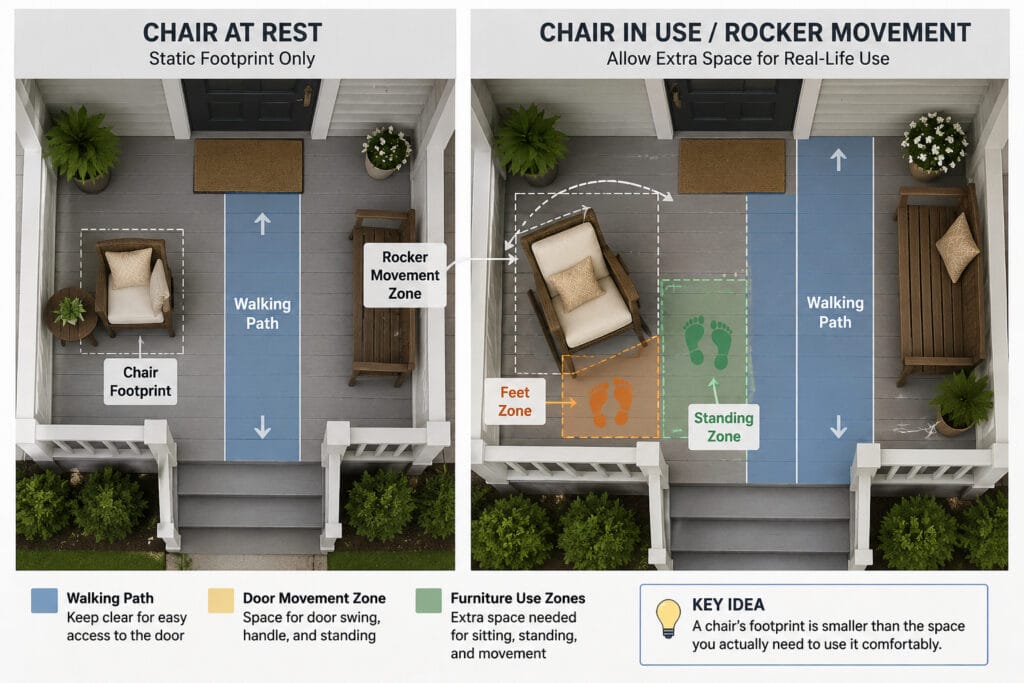
Rocking Chair Clearance: Measure the Movement, Not Just the Chair
Rocking chairs deserve special attention because they move.
A rocker that looks perfectly placed while empty may enter the walking path once someone begins using it.
Check the chair in motion relative to:
- the wall behind it;
- the railing;
- the main walking path;
- nearby tables or planters;
- the top of the porch steps.
Do not rely on one universal rocking-chair clearance number. Rocker geometry and movement vary by model.
Instead, evaluate the actual in-use movement zone of the chair you are considering.
If that movement crosses the main path or approaches the stair edge, the chair may be too large for that position even when its resting footprint fits.
Storage Bench Clearance: Closed Size Is Only Half the Story
A storage bench needs two kinds of space:
- room for someone to sit and stand;
- room for the storage feature to operate.
Different designs create different clearance needs:
| Storage Feature | Clearance to Check |
|---|---|
| Lift-top | Space above and behind the lid |
| Cabinet doors | Door-swing area in front |
| Drawers | Full extension plus standing space |
| Pull-out baskets | Room to remove the basket completely |
A storage bench can fit perfectly against the wall when closed and still become frustrating if opening it blocks the entrance.
For bench-specific sizing, see what size bench fits a small front porch.
Steps and Railings Need Their Own Breathing Room
Steps and railings create fixed boundaries that furniture cannot simply move through.
Avoid creating a pinch point where people transition from the steps onto the porch.
Be especially cautious with:
- large planters near the top step;
- benches placed between the steps and door;
- rocking chairs near a stair edge;
- furniture that narrows the space between itself and the railing.
The top of the steps should feel like part of the walking route, not leftover space that can be filled once the furniture is arranged.
Test the Porch on a Busy Day
A porch layout should work during real life, not only when everything is still.
Imagine coming home while:
- carrying two grocery bags;
- holding a large package;
- walking a dog;
- helping a child through the door;
- passing someone who is already sitting outside.
A useful test is simple:
Take a box or bag and walk through the planned layout.
Then sit in the chair or bench while someone else uses the entrance.
If the porch works only when nobody is seated and nobody is carrying anything, the clearance is probably too tight.
Accessibility Dimensions: Useful Context, Not a Universal Furniture Rule
For accessibility context, U.S. Access Board standards generally use a 36-inch minimum clear width for accessible walking surfaces, with limited exceptions.
Door maneuvering clearances can also require additional space depending on the direction of approach and the door configuration.
These standards are useful context for understanding why clear movement space matters, but they are not a universal furniture-spacing rule for every private front porch.
Local building requirements and accessibility obligations can vary by project and jurisdiction.
HomyEntry Porch Clearance Fit Check
Before buying porch furniture, run through this clearance-specific check:
- Open every door fully, including storm or screen doors.
- Mark the door-use zone where the door and people actually move.
- Identify the direct walking route from the steps or walkway.
- Tape the furniture footprint onto the porch floor.
- Add the in-use zone for seated legs, standing, or movement.
- Test moving features, including rockers and storage openings.
- Carry a box or shopping bag through the layout.
- Check the steps and railing area before deciding the furniture fits.
If the tape outline already makes the porch feel crowded, the real furniture will usually feel larger once height, arms, cushions, and visual mass are added.
The HomyEntry method here is:
Measure → Clear → Use → Buy.
Frequently Asked Questions
How much space should you leave around front porch furniture?
There is no single number that works for every porch. Leave enough space to protect the door-use area, keep the main walking route usable, and allow the furniture to function normally.
Is 36 inches a required porch furniture walkway?
No. The U.S. Access Board generally uses a 36-inch minimum clear width for accessible walking surfaces, but that is an accessibility standard—not a universal furniture-clearance rule for every private porch.
Do rocking chairs need more clearance than regular chairs?
Yes. A rocking chair needs additional forward-and-back movement space beyond its static footprint.
Does a storage bench need extra clearance?
Usually. A lift-top, cabinet door, drawer, or basket needs enough room to open and be used without blocking the entrance.
Final Thoughts: Clearance Is What Makes a Porch Layout Work
The best front porch layout is not the one that fits the most furniture.
It is the one that leaves the entrance easy to use.
Start with the door.
Protect the natural walking route.
Then account for how the furniture behaves in real life—sitting, standing, rocking, opening, reaching, and moving around it.
A chair, bench, or storage piece should make the porch more useful without making the front door harder to live with.
Clearance is not one number. It is the space required by the door, the walking route, and the furniture in use.
When you are ready to plan seating and storage around your entrance, Explore Porch Solutions →