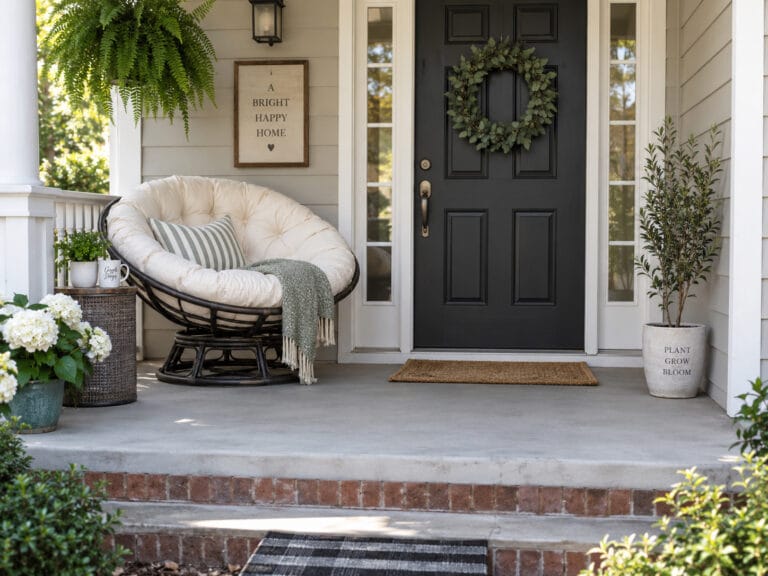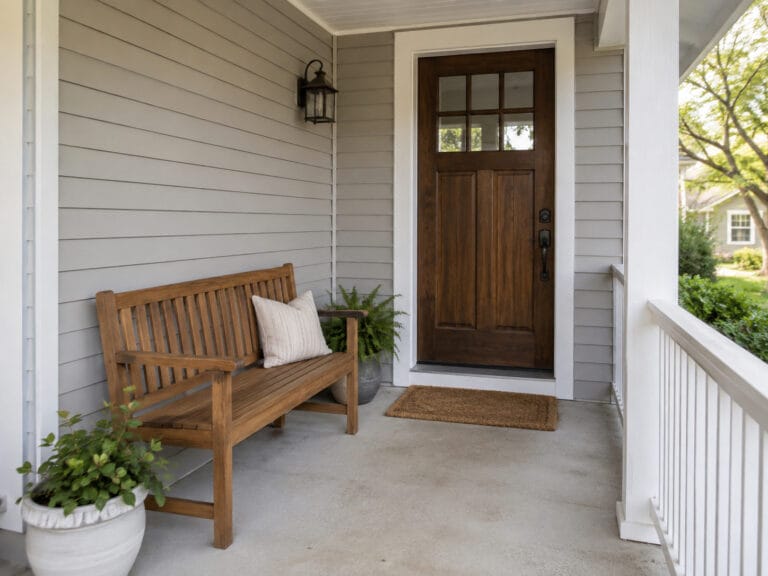
Front porch furniture does not need to sit in a full rainstorm to suffer from weather exposure.
A chair under a roof can still get wet from wind-driven rain. Cushions may stay damp long after the frame has dried. Moisture can collect around hardware and joints. Afternoon sun can reach furniture that looked completely shaded earlier in the day.
That is why protecting porch furniture is rarely about buying one waterproof cover and calling the problem solved.
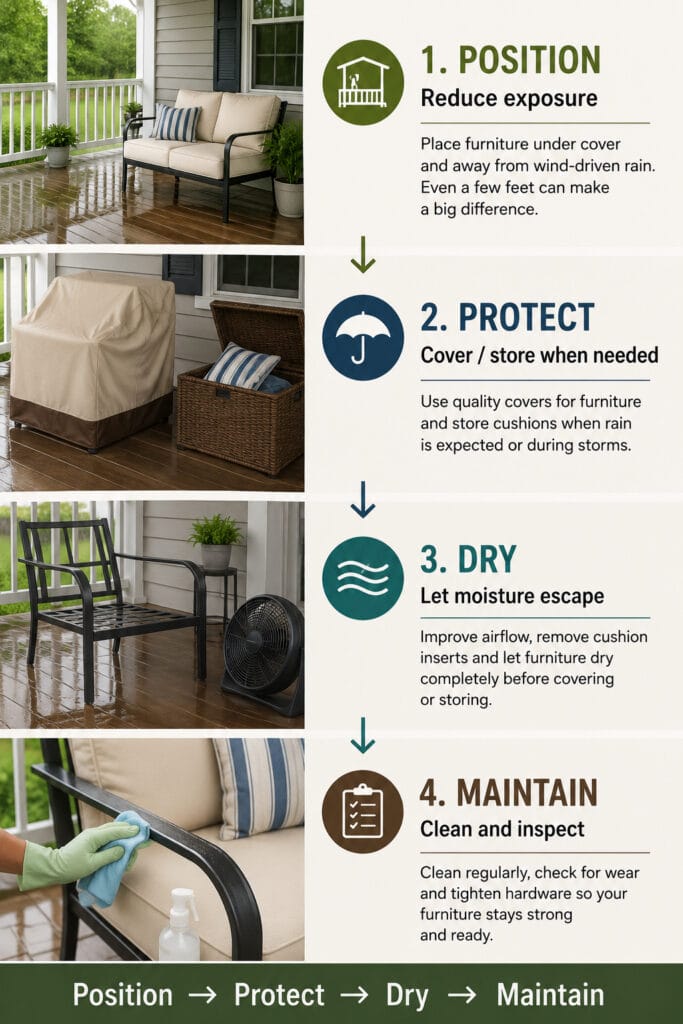
A better approach is to use several layers of protection:
Position → Protect → Dry → Maintain
Each step solves a different problem.
The goal is not to keep outdoor furniture completely isolated from weather. It is to reduce unnecessary exposure, help moisture escape, and catch small maintenance issues before they become bigger ones.
Table of Contents
Quick Answer: How to Protect Porch Furniture From Rain
Start with the furniture’s actual location.
If rain regularly blows into that part of the porch, moving a chair or bench farther under the roof may help more than adding another protective product.
Then check that the furniture itself is intended for outdoor or covered-outdoor use.
After that:
- use a properly fitted, ventilated furniture cover when extra protection is useful;
- store cushions before prolonged rain when practical;
- let wet furniture dry before covering it;
- keep air moving around frames and cushions;
- remove standing water, pollen, leaves, and debris after storms;
- inspect hardware, finishes, joints, and storage furniture periodically.
The key principle is:
Protect from new moisture, but always give existing moisture a way out.
A cover cannot compensate for poor placement, indoor-only furniture, trapped moisture, or neglected maintenance.
Know How Exposed Your Porch Really Is
Before adding covers or storage, figure out what weather the furniture actually experiences.
Do not judge exposure only by whether the porch has a roof.
A covered front porch may still receive:
- wind-driven rain;
- splash near steps or railings;
- low-angle morning or afternoon sun;
- humid air;
- damp flooring;
- condensation;
- seasonal temperature swings.
The easiest way to understand your porch is to observe it during normal weather.
Check:
- which furniture gets wet during ordinary rain;
- where water lands on the floor;
- whether one side receives stronger wind;
- which areas get direct sun;
- how long cushions and frames stay damp afterward.
If you have not done this yet, start with our covered vs. uncovered porch furniture guide.
Move Furniture Away From Roof Edges When Possible
Placement is one of the easiest ways to reduce weather exposure.
Furniture closer to the house wall will often receive less direct rain and splash than furniture near:
- railings;
- steps;
- open corners;
- roof edges;
- drip lines or drainage points.
Even a modest shift inward can reduce repeated wetting.
This matters because weather exposure is rarely uniform across a porch.
A bench deep under the roof may stay mostly dry, while another piece only a few feet farther out gets wet every time the wind changes.
If repositioning furniture keeps it out of ordinary rain without affecting the doorway or walking route, it is usually one of the simplest improvements you can make.
But do not solve a weather problem by creating a layout problem.
Furniture should still stay clear of:
- the front door;
- the main walking path;
- steps;
- railings;
- utility access.
For measuring and placement, see our front porch furniture size guide.
Start With Furniture Designed for Outdoor Conditions
Weather protection begins with the furniture itself.
A cover can reduce exposure, but it cannot turn indoor furniture into outdoor furniture.
For a typical front porch, check whether the manufacturer states that the product is suitable for:
- outdoor use;
- covered outdoor use.
Useful features may include:
- outdoor-rated frames;
- protective finishes;
- corrosion-resistant hardware;
- drainage around joints;
- synthetic outdoor wicker rather than natural indoor wicker;
- outdoor fabrics;
- construction that can dry after getting wet.
The more exposed the furniture location, the more important these features become.
The safest rule is simple:
Use the manufacturer’s stated use environment as the starting point.
Do not rely only on words such as porch, wicker, bench, or all-weather without checking the actual product guidance and care instructions.
Use Furniture Covers Correctly
Furniture covers can be useful, but how they are used matters just as much as whether you have one.
They are especially helpful when:
- rain often blows beneath the porch roof;
- furniture sits near an exposed edge;
- the porch receives strong seasonal sun;
- pollen, leaves, or debris are heavy;
- furniture will not be used for a while.
A furniture cover should do more than block rain.
Look for:
- a secure fit;
- ventilation that allows moisture to escape;
- outdoor-rated rain protection;
- straps, buckles, or another wind-secure system;
- a shape that does not encourage water to pool on top.
Classic Accessories’ patio cover guidance specifically highlights ventilation as a way to reduce condensation and recommends covering furniture only after it is clean and dry.
The most important rule is:
Do not seal wet furniture under a cover.
A cover can stop new rain from reaching the furniture. It cannot remove moisture that is already there.
Furniture Cover Check
| Check | What to Look For |
|---|---|
| Fit | Sized for the furniture without being excessively loose or stretched tight |
| Ventilation | Air vents or another design that allows moisture to escape |
| Rain protection | Outdoor-rated water-resistant or waterproof construction |
| Secure fit | Straps, buckles, drawcords, or another wind-secure system |
| Water shedding | A shape that discourages pooling on top |
| Care compatibility | Follow both the furniture and cover manufacturer instructions |
Do not assume that a heavier or more waterproof-looking cover is automatically better.
A good cover needs to keep new weather out without creating a sealed moisture trap underneath.
Store Cushions Before Prolonged Rain
Cushions often need more protection than the furniture frame.
A metal, resin, or outdoor wood frame may dry relatively quickly after a storm, while thick cushions can remain damp much longer.
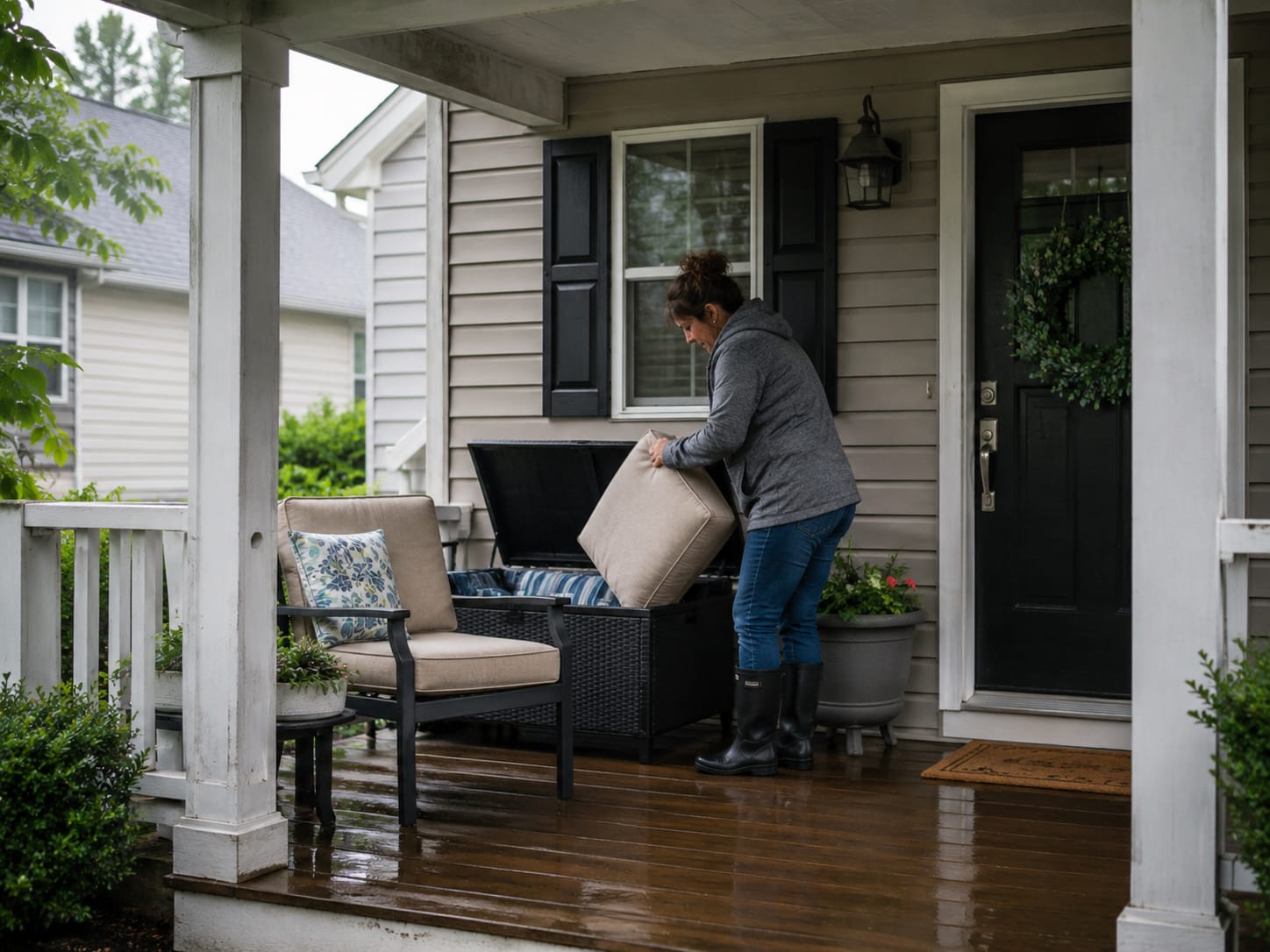
If several days of rain are expected, or your porch regularly receives wind-driven rain, storing cushions before they get soaked is usually easier than trying to dry them repeatedly afterward.
Possible storage locations include:
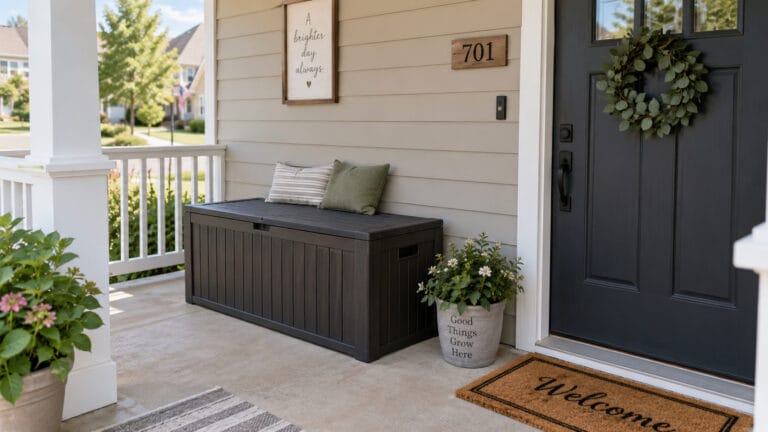
- an outdoor-rated storage bench;
- a compact porch storage box;
- a garage;
- an indoor closet;
- another dry storage area.
For a small porch, storage should not create a new obstruction.
If adding a large deck box means narrowing the walking path or blocking the door, bringing cushions indoors may be the better solution.
For more ideas, see our front porch storage ideas for small spaces.
Never Trap Wet Furniture Under a Cover
This point is important enough to stand on its own.
If furniture gets wet:
- remove standing water;
- separate wet cushions from the frame when practical;
- let air move around the furniture;
- allow surfaces and seams to dry;
- cover only after the moisture has had time to escape.
This matters especially with:
- thick cushions;
- wood joints;
- woven surfaces;
- metal fasteners;
- storage furniture.
The goal after a storm is not only to stop more water from arriving.
It is also to help the water that is already there leave.
Help Furniture Dry Faster
Air movement is one of the simplest forms of weather protection.
Small front porches can make drying harder because furniture is often placed close to:
- walls;
- railings;
- storage boxes;
- other seating.
After furniture gets wet, avoid packing everything tightly together if you can.
For cushions:
- remove them from the frame;
- stand them upright when practical;
- avoid stacking damp cushions;
- expose more than one side to moving air.
Manufacturer guidance can be useful here. POLYWOOD’s furniture care guide, for example, recommends air-drying cushions and notes that standing them on their sides can help them dry faster.
Storage furniture needs airflow too.
A storage box may look dry on the outside while damp cushions or textiles remain humid inside.
If the contents still need to dry, enclosure alone is not enough.
Quick Post-Storm Check
You do not need a full cleaning routine after every light shower.
After a heavier storm, however, a quick inspection can prevent water and debris from sitting in hidden areas.
Check these six things:
- Remove standing water and loose debris.
- Separate wet cushions from the frame.
- Check seams, wicker gaps, hardware, and storage lids for trapped water.
- Let air move around all wet surfaces.
- Look for obvious coating damage or loose fasteners.
- Cover or store only after the furniture has dried.
Storms can leave behind more than water.
Pollen, leaves, grit, dirt, and organic debris can collect in joints and woven surfaces and hold moisture longer than the rain itself.
Inspect Hardware, Frames, and Finishes
Weather protection also means catching small problems early.
Inspect furniture periodically, and more often during wet, windy, or high-use seasons.
Wood
Look for:
- finish wear;
- cracks;
- areas where water collects;
- moisture around legs or joints.
Follow the manufacturer’s instructions for cleaning, sealing, or refinishing.
Metal
Check:
- coating chips;
- early corrosion;
- screws and bolts;
- welds and frame joints.
Damage to a protective finish can expose the underlying metal.
Synthetic Wicker
Check both:
- the weave;
- the frame underneath.
The woven material may still look fine while hardware or the internal frame begins to show wear.
Maintenance should stay material-specific.
Manufacturer care instructions should take priority over generic household tips.
Check Storage Furniture for Water Entry
Outdoor storage benches and compact boxes can be useful on a front porch, but do not automatically assume they are waterproof.
Check:
- lid seams;
- hinges;
- drainage around the base;
- whether rain blows directly onto the unit;
- whether moisture rises from the porch floor;
- whether the contents need ventilation.
A storage bench near the porch edge may receive much more rain than the same product against the house wall.
If you are storing moisture-sensitive textiles in a box that is not marketed as waterproof, an additional dry interior container may provide another layer of protection.
The strongest storage setup is one where:
placement + storage design + contents all match each other.
Use Seasonal Storage When It Makes Sense
Not every piece of porch furniture needs to stay outside all year.
Seasonal storage may make sense when:
- the furniture will not be used for months;
- local winters bring repeated snow or freeze-thaw cycles;
- cushions take a long time to dry;
- storms are common during part of the year;
- smaller pieces are easy to move indoors.
Soft items are often the easiest things to store first:
- cushions;
- pillows;
- light accessories.
Larger outdoor-rated frames may remain outside if the manufacturer allows it, but they should still be cleaned and dried before long-term covering.
There is no single seasonal schedule that applies to every U.S. climate.
Use your local weather and the manufacturer’s care guidance as the deciding factors.
Rain Protection Decision Tree
A simple decision process can make porch weather protection much easier.
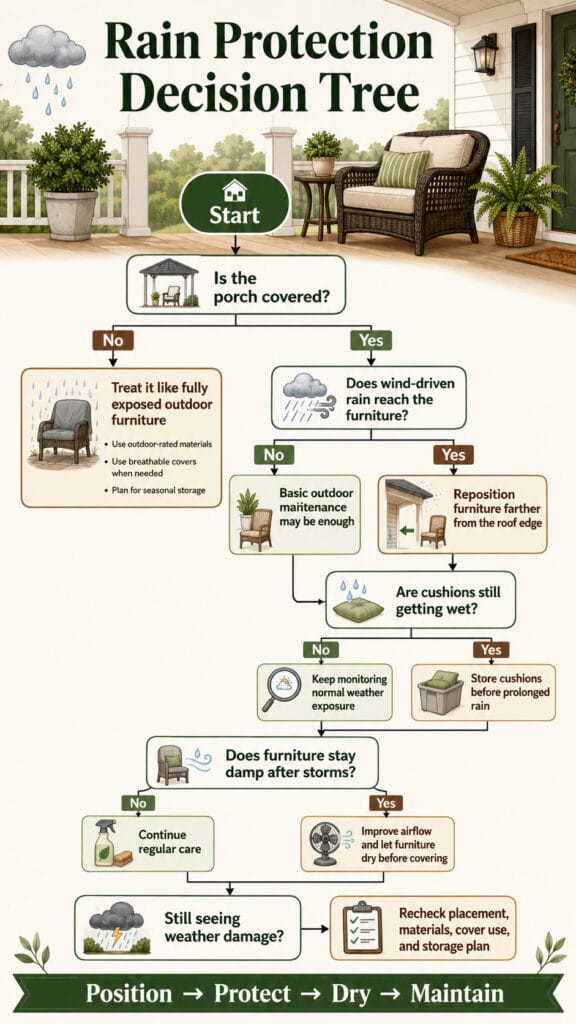
Is the furniture under a roof?
No
→ Treat it as directly exposed outdoor furniture.
→ Use furniture intended for direct outdoor conditions.
Yes
→ Continue to the next question.
Does wind-driven rain reach the furniture?
No
→ Normal outdoor maintenance may be enough.
Yes
→ Reposition the furniture farther under the roof if possible.
Still exposed?
→ Consider a properly fitted, ventilated cover.
Are the cushions regularly getting wet?
No
→ Keep monitoring normal exposure.
Yes
→ Store them before prolonged rain or create a reliable dry-storage plan.
Is the furniture still damp after the storm?
Yes
→ Improve airflow.
→ Separate cushions.
→ Dry before covering.
Does the problem keep coming back?
Yes
→ Reconsider the placement, furniture material, or furniture type.
The core rule is:
Reposition first. Protect second. Dry before covering.
HomyEntry Porch Weather Protection Fit Check
Before the next wet season, run through this checklist:
- Watch where rain actually enters the porch.
- Move furniture away from exposed roof edges when possible.
- Confirm the furniture is intended for outdoor use.
- Check whether cushions get wetter than the frame.
- Create a storage plan for cushions before prolonged rain.
- Use covers only when furniture is dry.
- Make sure covers allow some ventilation.
- Improve airflow around damp furniture.
- Remove debris and standing water after storms.
- Inspect hardware, joints, coatings, and finishes periodically.
- Check storage furniture for water entry.
- Move soft items indoors during long periods of bad weather when practical.
The HomyEntry method is:
Position → Protect → Dry → Maintain
Good protection should reduce unnecessary weather exposure without trapping moisture or making the porch harder to use.
Frequently Asked Questions
Should I Cover Porch Furniture Every Time It Rains?
Not necessarily.
If the furniture is designed for outdoor use and sits in a well-sheltered location, an ordinary light rain may not require a cover every time.
Covers are more useful when furniture receives frequent wind-driven rain, strong sun, heavy debris, or long periods of non-use.
Can I Put A Furniture Cover On Wet Furniture?
It is better to let the furniture dry first.
Covering damp furniture can slow evaporation and trap moisture around cushions, joints, finishes, and hardware.
How Do I Keep Porch Cushions Dry?
Combine good placement, outdoor-rated cushions, and a storage plan.
If prolonged rain is expected, move cushions into a dry storage bench, storage box, garage, closet, or another protected area.
Does A Covered Porch Protect Furniture From Rain?
It reduces direct rain from above, but it may not stop wind-driven rain, splash, humidity, or damp flooring.
The exact furniture location still matters.
Are Waterproof Furniture Covers Better?
Rain resistance matters, but so do ventilation, fit, and drainage.
A cover that blocks rain but traps moisture around wet furniture can create a different problem.
Use a cover designed for outdoor furniture and follow the manufacturer’s instructions.
Final Thoughts: Protect Furniture in Layers
Protecting front porch furniture from rain and weather is not a one-product solution.
The most effective approach usually combines several steps:
- place furniture in the most protected usable zone;
- choose furniture suited to the real exposure;
- use covers when they add value;
- store cushions before prolonged wet weather;
- let damp furniture dry before covering;
- keep air moving;
- clean away debris after storms;
- inspect frames, hardware, and finishes.
The order matters.
A better location can reduce the need for a cover.
A better cushion-storage routine can prevent repeated soaking.
Proper drying can be just as important as keeping new rain off the furniture.
And regular inspection can catch small maintenance issues before they become larger ones.
The simplest rule is:
Protect from new moisture, but always give existing moisture a way out.
When you are ready to add practical protection, Explore Porch Storage & Protection →