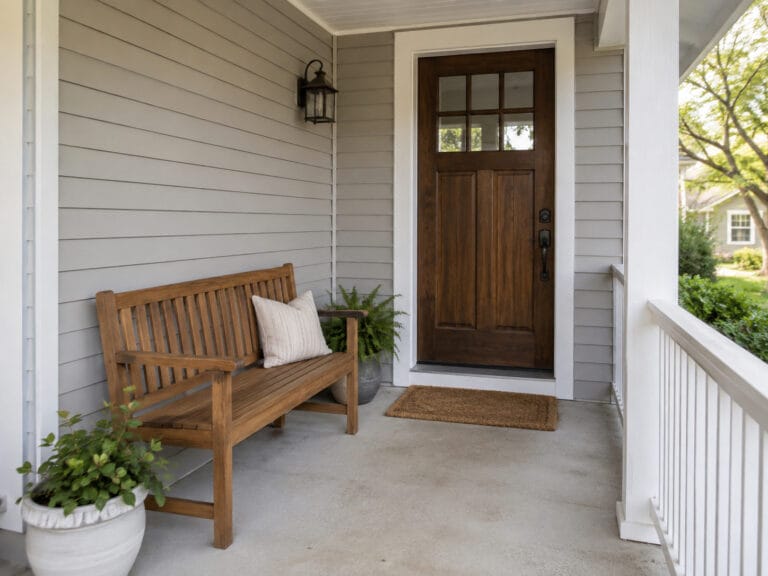
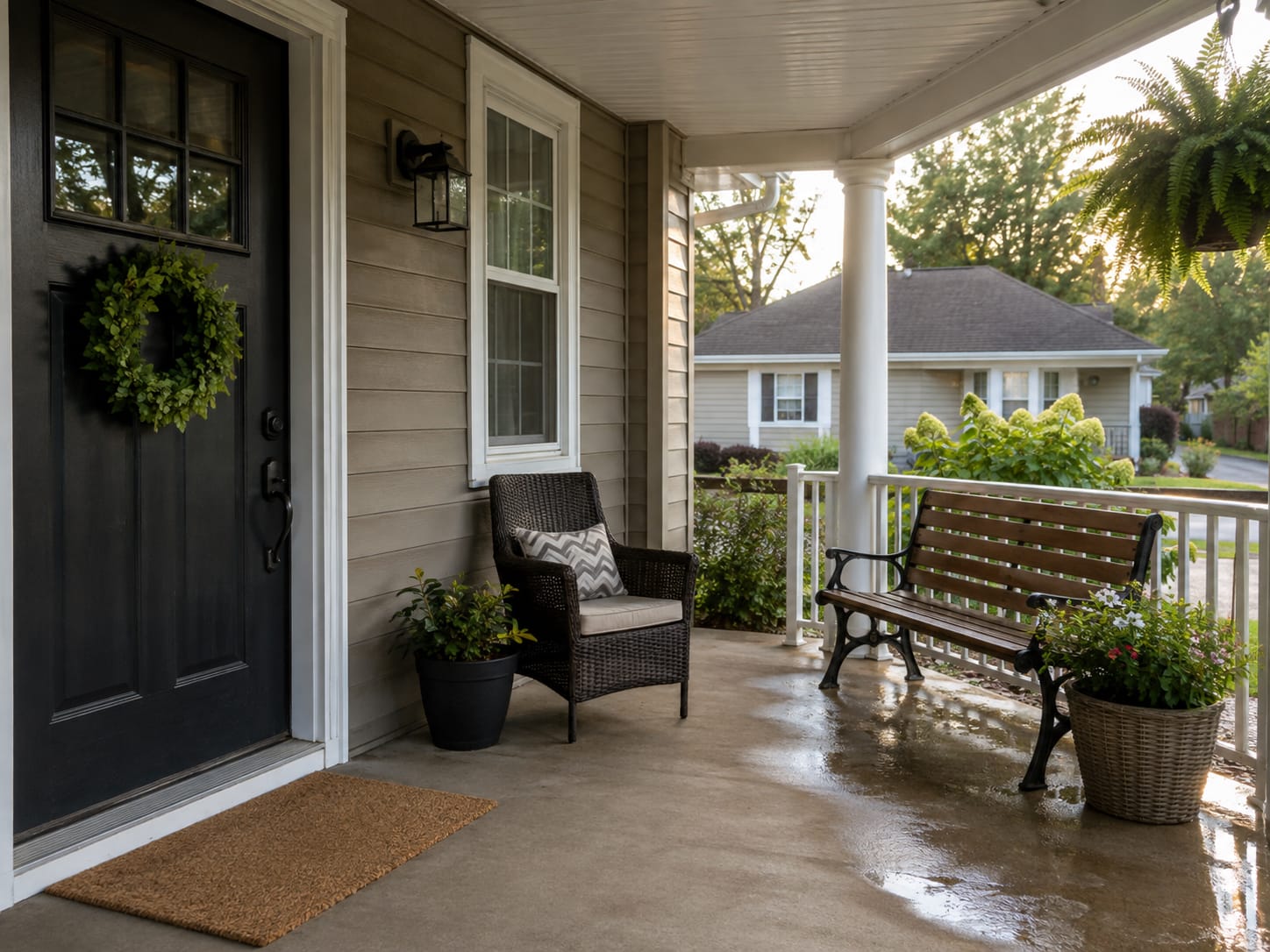
A covered porch can protect furniture from some weather, but it does not turn an outdoor space into an indoor room.
Rain can still blow in from the side. Morning or late-afternoon sun may reach furniture well beneath the roof. Humidity, dew, damp flooring, temperature swings, and wind can affect materials even when there is an overhang above them.
So the most useful question is not:
“Is my porch covered?”
It is:
“How exposed is the exact spot where this furniture will sit?”
For many front porches, the answer falls somewhere between fully protected and fully exposed.
A chair against the house wall may stay relatively dry, while a bench only a few feet closer to the porch edge may receive far more rain and sun.
That is why furniture should be chosen for the furniture zone, not just the roof.
Table of Contents
Quick Answer: Covered vs. Uncovered Porch Furniture
A covered porch usually gives furniture more protection, but outdoor-rated furniture is still the safer starting point because humidity, low-angle sun, and wind-driven rain can still reach the space.
A partially covered porch needs even more careful planning because protection can change significantly from one part of the porch to another.
A fully exposed porch should be treated as a direct outdoor environment, with furniture, cushions, hardware, and storage designed for regular weather exposure.
| Porch Exposure | Typical Conditions | Better Furniture Direction |
|---|---|---|
| Covered | Lower direct rain and sun exposure, but still outdoor humidity and occasional weather | Outdoor furniture with more flexibility in finish and cushion choice |
| Partially covered | Some areas stay sheltered while others receive rain, sun, or splash | Match each furniture piece to its exact placement zone |
| Fully exposed | Direct rain, sun, wind, and more frequent wet-dry cycles | Furniture designed for direct outdoor exposure and easier maintenance |
This three-level model is practical planning guidance, not an official furniture industry rating system.
The main idea is simple:
“Covered” describes the roof. It does not fully describe the conditions around the furniture.
What a Covered Porch Actually Protects From
A porch roof can reduce some of the most obvious weather exposure.
Depending on the roof depth, porch orientation, nearby walls, and local climate, it may reduce:
- rain falling directly from above;
- strong overhead sun;
- falling leaves and debris;
- direct snow accumulation;
- water landing directly on seating surfaces.
That can make furniture easier to maintain and give you more flexibility when comparing finishes, cushions, and storage pieces.
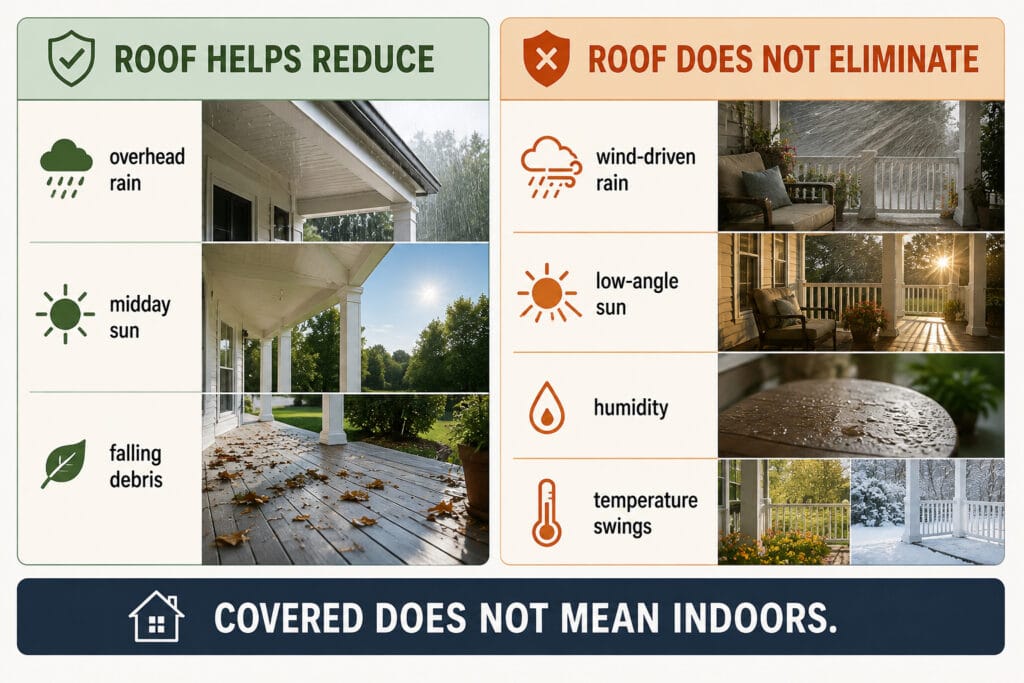
But protection is rarely equal across the entire porch.
A piece close to the house may stay relatively sheltered, while furniture near the railing or steps can behave more like furniture on an uncovered patio.
Wayfair’s outdoor furniture climate guide makes a similar distinction: furniture placed under a covered patio or porch may have more material options, but humidity and coastal moisture can still affect sheltered outdoor spaces.
For a broader buying process, see our guide to choosing furniture for a small front porch.
Wind-Driven Rain Still Reaches Covered Furniture
A roof blocks rain falling from above.
It cannot always stop rain being pushed sideways by wind.
Wind-driven rain can reach:
- chair frames;
- cushion edges;
- bench seats;
- storage-box seams;
- metal hardware;
- furniture legs near the porch edge.
This is especially worth checking on porches with:
- shallow overhangs;
- open sides;
- exposed corners;
- furniture close to railings;
- furniture near the top of the steps.
One of the simplest real-world tests is also one of the most useful:
Watch the porch during a normal rainstorm.
If a chair regularly gets wet during ordinary rain, treat that location as an exposed furniture zone—even if the chair technically sits under the roof.
Sun Exposure Still Matters Under a Roof
A covered porch is not necessarily a shaded porch all day.
Morning and late-afternoon sunlight enters at a lower angle than midday sun and can reach farther beneath an overhang.
Repeated UV exposure can affect:
- wood finishes;
- synthetic wicker;
- resin and plastic;
- painted surfaces;
- cushions;
- decorative pillows.
That means furniture can stay mostly dry and still receive significant sun exposure.
Check the porch at more than one time of day.
A furniture zone that looks protected at noon may receive direct sunlight in the morning or late afternoon.
Humidity and Moisture Do Not Need Direct Rain
Protection from rainfall is not the same as protection from moisture.
Covered porches can still experience:
- high humidity;
- morning dew;
- condensation;
- damp flooring;
- slow drying after storms;
- trapped moisture inside cushions or storage furniture.
This is an important reason not to assume indoor furniture is suitable for a covered front porch.
Indoor furniture may use fabrics, adhesives, wood finishes, hardware, or cushion fillings that were not designed for outdoor humidity and temperature changes.
If the porch often feels damp after rain, it should still be treated as an outdoor or semi-outdoor environment.
Covered, Partially Covered, or Fully Exposed?
A simple covered-versus-uncovered label does not tell the whole story.
For practical planning, it is more useful to think in three exposure levels.

Covered Porch
This is the most protected condition.
Furniture may sit close to the house wall beneath a relatively deep roof, with limited direct rain and reduced sun exposure.
Typical options can include:
- outdoor wood furniture;
- powder-coated metal;
- outdoor PE rattan or resin wicker;
- outdoor cushions;
- outdoor-rated storage benches.
You may have more flexibility here, but outdoor-grade construction is still the better starting point for an open porch.
Partially Covered Porch
This is very common on small front porches.
The inner area near the house may stay relatively dry, while furniture closer to the railing, steps, or roof edge receives more:
- wind-driven rain;
- low-angle sun;
- splash;
- humidity.
This is where zone-by-zone selection matters most.
Do not assume every chair on the same porch needs exactly the same level of weather resistance.
Fully Exposed Porch
A fully exposed furniture zone receives direct outdoor weather.
Furniture may face:
- direct rainfall;
- prolonged sunlight;
- stronger wind;
- larger seasonal temperature changes;
- more frequent wet-dry cycles.
Here, prioritize furniture clearly intended for direct outdoor exposure and designed to clean, drain, and dry easily.
Choose for the furniture zone, not just the roof.
Can You Use Indoor Furniture on a Covered Porch?
Do not assume indoor furniture is suitable simply because the porch has a roof.
A typical open-sided covered porch still experiences outdoor conditions.
Indoor furniture may not be designed for:
- humidity;
- condensation;
- occasional rain;
- direct sunlight;
- temperature swings;
- damp flooring;
- insects.
A highly enclosed porch may behave differently, but even a screened porch is not automatically the same as a climate-controlled interior room.
The safer rule is:
Check the manufacturer’s stated use environment.
If the manufacturer does not say the product is suitable for outdoor or covered-outdoor use, do not assume the roof makes it safe.
Choose Materials for the Exposure Zone
Material matters, but there is no single “best porch material.”
A useful comparison should consider:
- moisture;
- sun;
- corrosion;
- drainage;
- maintenance;
- the specific placement zone.
Wood Furniture
Wood can work very well on a covered porch, especially where direct rain is limited.
Its performance still depends on:
- wood species;
- finish;
- exposure;
- drainage;
- maintenance requirements.
Check whether the product is intended for outdoor use and whether water can sit on horizontal surfaces or around the legs.
Manufacturer guidance can also be surprisingly specific. For example, Old Hickory’s covered-porch guidance recommends particular surface treatments for covered outdoor placement because finish performance depends on the actual material surface.
The larger lesson is not that one wood treatment is correct for every porch.
It is that manufacturer-specific outdoor guidance matters.
Metal Furniture
Metal can work on both sheltered and exposed porches when the frame and finish are appropriate for outdoor use.
Look for:
- outdoor-rated protective finishes;
- powder coating or another durable coating system;
- corrosion-resistant hardware;
- drainage around joints;
- protected welds and fasteners.
Humidity matters even on a covered porch.
In coastal or consistently damp environments, hardware and corrosion protection deserve particular attention.
PE Rattan and Resin Wicker
Synthetic wicker can be a practical porch material because it offers a woven appearance while generally being better suited to outdoor use than natural indoor wicker.
But the word wicker alone does not tell you how weather-resistant a product is.
Performance depends on factors such as:
- resin quality;
- UV stabilization;
- weave construction;
- frame material;
- hardware;
- drainage.
For exposed zones, look for products explicitly intended for outdoor use rather than assuming all synthetic wicker performs the same way.
HDPE and other outdoor plastic-lumber furniture can also work well in many porch environments, but the same rule applies: use the manufacturer’s outdoor-use guidance rather than treating all products made from a similar material as identical.
Cushions Need Their Own Weather Plan
The furniture frame and the cushions do not always have the same tolerance for exposure.
A chair frame may handle moisture well while the cushions:
- absorb water;
- dry slowly;
- trap humidity;
- develop mildew odors;
- fade in direct sun.
On a well-sheltered porch, outdoor cushions may need relatively little intervention.
On a partially covered or exposed porch, look for:
- outdoor-rated fabric;
- faster-drying construction;
- removable covers when useful;
- good airflow;
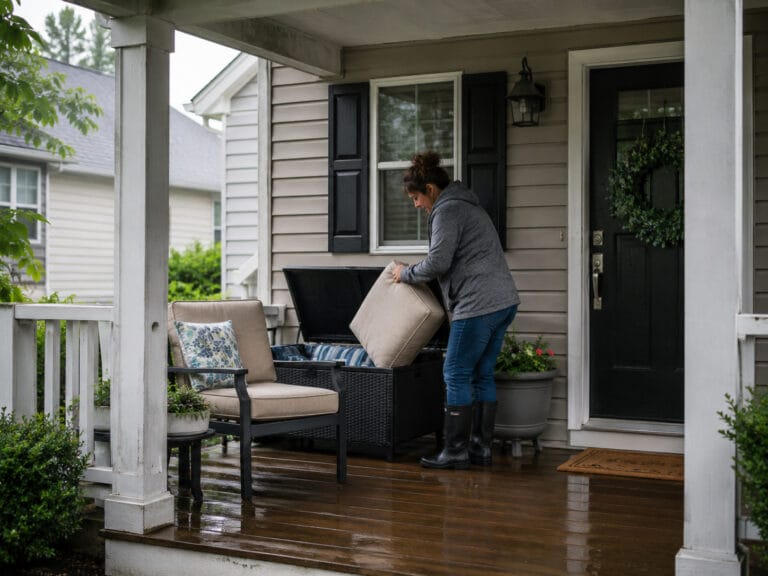
- practical storage during prolonged bad weather.
If cushions regularly remain damp long after the frame has dried, that seating zone may need either faster-drying cushions or a better storage routine.
Storage Furniture Needs More Than a Roof
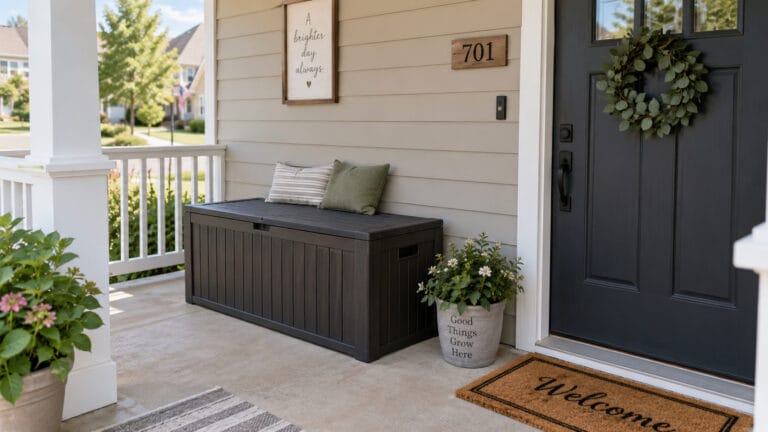
A covered porch does not automatically make a storage bench or box dry inside.
Before using porch storage, check:
- whether rain can reach the lid or seams;
- whether moisture rises from the porch floor;
- whether the contents need ventilation;
- whether the box sits near the exposed edge;
- whether the furniture is actually intended for outdoor storage.
This matters especially for moisture-sensitive items such as cushions and textiles.
For more detailed planning, see our front porch storage ideas.
When Furniture Covers Still Help
A furniture cover can still be useful on a covered porch.
It may make sense when:
- furniture sits near an exposed edge;
- rain regularly blows beneath the roof;
- the porch receives strong seasonal sun;
- the furniture is unused for long periods;
- pollen, leaves, or debris are a recurring problem.
But a cover should not become a moisture trap.
Do not treat covering as a substitute for choosing furniture suitable for the location.
For the full protection process, see our guide to protecting front porch furniture from rain and weather.
Materials by Porch Exposure
| Material / Item | Covered Porch | Partially Covered | Fully Exposed |
|---|---|---|---|
| Outdoor wood | Good with appropriate finish and care | Choose durable outdoor construction | Higher exposure usually means more maintenance and weather resistance |
| Powder-coated metal | Usually suitable | Good when frame and hardware are outdoor-rated | Suitable when corrosion protection matches the exposure |
| PE rattan / resin wicker | Usually suitable | Choose outdoor-rated products | Look for strong UV- and weather-resistant construction |
| HDPE outdoor furniture | Usually suitable | Usually suitable | Often suitable when designed for full outdoor exposure |
| Natural indoor wicker | Higher risk unless exceptionally protected | Generally a poor choice | Poor choice |
| Outdoor cushions | Good with airflow | Prefer outdoor fabrics that dry readily | Stronger weather resistance and a storage plan become more important |
| Indoor cushions | Generally a poor choice | Poor choice | Poor choice |
| Outdoor storage furniture | Usually suitable | Check seams, exposure, and water entry | Should be designed for direct outdoor exposure |
This table is practical planning guidance, not a durability guarantee.
Always follow the manufacturer’s stated use, exposure, and care instructions for the specific product.
Check Five Exposure Factors Before You Buy
Before choosing furniture, evaluate the exact placement zone using five factors.
1. Rain
Does wind carry rain into this part of the porch?
2. Sun
Does morning or late-afternoon sun reach the furniture?
3. Moisture
Does the porch stay damp after storms?
4. Temperature
Does the furniture experience large seasonal temperature changes?
5. Placement
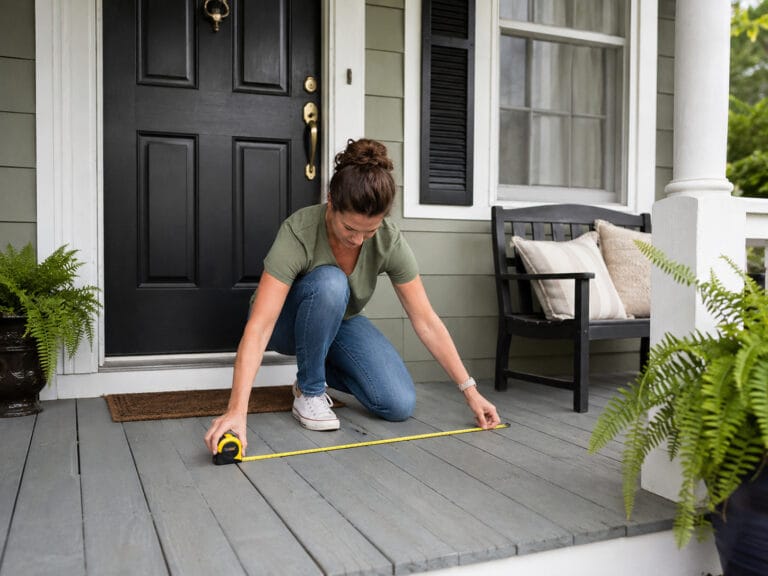
Is the piece close to the house wall or near the exposed outer edge?
Two pieces on the same porch may need different protection.
That is why “covered porch furniture” is not a single universal furniture category.
HomyEntry Porch Exposure Fit Check
Before buying furniture for a covered or uncovered porch:
- Observe the porch during a normal rainstorm.
- Identify where wind-driven rain reaches.
- Check morning and afternoon sun.
- Notice which areas stay damp after rain.
- Identify the most protected wall-side zone and the most exposed edge.
- Match each furniture piece to its actual placement zone.
- Use outdoor-rated cushions where moisture is likely.
- Check the manufacturer’s stated outdoor-use and care guidance.
- Plan storage or additional protection where exposure is higher.
- Do not use indoor furniture simply because there is a roof overhead.
The HomyEntry approach is:
Observe → Match → Protect
Observe the real conditions, match the furniture to them, then add protection where it is actually needed.
Frequently Asked Questions
Can Outdoor Furniture Stay On A Covered Porch Year-Round?
Often, yes, when the furniture is designed for outdoor use and matches the local conditions. A roof can reduce exposure, but humidity, wind-driven rain, sun, and seasonal temperature changes may still affect the furniture.
Is Indoor Furniture Safe On A Covered Porch?
Not automatically. An open covered porch still experiences outdoor humidity, temperature changes, and occasional moisture. Use indoor furniture only when the manufacturer states that it is suitable for that environment.
Does A Covered Porch Protect Cushions From Rain?
It reduces direct rainfall, but cushions near the porch edge may still get wet from wind-driven rain or splash. Outdoor-rated cushions and a practical drying or storage plan are safer for exposed zones.
What Furniture Is Best For An Uncovered Front Porch?
Choose furniture clearly designed for direct outdoor exposure. Pay attention to weather-resistant frames and finishes, corrosion-resistant hardware, outdoor fabrics, drainage, drying, and the manufacturer’s care requirements.
Final Thoughts: Choose for Exposure, Not Just the Roof
The real difference between covered and uncovered porch furniture is not simply whether there is a roof overhead.
What matters is how much weather the furniture actually experiences.
A chair deep beneath the roof and close to the house may stay relatively protected.
A bench a few feet farther out near the railing may need much stronger weather resistance.
A partially covered porch can contain both sheltered and exposed zones at the same time.
And a fully exposed porch needs furniture intended for direct outdoor conditions.
So before choosing materials, cushions, or storage furniture, observe the porch itself.
Watch the rain.
Check the sun.
Notice the moisture.
See how quickly different areas dry.
Then choose furniture for those real conditions.
Choose for the furniture zone, not just the roof.
When you are ready to compare options, Explore Front Porch Furniture →
For storage and additional weather protection, Explore Porch Storage & Protection →