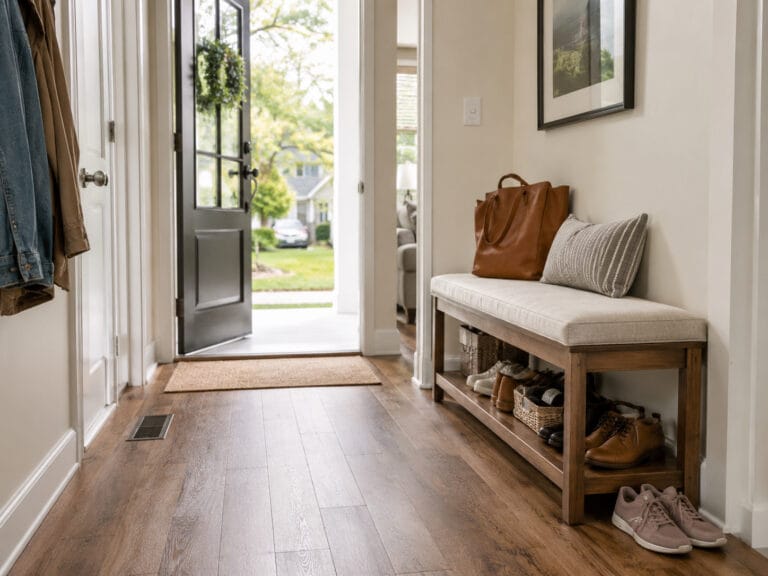
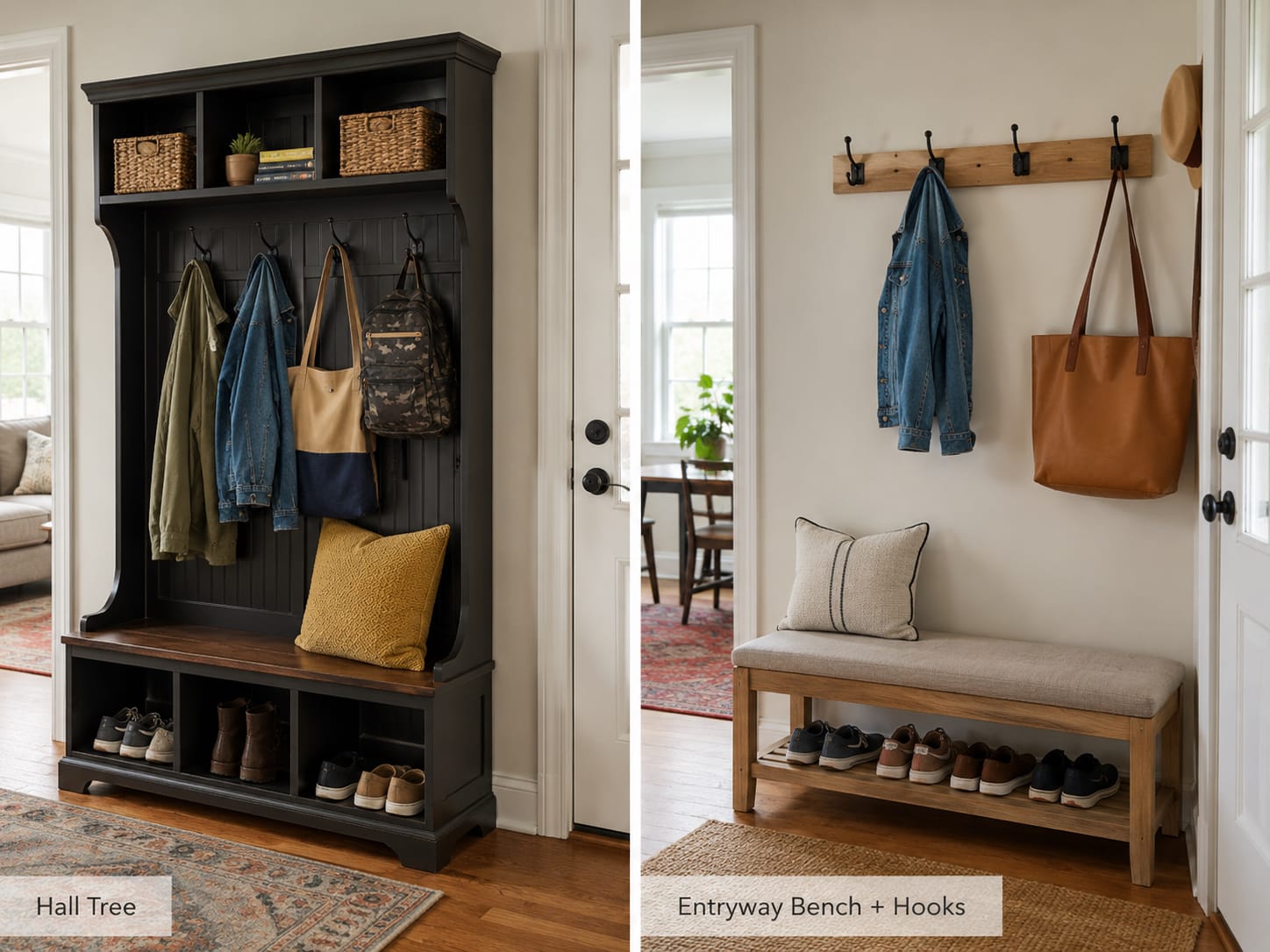
A hall tree and an entryway bench can both make the area near your front door more useful, but they solve different problems.
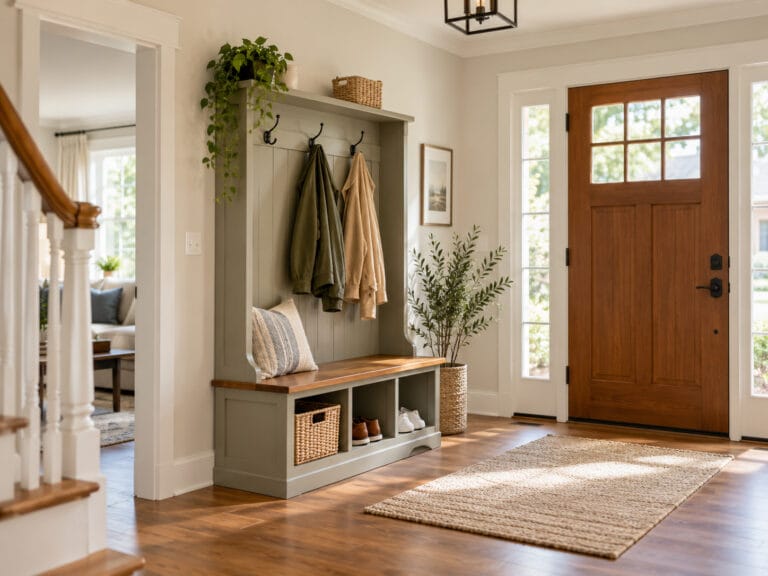
A hall tree is an integrated entryway storage station. It usually combines vertical hooks, seating, shoe storage, and sometimes upper shelves or side compartments in one tall piece of furniture.
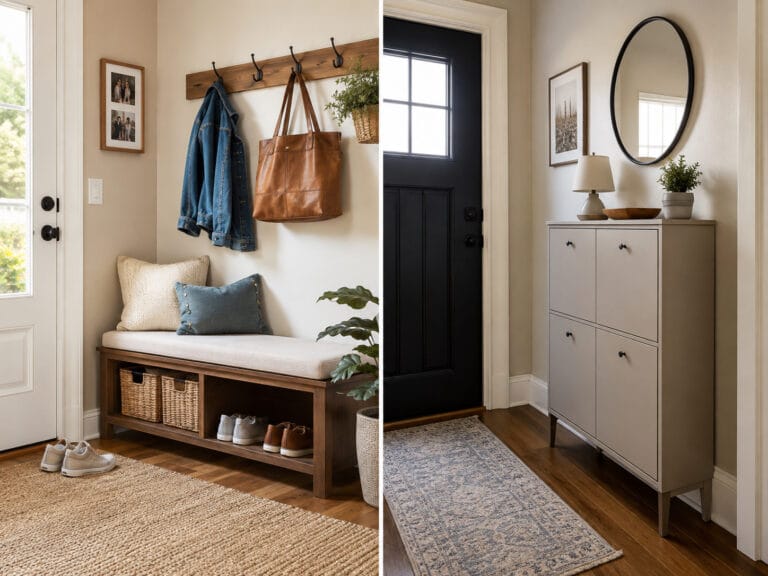
An entryway bench is simpler and lower. It focuses on seating and, depending on the design, shoe or accessory storage while leaving the wall above open for hooks, a mirror, artwork, or nothing at all.
The better choice depends less on which one looks more impressive and more on what your entryway is actually missing.
Choose a hall tree if coats, bags, shoes, and other everyday items all need one organized place near the door.
Choose an entryway bench if your main needs are seating, shoe storage, and a lighter, more flexible layout.
Table of Contents
Quick Answer: Hall Tree or Entryway Bench?
Choose a hall tree if you need:
- coat and jacket hooks;
- bag or backpack storage;
- shoe storage;
- seating;
- one integrated entryway station;
- vertical storage because you do not have a nearby coat closet.
Choose an entryway bench if you want:
- a simple place to sit;
- everyday shoe storage;
- a lower visual profile;
- easier placement along a short or narrow wall;
- flexibility to add separate hooks, a mirror, or shelving later.
In simple terms:
A hall tree organizes more types of entryway items.
A bench gives you more layout flexibility.
Hall Tree vs. Entryway Bench: Key Differences
| Factor | Hall Tree | Entryway Bench |
|---|---|---|
| Seating | Usually built in | Yes |
| Shoe storage | Common | Common on storage models |
| Coat storage | Usually built in | Requires separate hooks |
| Bag storage | Strong | Limited without hooks |
| Vertical storage | High | Low unless paired with wall storage |
| Floor footprint | Varies by model | Varies by model |
| Visual bulk | Higher | Lower |
| Layout flexibility | Lower | Higher |
| Best for | All-in-one entryway storage | Seating, shoes, and flexible wall use |
What Is a Hall Tree?
A hall tree is a tall piece of entryway furniture designed to organize several categories of everyday items in one location.
Most models combine some of the following:
- coat hooks;
- a bench;
- lower shoe storage;
- upper shelving;
- side compartments or cubbies.
Its biggest advantage is vertical organization.
Instead of adding a bench, separate coat rack, and another storage piece, a hall tree can combine those functions within one furniture footprint.
That makes it especially useful when the entryway does not have a built-in coat closet.
The trade-off is its overall presence.
Even when a hall tree does not use dramatically more floor space than a bench, its tall side panels, hooks, upper shelves, and framing can make a small entrance feel much fuller.
What Is an Entryway Bench?
An entryway bench is a lower piece of furniture designed primarily for sitting and, depending on the model, shoe or accessory storage.
Common storage styles include:
- open shoe shelves;
- baskets;
- drawers;
- cabinets;
- lift-top compartments.
The major advantage is flexibility.
Because the furniture stays low, you can decide how — or whether — to use the wall above it.
You might add:
- wall hooks;
- a mirror;
- artwork;
- a shallow shelf.
Or leave the wall open to keep the entrance feeling lighter.
For more detailed sizing guidance, see our entryway bench size guide.
Which Uses Space More Efficiently?
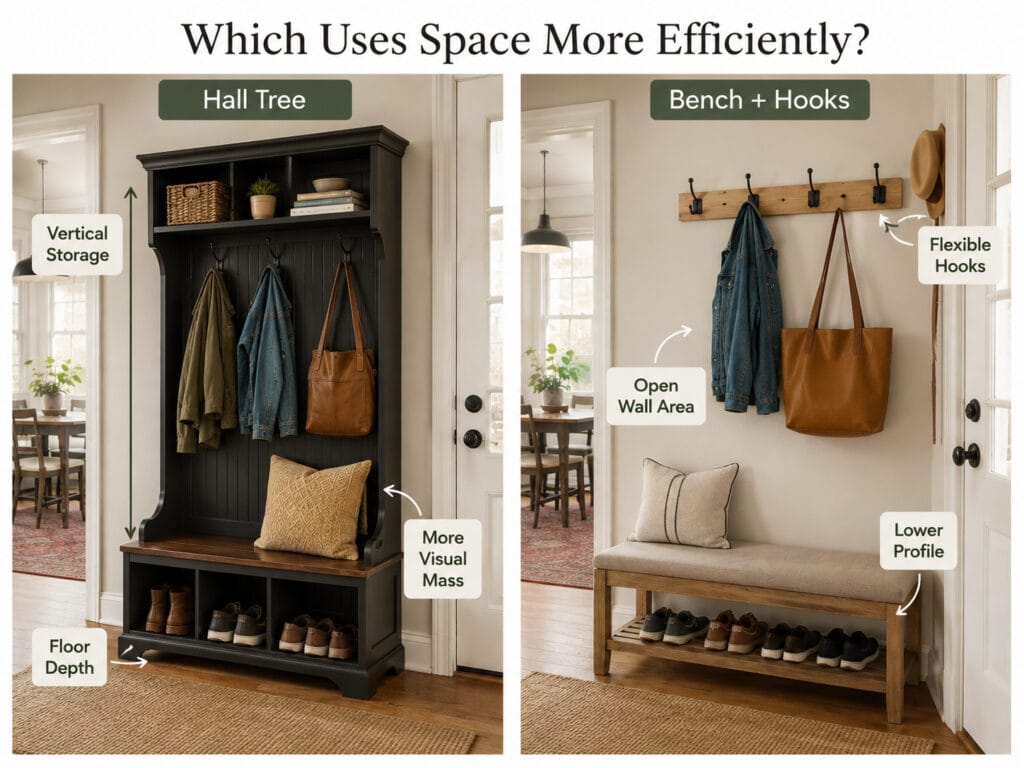
This question has two different answers because floor space and visual space are not the same thing.
Hall Tree: Efficient Vertically
A hall tree can use floor space efficiently because it stacks several functions vertically.
One unit may provide:
- seating;
- coat storage;
- shoe storage;
- bag storage.
That can be more efficient than placing several separate furniture pieces around the entryway.
Entryway Bench: Visually Lighter
A bench generally uses less vertical space.
Even if its floor depth is similar to a hall tree, it leaves much more open wall above it.
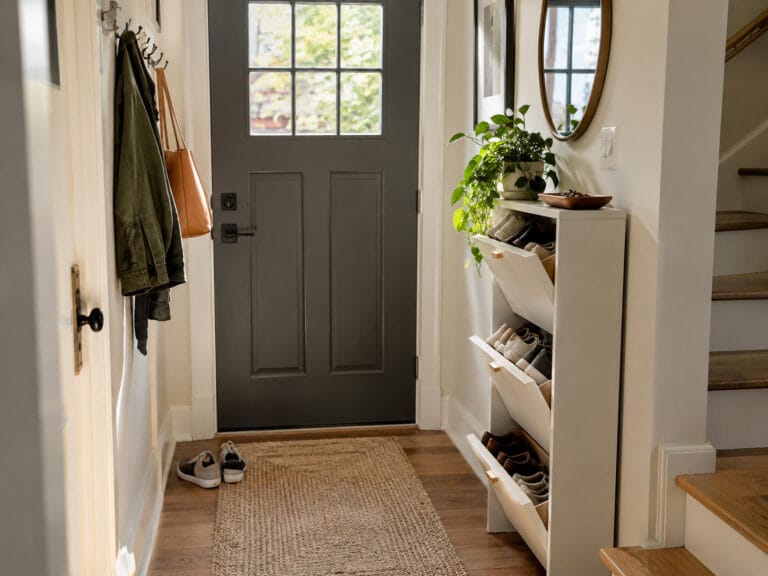
That makes a bench easier to use in:
- narrow hallways;
- open-concept entrances;
- short wall sections;
- spaces where the front door already creates a lot of visual activity.
A useful way to think about it is:
A hall tree can be efficient on the floor and still feel visually much larger than a bench.
Current retail examples show how different the vertical profiles can be. Tall coat-and-shoe storage units can reach well above normal seating height, while a shoe-storage bench remains below the waist. These are product examples rather than industry standards, but they illustrate why two entryway pieces can occupy similar floor depth and still feel very different in the same room.
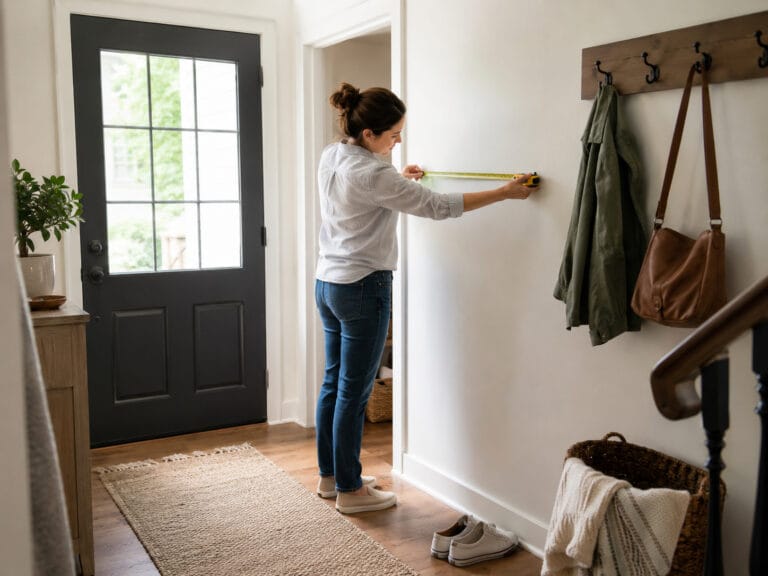
Before choosing either option, measure the actual usable wall, furniture depth, door swing, and remaining walking path.
For the full process, see how to measure your entryway before buying furniture.
Which Organizes More Types of Entryway Items?
A hall tree usually wins on category coverage.
That does not necessarily mean it stores more shoes.
It means it is designed to handle more kinds of things near the front door.
A hall tree can typically organize:
- coats;
- jackets;
- backpacks;
- handbags;
- hats;
- shoes;
- scarves;
- dog leashes;
- other small entryway accessories.
An entryway bench is usually more focused.
It works best for:
- everyday shoes;
- baskets;
- gloves or small accessories;
- occasional bags.
If your main problem is that many different items collect near the door, a hall tree may solve more problems with one piece.
If the main issue is shoes and you already have somewhere to hang coats and bags, a bench may be enough.
More storage functions are only useful when your household actually needs them.
Which Is Better Without a Coat Closet?
This is one of the clearest decision points.
If your entryway does not have a nearby coat closet, a hall tree becomes much more useful.
Its hooks create hanging storage where none exists, while the lower bench and shoe area handle the rest of the entry routine.
One piece can provide a home for:
- jackets;
- bags;
- shoes;
- hats;
- daily accessories.
However, a hall tree is not the only option.
A bench with separate wall hooks can create many of the same functions while giving you more control over the layout.
You can choose:
- hook height;
- hook spacing;
- number of hooks;
- how much open wall to leave.
If the entryway already has a nearby coat closet, ask whether you really need to duplicate hanging storage with a hall tree.
In that case, a simpler bench may be the more efficient choice.
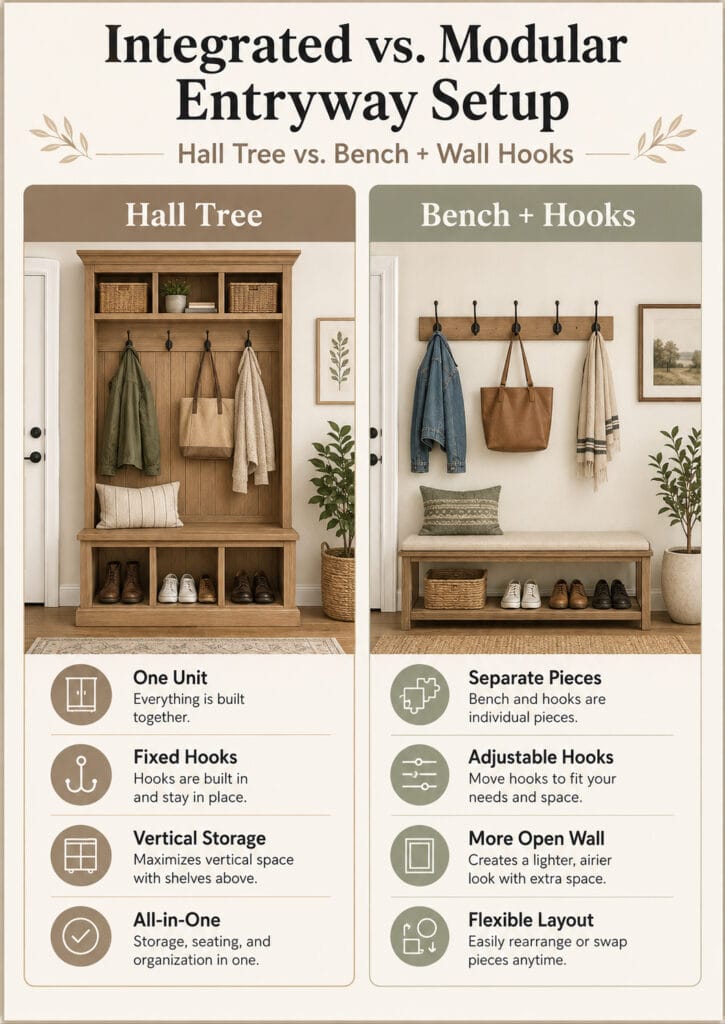
Hall Tree vs. Bench + Wall Hooks: Integrated or Modular?
For many small entryways, this is the more useful comparison.
Both setups can provide seating, shoe storage, coat storage, and a place for bags.
The difference is how fixed the system is.
| Feature | Hall Tree | Bench + Wall Hooks |
|---|---|---|
| Setup | One integrated unit | Separate pieces |
| Hook height | Fixed | Customizable |
| Hook spacing | Fixed | Adjustable |
| Layout flexibility | Lower | Higher |
| Visual consistency | Built in | Depends on chosen pieces |
| Future changes | Larger unit must be adjusted or replaced | Individual components can change |
| Best for | Complete storage station | Irregular or evolving spaces |
Hall Tree
A hall tree is easier when you want an all-in-one solution.
The storage components are already designed to work together, so there is less planning involved.
The downside is that the layout is fixed.
Bench + Wall Hooks
A bench with separate hooks is more modular.
It works especially well when:
- switches interrupt the wall;
- the wall is short;
- hook height needs to vary;
- you want more open wall space;
- you may change the layout later.
If you value customization, the modular setup usually gives you more freedom.
Which Is Better for a Narrow Entryway?
An entryway bench is usually easier to fit into a narrow entrance.
Its lower profile helps keep more wall area open and reduces visual bulk.
It is also easier to work around:
- door trim;
- switches;
- vents;
- nearby doors;
- irregular wall sections.
A hall tree can still work in a narrow entryway if:
- the unit itself is shallow;
- the wall is continuous and unobstructed;
- the front door can open fully;
- hooks do not project too far into the walking path;
- the overall height does not make the entrance feel boxed in.
In tight spaces, the furniture shape matters just as much as its footprint.
For more small-space planning ideas, see our guide to small entryway ideas for tight spaces.
When Is a Hall Tree Too Large?
A hall tree may technically fit and still feel too large for the entrance.
Watch for these signs:
- the furniture visually dominates the entire entryway;
- the front door feels boxed in;
- side panels or hooks interfere with the door swing;
- the lower bench projects too far into the walking path;
- upper shelving makes the entrance feel crowded;
- the unit fills nearly all available wall width and height.
A useful question is:
Do you actually need every function built into the hall tree?
If you already have:
- a coat closet;
- another place for bags;
- only a few daily shoes near the door;
then a large integrated unit may be solving problems you do not really have.
A bench with a few wall hooks may be the cleaner solution.
Check Wall Anchoring and Stability
Because hall trees are tall and may carry coats or bags above the seating area, check the manufacturer’s installation and wall-anchoring instructions.
Tall furniture can become unstable if it is overloaded, pulled on, or not installed as intended.
If the manufacturer provides anti-tip hardware or requires wall attachment, follow those instructions and use fasteners appropriate for your wall construction.
This is especially important in homes with children.
Decision Table: Which One Fits Your Entryway?
| Your Situation | Better First Choice | Why |
|---|---|---|
| No coat closet | Hall tree | Adds hanging storage + seating |
| Narrow hallway | Entryway bench | Lower and visually lighter |
| Coats and bags collect near the door | Hall tree | Organizes more item categories |
| Main problem is shoe storage | Entryway bench | Simpler solution |
| Open-concept entrance | Entryway bench | Keeps the wall visually lighter |
| One tall uninterrupted wall | Hall tree | Uses vertical space efficiently |
| Wall has switches, doors, or other interruptions | Entryway bench | More flexible placement |
| Want one all-in-one piece | Hall tree | Integrated storage system |
| Want a customizable setup | Bench + hooks | Easier to adjust over time |
HomyEntry Fit Check: Before You Choose
Before deciding between a hall tree and an entryway bench, check five things.
1. Measure the Usable Wall
Do not count areas blocked by:
- door trim;
- vents;
- switches;
- outlets;
- front-door swing.
2. Check Furniture Depth
Measure how far the piece extends into the entrance and how much walking space remains.
3. Look at What Actually Collects Near the Door
If the problem is mostly shoes, a bench may be enough.
If coats, bags, backpacks, and shoes all need a home, a hall tree may earn its extra visual presence.
4. Check Vertical Space
A hall tree needs more than floor area.
Look for:
- ceiling clearance;
- wall-mounted lights;
- artwork;
- trim;
- shelves;
- other obstacles.
5. Test the Footprint
Use painter’s tape to mark the furniture footprint on the floor.
Then:
- open the front door;
- walk through the entrance;
- sit where the bench would be;
- carry a bag or package through the space.
For a hall tree, also imagine the full vertical frame above the taped footprint.
If the entrance already feels tight during the test, the real furniture will usually feel larger.
Frequently Asked Questions
Is a hall tree better than an entryway bench?
A hall tree is better when you need coats, bags, shoes and seating in one unit, while a bench is better for simpler seating and shoe storage.
Does a hall tree take more space than an entryway bench?
Not necessarily on the floor, but its tall frame usually creates more visual bulk than a low entryway bench.
Is a hall tree good for a small entryway?
It can work if the unit is shallow and the wall is unobstructed, but a bench is usually easier to fit in a tight entrance.
What can I use instead of a hall tree?
An entryway bench with separate wall hooks can provide similar functions with more flexibility.
Do hall trees need to be anchored to the wall?
Follow the manufacturer’s installation instructions, as many tall furniture pieces should be secured to reduce tip-over risk.
Final Thoughts: Hall Tree or Entryway Bench?
Choose a hall tree when you need a complete vertical storage station for coats, bags, shoes, and seating.
Choose an entryway bench when you want a simpler, lower piece that provides seating and shoe storage while leaving more freedom on the wall above.
For many homes, the real choice is:
integrated storage system vs. modular setup.
A hall tree gives you one complete station.
A bench with separate hooks gives you more flexibility.
Neither is automatically better.
The right choice depends on:
- what your household actually stores near the door;
- whether you already have a coat closet;
- how much usable wall space you have;
- how much visual openness you want to preserve.
If the entrance is tight, start with the smallest amount of furniture that solves the actual problem.
If the entrance lacks hanging storage and several types of everyday items collect near the door, a hall tree may justify its larger visual footprint.
The goal is not to fit the most storage into the entryway.
It is to make the entrance easier to use every day.
If a bench looks like the better fit, see our guide on how to choose an entryway bench with shoe storage before making your final choice.
Ready to plan your entrance? Explore Entryway Solutions for furniture, storage and practical front-door ideas.