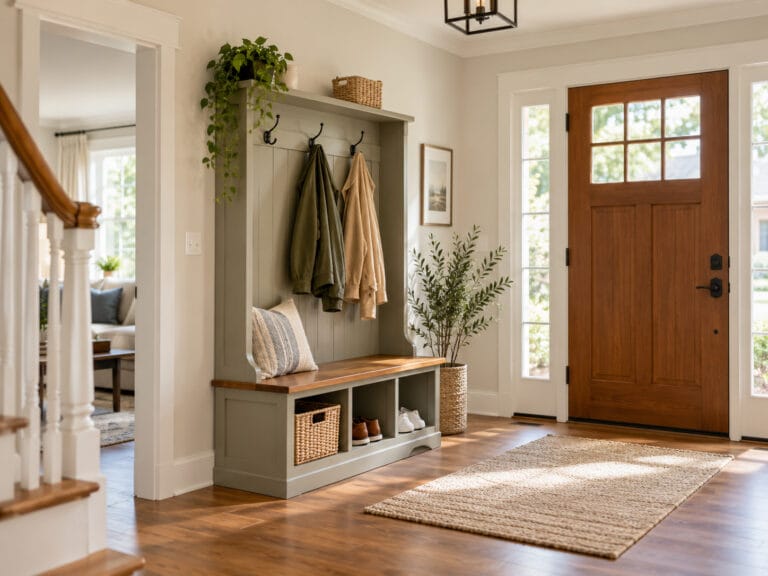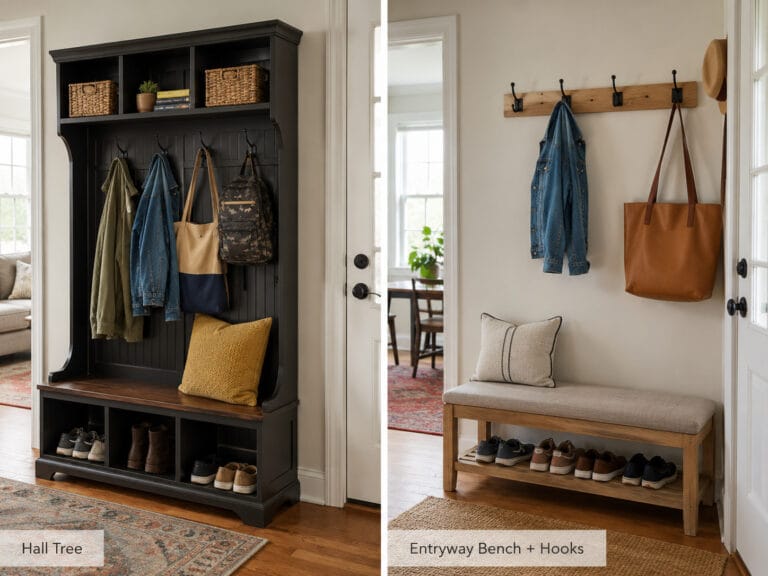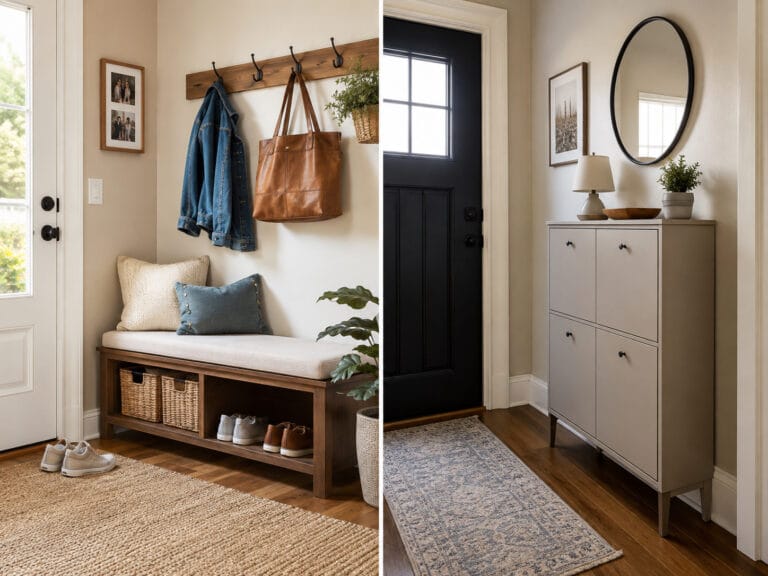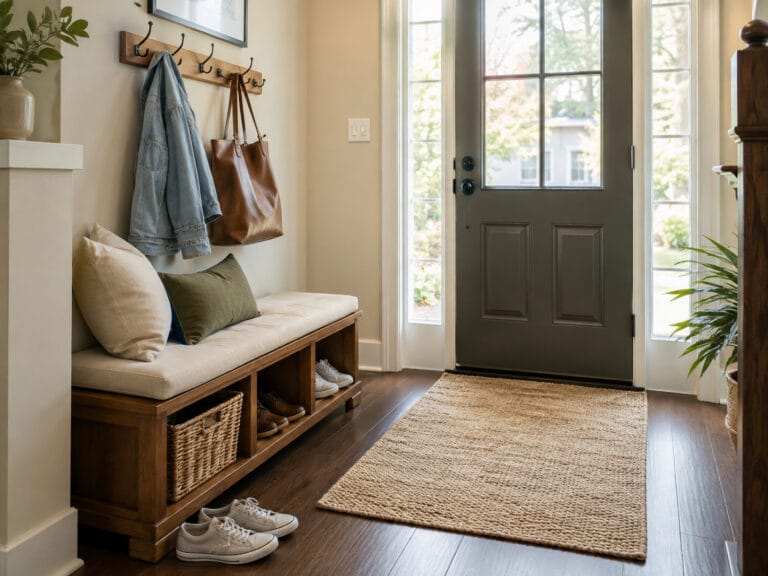
A small entryway does not need a lot of furniture to work well. In fact, adding too much is often what makes the space feel cramped.
The most useful small entryway ideas start with three basics: keep the front door easy to use, preserve a comfortable path into the home, and give everyday items such as shoes, coats, bags and keys a clear place to land.
Once those basics are handled, even a narrow hallway, compact foyer or front door that opens directly into a living room can feel organized and intentional.
The key is to choose furniture and storage for the space you actually have—not for the perfectly staged entryway in a product photo.
Table of Contents
Start With the Door and Walking Path
Before choosing a bench, shoe cabinet or console table, look at how people actually move through the entryway.
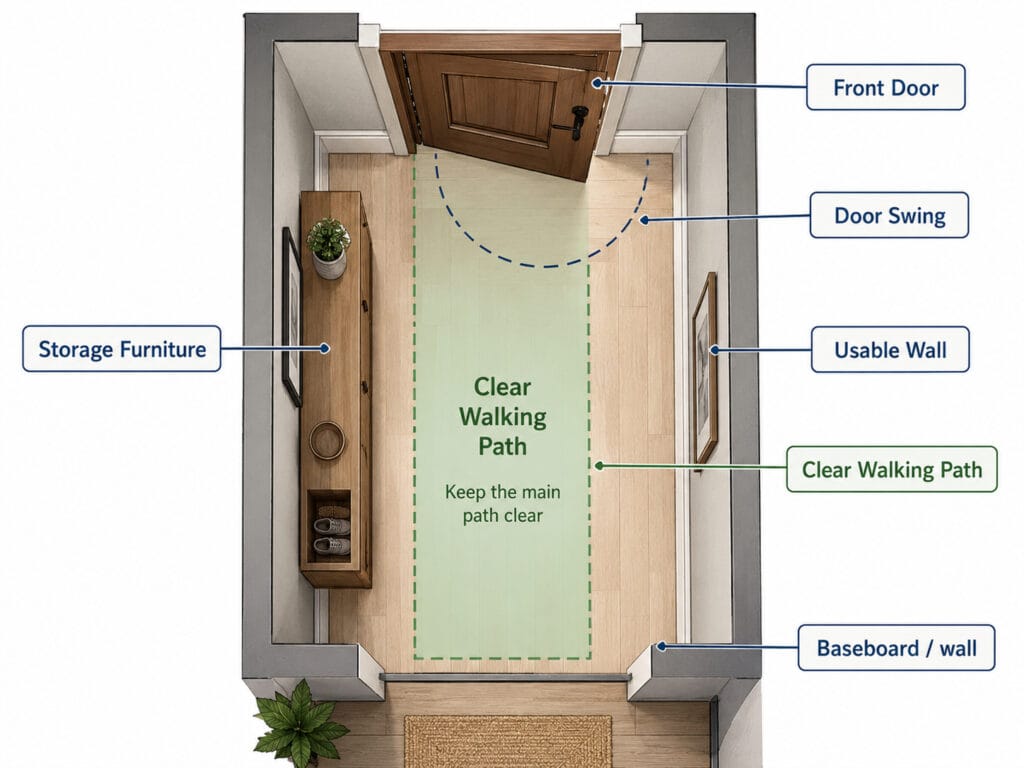
The front door needs room to open, people need a clear place to step inside, and the main path into the home should not feel squeezed by furniture. This matters especially in narrow entryways, where a cabinet may fit the wall but still project too far into the walkway.
Start by measuring the usable wall, not simply the total wall. Check the door swing, nearby closet doors, vents, outlets, switches and trim, then compare those limits with the furniture depth.
Don’t Forget the Baseboard
A cabinet’s listed depth may not equal how far it actually projects into the room.
If the back cannot clear the baseboard, the cabinet may sit slightly away from the wall. Some slim storage pieces include a recessed or cut-out back for this reason, so check the installation drawing as well as the listed width, depth and height.
Use Accessibility Dimensions as a Reference
For context, the 2010 ADA Standards generally use a 36-inch minimum clear width for accessible walking surfaces, with limited exceptions.
That is not a universal furniture-clearance rule for every private home. The practical takeaway is simply this:
A piece can technically fit and still make an entryway uncomfortable to use.
Households that regularly move a stroller, mobility aid, groceries or bulky bags through the entrance may benefit from leaving more open space.
Try the Painter’s-Tape Test
Before ordering, use painter’s tape to mark the full furniture footprint on the floor, especially its depth.
Then test the layout the way you actually use the entryway: open the front door fully, carry in grocery bags, set down a package, and have another person walk past.
If the taped footprint already feels intrusive, the real furniture will usually feel larger once it has height and visual mass.
For a complete measuring process, see our guide to measuring your entryway before buying furniture.
Choose One Piece That Solves More Than One Problem
In a small entryway, every piece of furniture should earn the floor space it occupies.
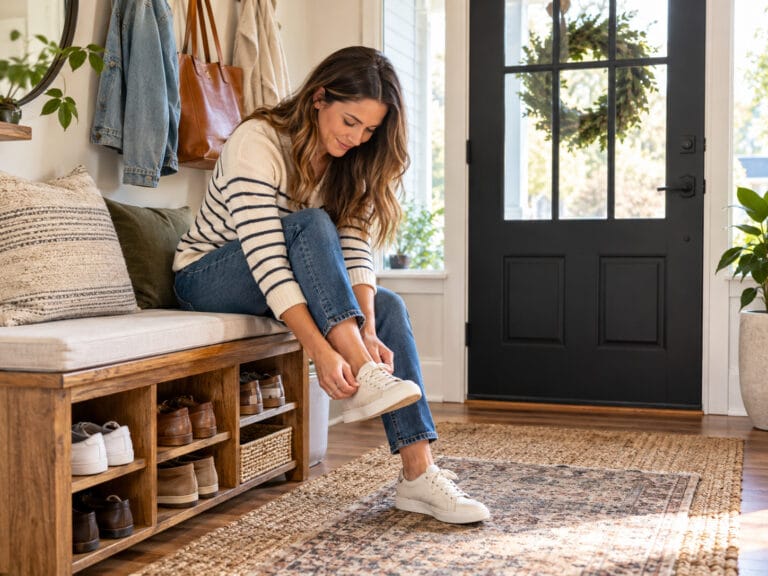
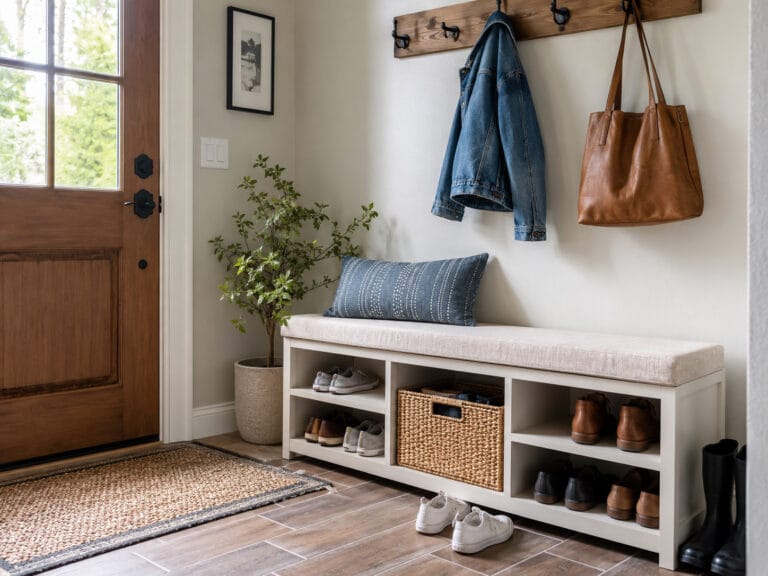
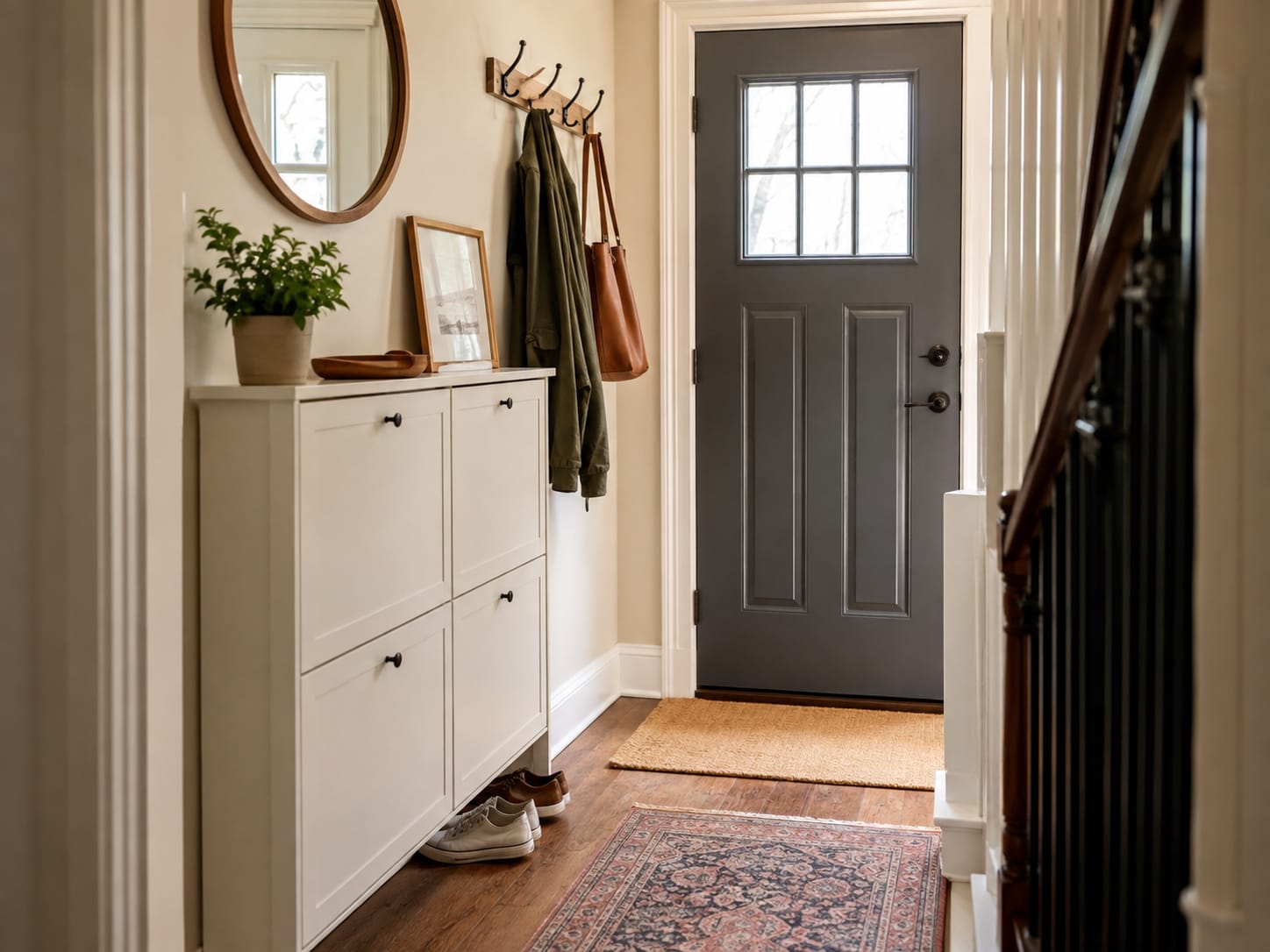
A storage bench can provide a place to sit while putting on shoes and storage underneath. A hall tree can combine seating, hooks and vertical organization. A slim shoe cabinet can hide footwear while providing a small surface for keys, sunglasses or mail.
The best option is not necessarily the one with the most features.
It is the one that solves the problem your household actually has.
If everyone removes shoes at the door, shoe storage may deserve most of the available space.
If coats and backpacks are constantly landing on nearby chairs, wall hooks or a hall tree may be more useful.
If the entryway only needs a place for keys and a few small items, a shallow console or wall-mounted shelf may be enough.
Avoid adding a bench, shoe cabinet, coat rack and console simply because each piece seems useful by itself. Four useful pieces can still create one overcrowded entryway.
If you are already comparing furniture options, browse our Entryway Furniture & Storage collection to see how different furniture types solve different entryway needs.
Use Vertical Space Before Taking More Floor Space
When floor space is limited, look up.
Wall hooks, shelves and taller storage can hold coats, hats, bags and other everyday items without taking more walking space.
This is especially useful when the front door opens directly into a living room. A small section of wall beside the door can become a simple arrival zone with hooks or a shallow shelf above and shoe storage below.
Organize vertical storage by how often items are used:
- shoes and heavier items stay low;
- everyday bags and jackets stay within easy reach;
- less frequently used items can go higher.
Leave some wall space open rather than filling every inch. A little visual breathing room can make a small entryway feel calmer and easier to use.
Safety Matters With Tall or Narrow Storage
Tall or narrow storage can save floor space, but it should be installed securely.
Follow the manufacturer’s anchoring instructions. The U.S. Consumer Product Safety Commission recommends securing furniture that could tip, especially in homes with children, and many slim cabinets require wall fastening.
Choose Shoe Storage Based on Depth, Not Just Capacity
Shoes are one of the easiest ways for a small entryway to feel cluttered, but the largest organizer is not always the best fit.
In a tight space, depth can matter just as much as capacity.
A storage bench may work well when you also want seating, while a slim tilt-out cabinet can preserve more walking space in a narrow hallway. Open storage keeps daily shoes easy to reach; closed storage creates a cleaner look.
Real-World Depths Can Vary
The word slim is not a standardized furniture dimension.
As a current U.S. retail reference, IKEA shoe-storage products range from roughly 6¾ inches deep for some narrow models to about 11 inches for others.
Those measurements are not industry standards. They simply show why it is better to check the actual product depth than to rely on labels such as slim, narrow or space-saving.
Store the Shoes You Actually Use
A household may own dozens of pairs, but only a smaller group usually needs to stay near the front door.
Designing the entryway around daily footwear can reduce the amount of storage furniture you need. Seasonal boots, special-occasion shoes and backup pairs can usually live elsewhere.
Also, do not rely on advertised pair count alone. Men’s sneakers, high-tops, work shoes and winter boots can use much more space than low-profile shoes.
Check the usable interior dimensions and compartment layout, not just the number of pairs listed on the product page.
| Shoe Storage Type | Best When | Main Space Check |
|---|---|---|
| Slim tilt-out cabinet | The hallway is narrow | Cabinet depth and wall attachment |
| Storage bench | You want seating + shoe storage | Bench depth and room to sit |
| Open shoe rack | Fast daily access matters most | Visual clutter and shoe depth |
| Closed shoe cabinet | You prefer a cleaner look | Door or drawer opening space |
| Wall-mounted storage | Floor space is extremely limited | Wall construction and installation |
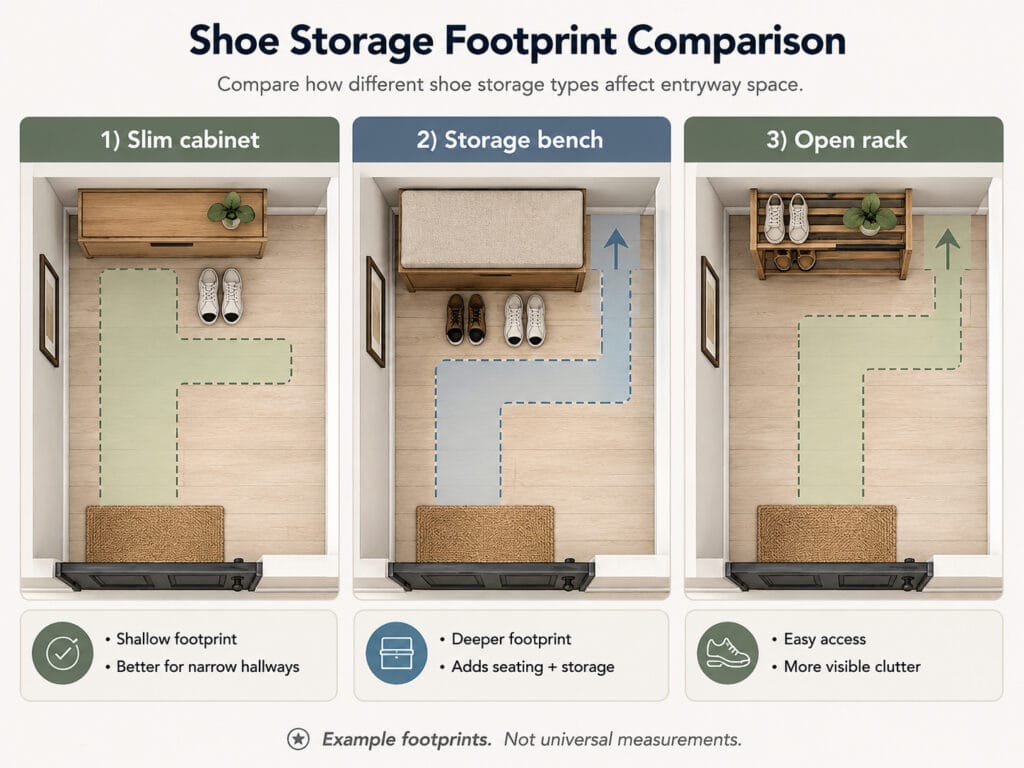
For a closer comparison of these options, see our entryway shoe storage ideas for small spaces.
Decide Whether You Really Need a Bench
An entryway bench is useful, but it is not required.
It makes the most sense when sitting down to put on or remove shoes is part of your everyday routine and there is enough room in front of the bench to use it comfortably.
A bench with storage underneath can also reduce the need for a separate shoe rack.
But in a very narrow entry, a bench may take more floor depth than the space can comfortably give up.
A slim shoe cabinet with a movable stool—or even wall-mounted storage with no permanent seating—may work better.
If you are deciding between hidden shoe storage and permanent seating, our entryway bench vs. shoe cabinet guide explains the tradeoffs in more detail.
And if you already know you want seating, use our entryway bench size guide before choosing a width or depth.
The important question is not:
“Can a bench physically fit here?”
It is:
“Does the entryway still work normally after the bench is added?”
Create a Simple Drop Zone for Everyday Items
Small entryways become cluttered quickly when everyday objects do not have an obvious destination.
Think about what normally enters the house with you:
keys, sunglasses, mail, a dog leash, reusable shopping bags, a purse, backpack or jacket.
The best drop zone is usually close enough to the door that using it takes almost no extra effort.
A small tray on top of a shoe cabinet may be enough for keys and sunglasses. Wall hooks can hold bags and jackets. A basket can collect items that need to leave the house again.
Think of a small entryway as a daily-use zone, not overflow storage.
The space closest to the front door should usually be reserved for things that actually leave the house regularly. Seasonal boots, backup coats and rarely used bags probably do not deserve prime entryway space.
That distinction helps keep storage furniture from slowly becoming a permanent clutter container.
Pick Furniture That Matches the Shape of the Entryway
Not all small entryways have the same problem.
Some are narrow, some are shallow, and others have limited usable wall space because of doors or openings. The best furniture choice depends on which constraint matters most.
| Entryway Problem | Better First Choice | Why | Check Before Buying |
|---|---|---|---|
| Narrow hallway | Slim shoe cabinet + wall hooks | Preserves more floor depth | Remaining walking path |
| Small square foyer | Compact storage bench | Combines seating and shoe storage | Front-door swing |
| Door opens into living room | Wall hooks + shallow cabinet | Creates a landing zone without bulky furniture | Visual connection to living room |
| Very short usable wall | Compact bench or narrow cabinet | Avoids oversized furniture | Actual usable wall width |
| No coat closet | Hall tree or vertical storage | Uses height for coats and bags | Depth, stability and visual bulk |
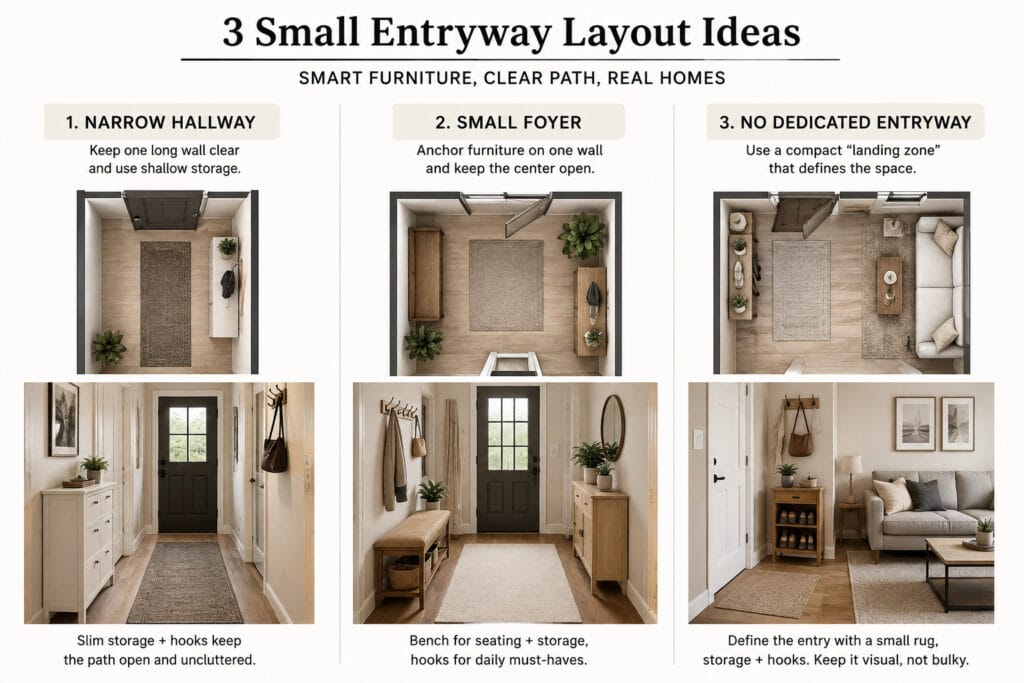
Layout 1: A Narrow Hallway
In a narrow hallway, furniture depth is usually the first measurement to watch.
A slim cabinet with wall hooks above can solve storage needs without taking as much floor space as a full-depth bench and separate coat rack. Keep the opposite side as open as possible so the entry still functions like a passage.
Layout 2: A Small Square Foyer
A compact foyer may have room for a bench, but the front-door swing should still guide the layout.
Place one main piece where it does not interfere with the door, then use the wall above for hooks or a mirror instead of adding more floor-standing furniture.
Layout 3: No Dedicated Entryway
If the front door opens directly into a living room, create a small landing zone instead of trying to build a full foyer.
A rug or mat can define the area, while wall hooks, a shallow shelf and compact shoe storage give everyday items a place to stop before they spread into the room.
Keep the Entryway Visually Light
Storage solves physical clutter, but visual clutter matters too.
Too many furniture styles, baskets, hooks, signs, plants and decorative objects can make a small entryway feel busy even when everything has a place.
Start with function, then add decor. A mirror adds usefulness without taking floor space and can help reflect available light. One tray or small decorative object is usually enough for a cabinet top.
Closed storage can create a calmer look, especially when the entryway is visible from the living or dining area. Open hooks and cubbies can work just as well when the number of visible items is controlled.
The goal is balance, not hiding everything.
Avoid These Common Small Entryway Mistakes
Many entryway problems begin before the furniture even arrives.
Buying by width alone.
A piece can fit the wall perfectly and still project too far into the walkway.
Ignoring the front-door swing.
Test the entire path of the door, including the handle.
Forgetting the baseboard.
A cabinet that cannot sit flush against the wall may occupy more room than its listed depth suggests.
Trying to store everything at the entrance.
Keep prime entryway space focused on frequently used items.
Using too many single-purpose pieces.
One multifunctional piece can often replace several smaller ones.
Choosing storage before identifying the problem.
If shoes create the clutter, prioritize shoes. If coats and bags are the issue, another shoe rack will not solve it.
Forgetting how furniture opens.
Drawers, cabinet doors, baskets and lift-top benches all need additional working space.
Ignoring furniture stability.
Tall or narrow storage should be installed according to the manufacturer’s anchoring instructions.
Filling every open wall.
Some empty space is useful. An entryway also needs temporary room for people, packages, shopping bags and the normal mess of arriving home.
The HomyEntry Fit Check
Before buying furniture for a small entryway, check the space in this order:
- Measure the usable wall width.
Account for trim, switches, outlets, vents and other obstructions. - Mark the full front-door swing.
Include the door handle and the space needed to operate the door comfortably. - Check furniture depth.
Look at how far the piece will actually project into the room once installed. - Check the remaining walking path.
Test the layout the way your household actually uses the entry. - Open everything.
Make sure drawers, cabinet doors, baskets and storage lids can operate normally. - Confirm the furniture is usable—not merely placeable.
A bench needs room for someone to sit. A cabinet needs room to open. - Tape out the footprint before ordering.
Walk through it carrying the things you normally bring home.
If the taped layout already feels tight on the floor, the real furniture will usually feel tighter once it has height, visual mass and stored items around it.
That simple check can eliminate many poor furniture choices before they turn into return problems.
Frequently Asked Questions
What furniture works best in a small entryway?
Furniture that solves more than one everyday problem is usually the most efficient choice. Depending on the space, that may be a storage bench, slim shoe cabinet, hall tree or shallow console. The best option is the one that solves your household’s main storage problem without interfering with the front door or walking path.
How can I add shoe storage without making a narrow entryway feel crowded?
Pay close attention to furniture depth. Slim or wall-mounted shoe storage can preserve more walking space than a deeper bench or traditional cabinet. Store primarily the shoes used near the front door rather than trying to fit the household’s entire shoe collection in the entryway.
Is an entryway bench necessary in a small space?
No. A bench is worthwhile when you regularly sit to put on shoes and there is enough space to use it comfortably. In a very narrow entryway, a slim shoe cabinet, wall hooks or a movable stool may make better use of the available floor area.
Make the Entryway Do One Job Well
A small entryway does not need to look like a full mudroom.
It needs to make coming and going easier.
Start with how the door opens and how people move through the space. Identify what creates the most everyday clutter. Then choose the smallest amount of furniture and storage that solves those problems.
For one household, that may be a storage bench and a row of hooks.
For another, it may be a slim shoe cabinet with nothing else permanently occupying the floor.
When the entryway remains easy to walk through, easy to use and easy to reset at the end of the day, the space is doing its job.