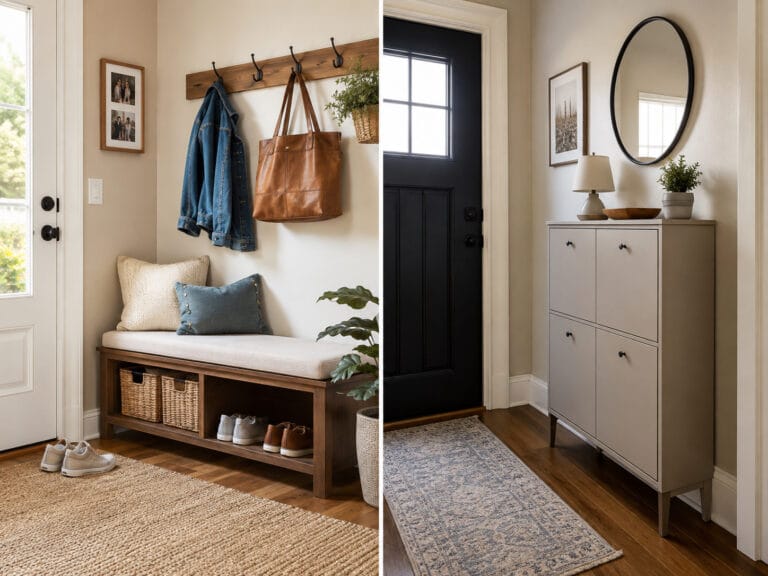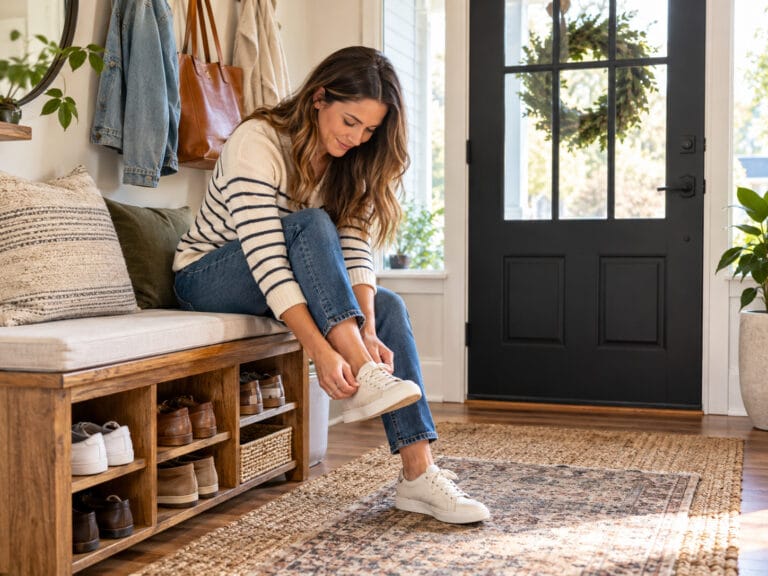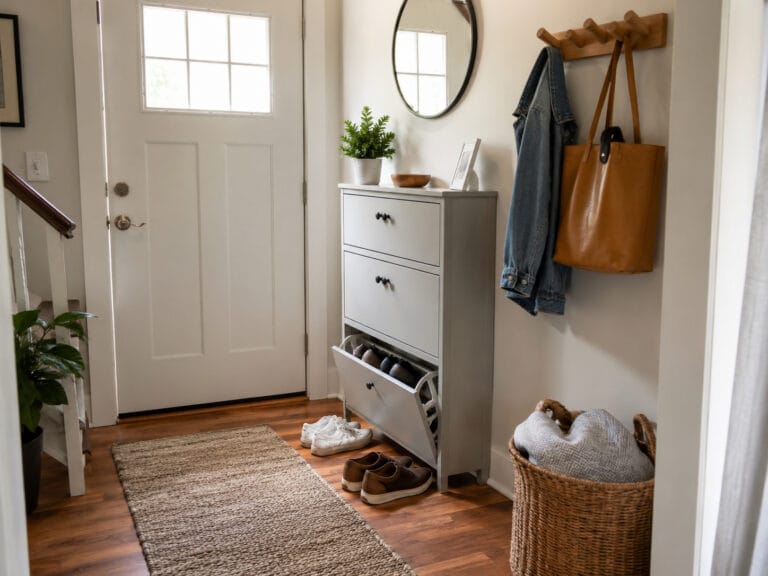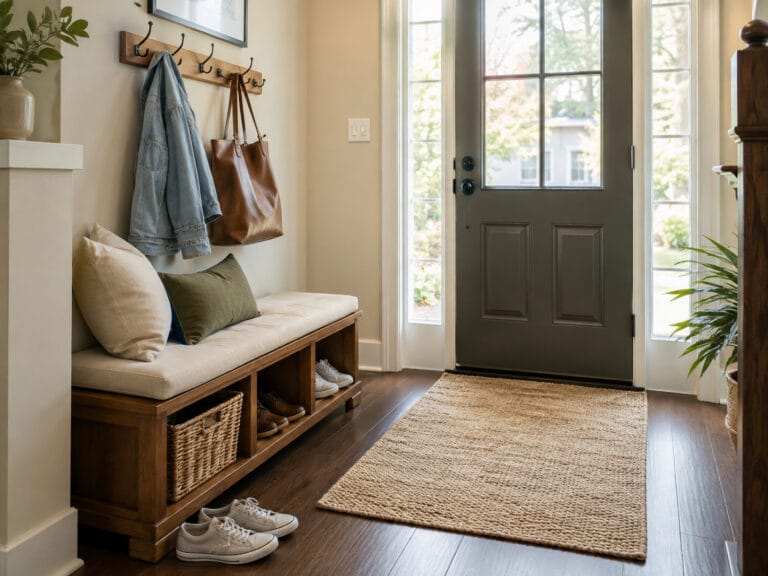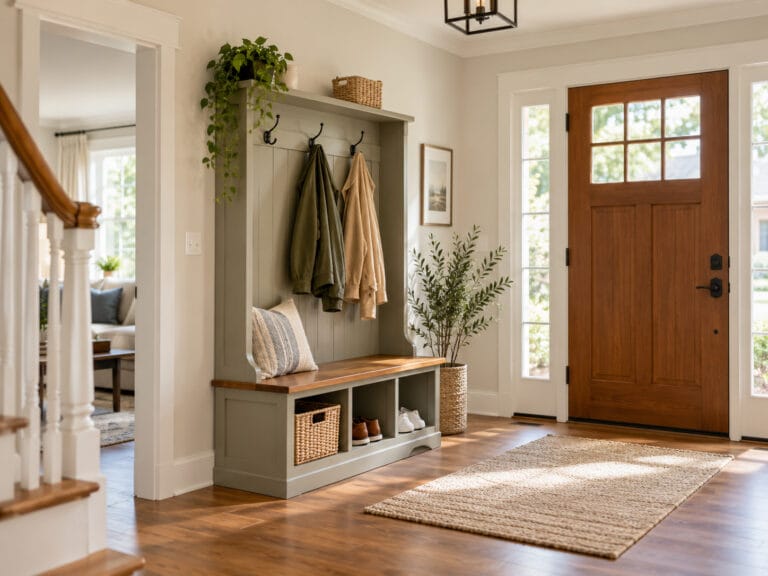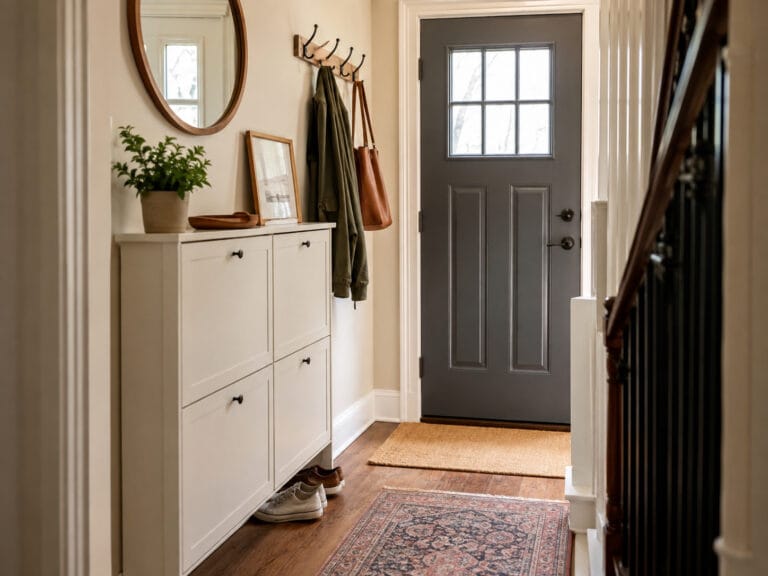
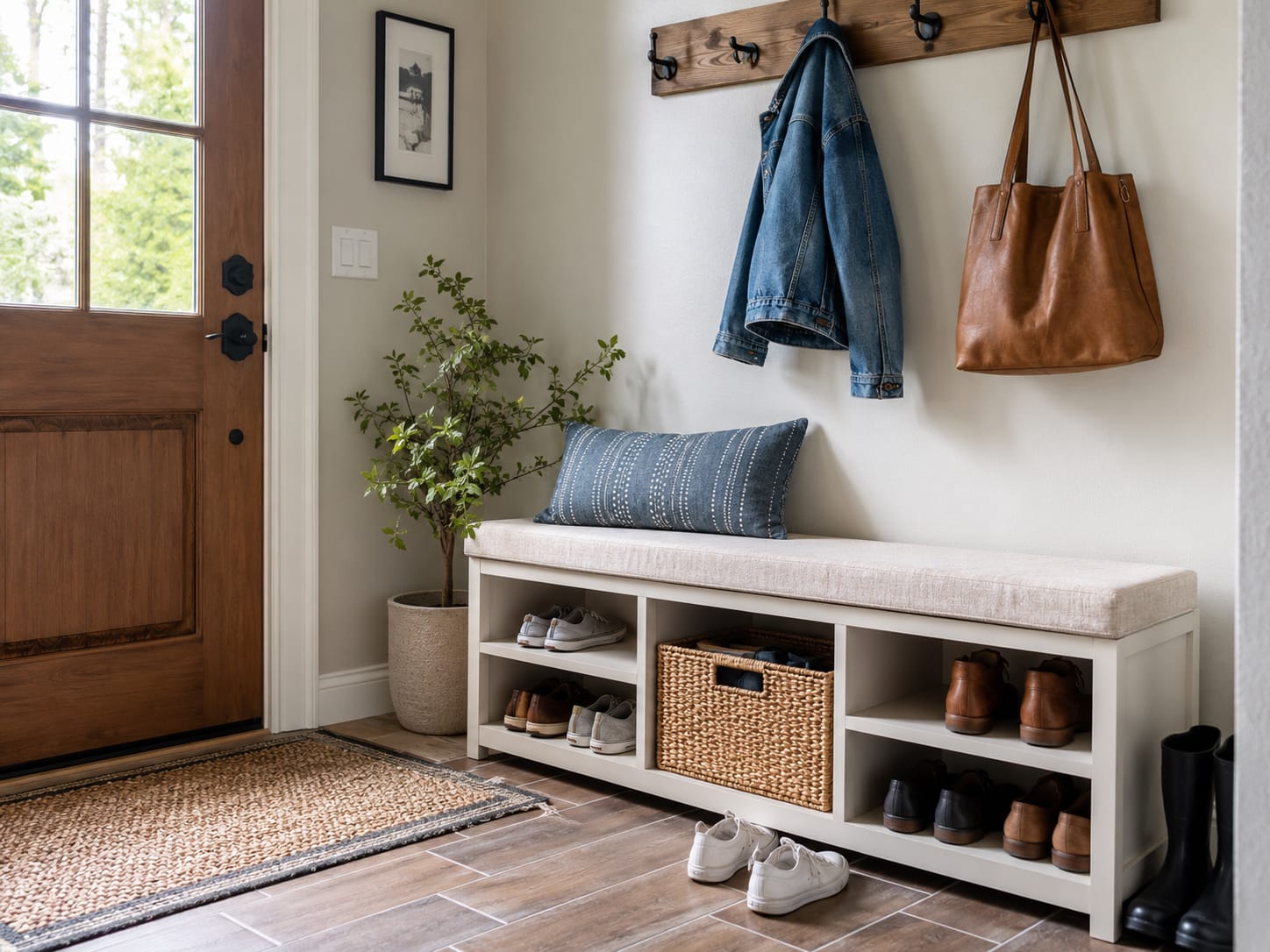
An entryway bench with shoe storage can solve several everyday problems at once.
It gives you a place to sit while putting on shoes, keeps frequently used footwear near the front door, and helps prevent the entrance from becoming a collection point for shoes, bags, pet gear, and other daily items.
But not every storage bench works well in every entryway.
A bench can be the right width and still feel too deep. It can advertise plenty of shoe storage but have compartments that do not fit your actual footwear. A lift-top design may look convenient online but become frustrating if nearby hooks or shelves prevent the lid from opening fully.
The best way to choose an entryway bench is to start with your space and daily routine, not the product photo.
This guide walks through the measurements, storage styles, seating needs, and practical details worth checking before you buy.
Table of Contents
Measure the Available Space First
Before comparing benches, measure the part of the entryway where the furniture will actually sit.
Do not assume the entire wall is usable.
Your available width may be reduced by:
- door trim;
- baseboards;
- outlets;
- light switches;
- floor or wall vents;
- nearby closet doors;
- the front-door swing.
Measure the usable wall width, then check how far a bench can project into the room without making the entrance difficult to use.
Also look above the bench.
Wall hooks, mirrors, artwork, and shelves can affect whether the bench fits visually and whether lift-top storage can open properly.
The goal is not simply to make the furniture fit the wall. The goal is to keep the entrance working normally after the bench is installed.
For the complete process, see our guide on how to measure your entryway before buying furniture.
Choose the Right Bench Depth
In a small or narrow entryway, depth can matter more than width.
Depth determines how far the bench extends from the wall into the walking path.
A deeper bench may offer:
- a more generous seat;
- larger shoe compartments;
- more hidden storage.
But it also takes away more floor space.
A shallower bench helps preserve the walkway, although the trade-offs may include:
- less seat depth;
- smaller storage compartments;
- less room for bulky shoes.
The best approach is not to choose the shallowest bench you can find.
Choose the shallowest bench that still works comfortably for your household.
As a current retail reference, IKEA U.S. hallway benches vary noticeably in depth across models, which is a useful reminder that labels such as “compact” or “space-saving” are less important than the actual measurements.
A simple planning relationship can help:
Entryway width − bench depth = remaining walking space
This is not a building-code formula. It is simply a practical way to understand how much open space will remain after the bench is installed.
For more detail, see our entryway bench size guide and entryway bench clearance guide.
Decide How Many Shoes Actually Need Storage
A storage bench does not need to hold every pair of shoes your household owns.
For a small entryway, it is usually more practical to treat the area as a daily shoe rotation zone.
That might include:
- everyday sneakers;
- work shoes;
- kids’ school shoes;
- current-season outdoor footwear.
Special-occasion shoes, off-season footwear, and rarely used pairs can usually live elsewhere.
This matters because oversized storage often leads to oversized furniture.
Instead of asking:
“How many pairs can this bench hold?”
ask:
“How many pairs actually need to stay near the door every day?”
That question usually leads to a more useful bench size.
For broader organization strategies, see our guide to entryway shoe storage ideas for small spaces.
Compare Open Cubbies, Closed Cabinets and Lift-Top Storage
The storage style changes how the bench works every day.
| Storage Style | Best For | Main Advantage | Main Trade-Off |
|---|---|---|---|
| Open cubbies | Frequently used shoes | Fast access and airflow | Shoes remain visible |
| Closed cabinets | Cleaner-looking entryways | Hides footwear and clutter | Needs door-opening space |
| Lift-top storage | Bags and accessories | Large hidden compartment | Less convenient for daily shoes |
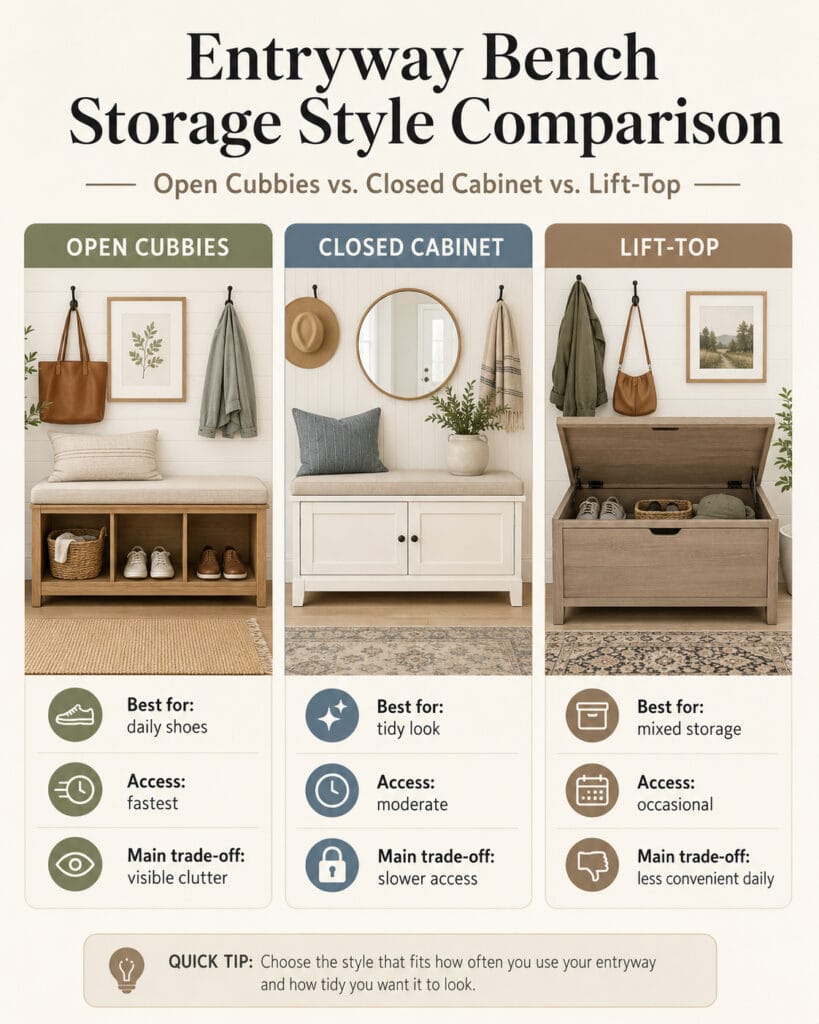
Open Cubbies
Open cubbies work well when quick access matters most.
They are especially practical for:
- sneakers;
- casual shoes;
- kids’ footwear.
Because the shoes remain visible, they are easy to grab and easier to air out after outdoor use.
The downside is visual clutter. If too many pairs accumulate, a small entryway can quickly look messy.
Closed Cabinets
Closed storage creates a cleaner appearance by hiding shoes behind doors.
This can work especially well when the front door opens directly toward a living room or dining area.
However, the cabinet doors need room to open, and wet or muddy shoes should be allowed to dry before being shut inside an enclosed compartment.
Lift-Top Storage
Lift-top benches create hidden space under the seat.
They are often better for:
- gloves;
- hats;
- scarves;
- bags;
- seasonal accessories.
For shoes that are used several times a day, lift-top storage may be less convenient because you need to open the seat every time.
The best storage style depends on what you plan to store and how often you need it.
Check the Shoe Compartment Dimensions
One of the easiest mistakes to make when buying online is looking only at the outside dimensions.
The inside dimensions matter just as much.
A bench may look large enough but still have compartments that are too shallow or too short for your actual shoes.
Before ordering, look for:
- usable compartment width;
- usable interior depth;
- shelf height;
- divider placement;
- adjustable or removable shelves.
Different footwear creates different storage needs.
| Shoe Type | What to Check |
|---|---|
| Everyday sneakers | Shelf depth and width |
| Large athletic shoes | Wider and deeper compartments |
| Hiking or work shoes | Extra depth and height |
| Kids’ shoes | Low, easy-access storage |
| Tall boots | Vertical clearance or adjustable shelving |
Advertised shoe capacity should be treated as an estimate.
A bench listed as holding several pairs may fit fewer if your household wears large sneakers, boots, or thick-soled outdoor shoes.
If the product page only provides exterior measurements, check the assembly diagram or interior specifications before buying.
Consider Seating Width
An entryway bench is still a seat.
That means width should be chosen based on how people will actually use it.
A compact bench may work well for one person putting on shoes.
A wider bench may be more useful if:
- two children sit at the same time;
- two adults regularly use the entryway together;
- the bench also serves as temporary guest seating.
But do not choose the widest bench simply because the wall allows it.
Leaving some open wall space can make a small entryway feel less crowded and may give you room for:
- an umbrella stand;
- a narrow basket;
- wall hooks;
- a small landing area for daily items.
The goal is not to fill the wall.
The goal is to provide enough seating for the way the entryway is actually used.
Check Weight Capacity and Support
Weight capacity is easy to overlook when a bench is marketed mainly as shoe storage.
But if people will sit on it regularly, the manufacturer’s stated capacity matters.
Check:
- the listed maximum load;
- frame construction;
- leg design;
- center support;
- how the seat connects to the frame.
A wider bench may need additional center support to reduce flexing over time.
Do not assume a longer bench automatically supports more weight.
For example, current retail models can have very different stated load limits, so this is a specification worth checking product by product rather than guessing from appearance.
If two people may sit on the bench at once, make sure the stated capacity and support structure are suitable for that use.
Consider Cushion Comfort and Cleaning
A cushioned bench may feel more comfortable, but the cushion becomes part of the maintenance routine.
Entryways regularly deal with:
- outdoor dust;
- wet jackets;
- pet hair;
- muddy shoes;
- everyday spills.
For high-use households, look for:
- removable cushion covers;
- washable or easy-clean fabrics;
- stain-resistant surfaces;
- cushions that stay securely in place.
A loose cushion that constantly slides forward can become annoying very quickly.
For homes with children, pets, or frequent outdoor traffic, a wood or wipeable seat may actually be easier to maintain than thick upholstery.
Comfort matters, but so does how easy the bench is to live with after six months of daily use.
Check Door, Drawer and Lid Opening Space
A bench can fit perfectly when everything is closed and still be difficult to use.
Before buying, think about the furniture in its active-use position.
Drawers
How far will they extend into the walkway?
Cabinet Doors
Can they open fully without hitting the front door, another piece of furniture, or the opposite wall?
Lift-Top Seats
Is there enough vertical space above the bench?
Hooks or shelves mounted too low can block the lid.
Pull-Out Baskets
Can they be completely removed without blocking the entrance?
A useful rule is:
A storage feature only counts if you can open and use it comfortably.
This matters especially in narrow entryways, where a few extra inches of opening space can temporarily block the main path.
Match the Bench to Your Daily Routine
Two benches with similar dimensions can feel completely different depending on how your household uses the entrance.
Ask yourself:
- Does everyone sit down to change shoes?
- Do children need to reach their own footwear?
- Are outdoor shoes often wet or muddy?
- Do bags, gloves, or pet accessories also need storage?
- Do several people use the entryway at the same time in the morning?
If your priority is fast shoe access, an open-cubby bench with a simple seat may work best.
If your priority is a cleaner appearance, closed storage with a comfortable cushion may be better.
If you need to organize more than shoes, a mixed-storage design with cubbies, baskets, or lift-top space may make more sense.
The bench should fit the routine your household already has rather than forcing everyone to change how they use the entrance.
Quick Buying Decision Table
| Your Priority | Look For |
|---|---|
| Narrow entryway | Shallower bench |
| Quick daily shoe access | Open cubbies |
| Cleaner appearance | Closed compartments |
| Boots or bulky footwear | Adjustable or open storage |
| Kids using the bench | Low, easy-access shoe storage |
| Frequent sitting | Comfortable seat + verified weight capacity |
| Bags and accessories | Lift-top or mixed storage |
HomyEntry Fit Check: Entryway Bench Buying Checklist
Before ordering, run through this checklist.
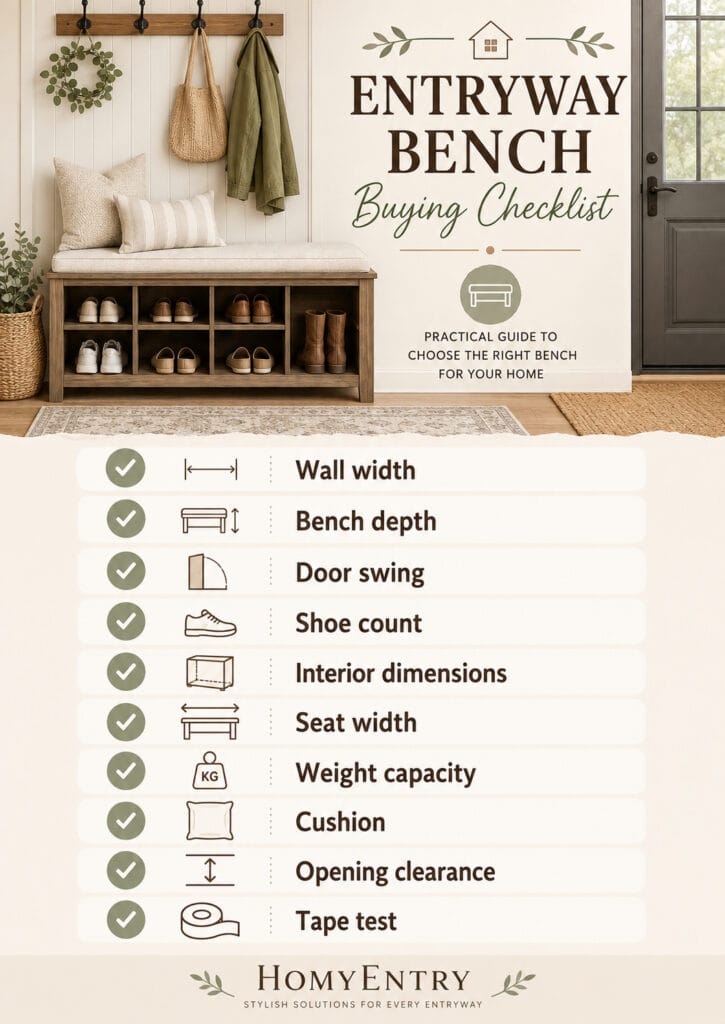
□ Measure the usable wall width, not the entire wall.
□ Check the front-door and closet-door swing.
□ Compare the bench depth with the remaining walking space.
□ Count the shoes that actually need to stay near the door.
□ Measure your largest frequently used shoes.
□ Check the internal storage dimensions.
□ Confirm the seating width matches how many people will use it.
□ Verify the manufacturer’s stated weight capacity.
□ Check whether the cushion is removable or easy to clean.
□ Test the opening space for drawers, cabinet doors, baskets, or a lift-top seat.
□ Use painter’s tape to mark the full furniture footprint before buying.
The painter’s-tape test is simple but useful.
Mark the bench footprint on the floor, then use the entrance as you normally would.
Open the front door.
Carry in a grocery bag.
Sit where the bench will go.
Have another person walk past.
If the entryway already feels crowded with only the taped outline, the real bench will usually feel larger once it has height, storage, shoes, and visual mass.
Common Entryway Bench Buying Mistakes
Choosing the largest bench that fits the wall
Wall width is only one measurement. A bench can fit the wall and still project too far into the walkway.
Trusting advertised shoe capacity
“Fits eight pairs” may not mean much if your household wears large sneakers, boots, or outdoor shoes.
Ignoring active-use clearance
Drawers, doors, baskets, and lift-top seats need additional space when opened.
Prioritizing storage over seating comfort
If the bench is uncomfortable to sit on, one of its main advantages disappears.
Assuming more features are always better
A bench with drawers, cabinets, baskets, hooks, and hidden storage may sound ideal, but a simpler design can work better in a small entrance.
Frequently Asked Questions
What should I look for in an entryway bench with shoe storage?
Look for the right depth, usable shoe compartment dimensions, comfortable seating, adequate weight capacity, and enough clearance for doors or storage openings.
How deep should an entryway bench be?
The right depth depends on your available walkway and seating needs, so measure the remaining path rather than relying on a single standard size.
Is open or closed shoe storage better in an entryway bench?
Open storage offers faster access and better airflow, while closed storage hides shoes and creates a cleaner appearance.
How many shoes should an entryway bench hold?
Choose capacity based on the shoes your household actually uses near the door rather than your entire shoe collection.
Final Thoughts: Choose a Bench That Makes the Entryway Easier to Use
The best entryway bench with shoe storage is not necessarily the one with the most shelves, the widest seat, or the largest advertised capacity.
It is the one that fits your space and supports your daily routine.
Start with the entryway itself.
Measure the usable wall.
Protect the walking path.
Count the shoes that really need to stay near the door.
Then choose the storage style, seating width, and features that make everyday use easier.
A good entryway bench should give you a comfortable place to sit and a practical place to organize shoes without making the entrance feel crowded.
If you are still deciding whether a bench is the right storage type for your space, compare an entryway bench vs. shoe cabinet before making your final choice.