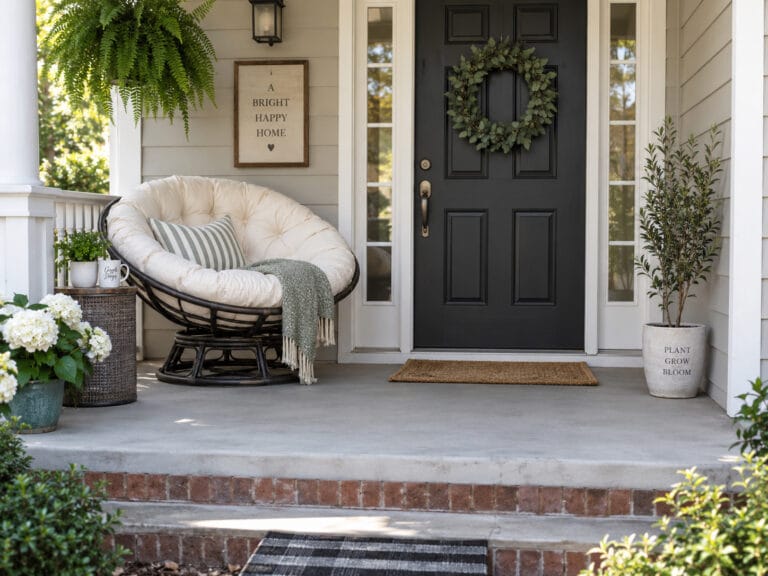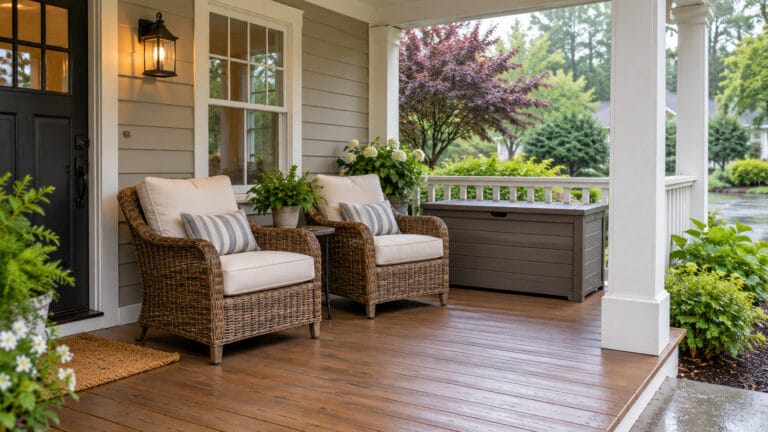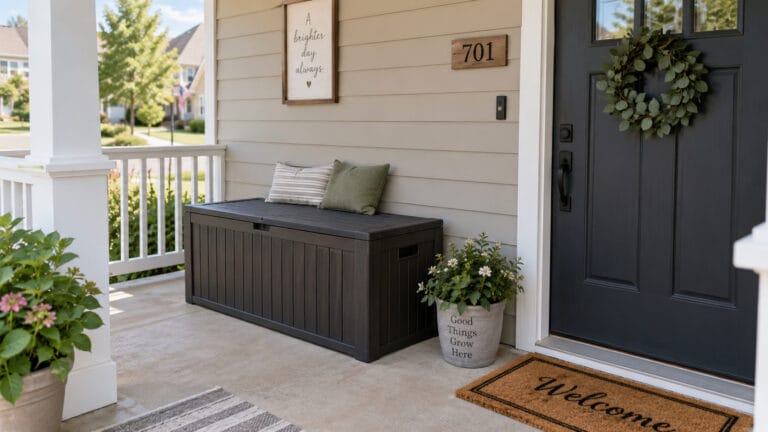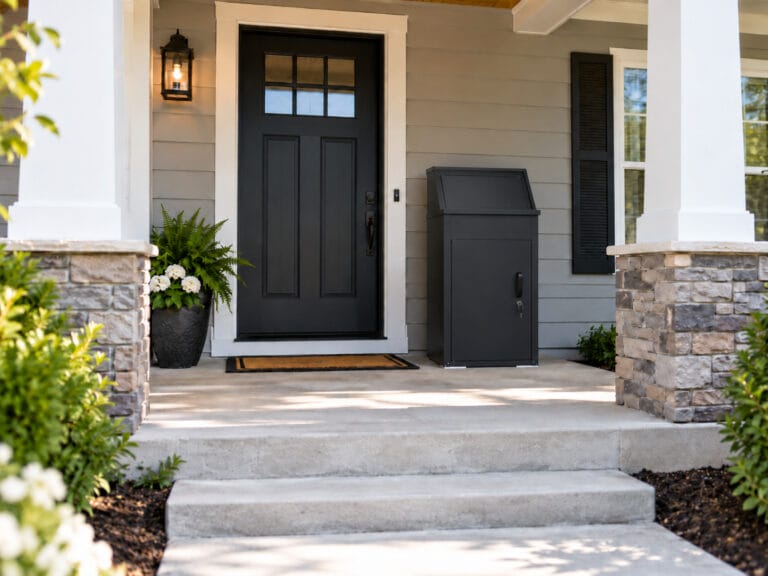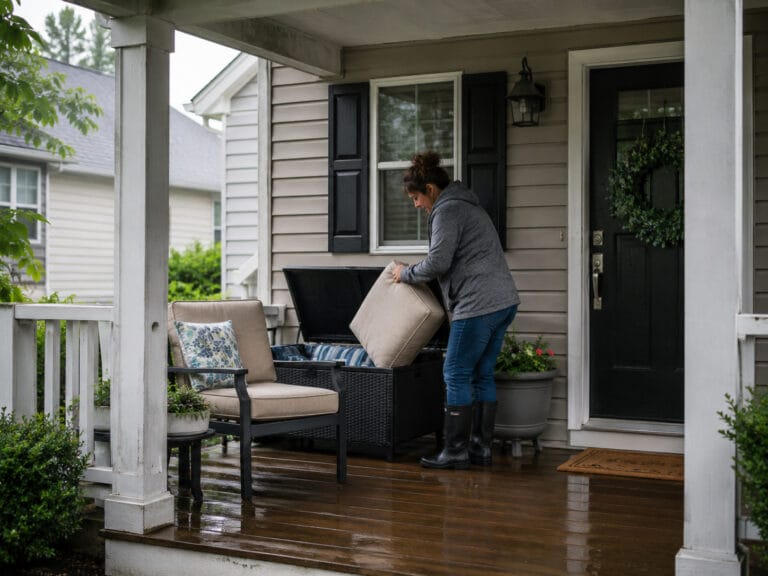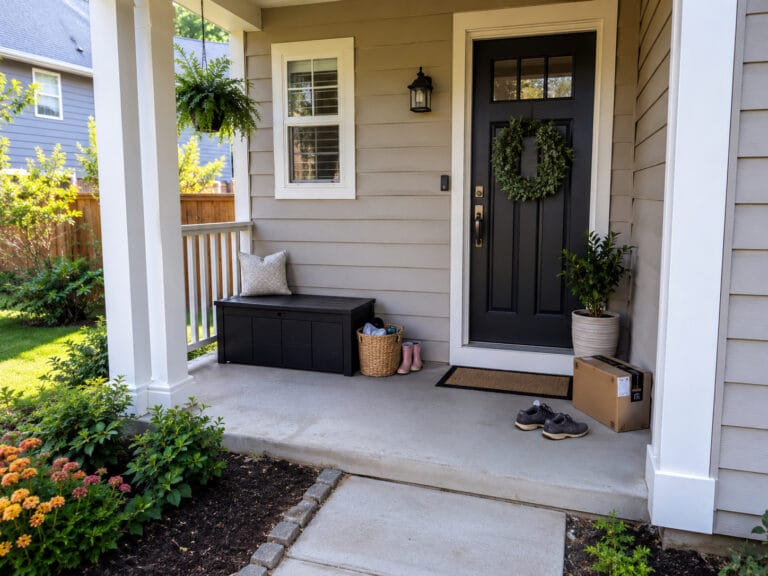
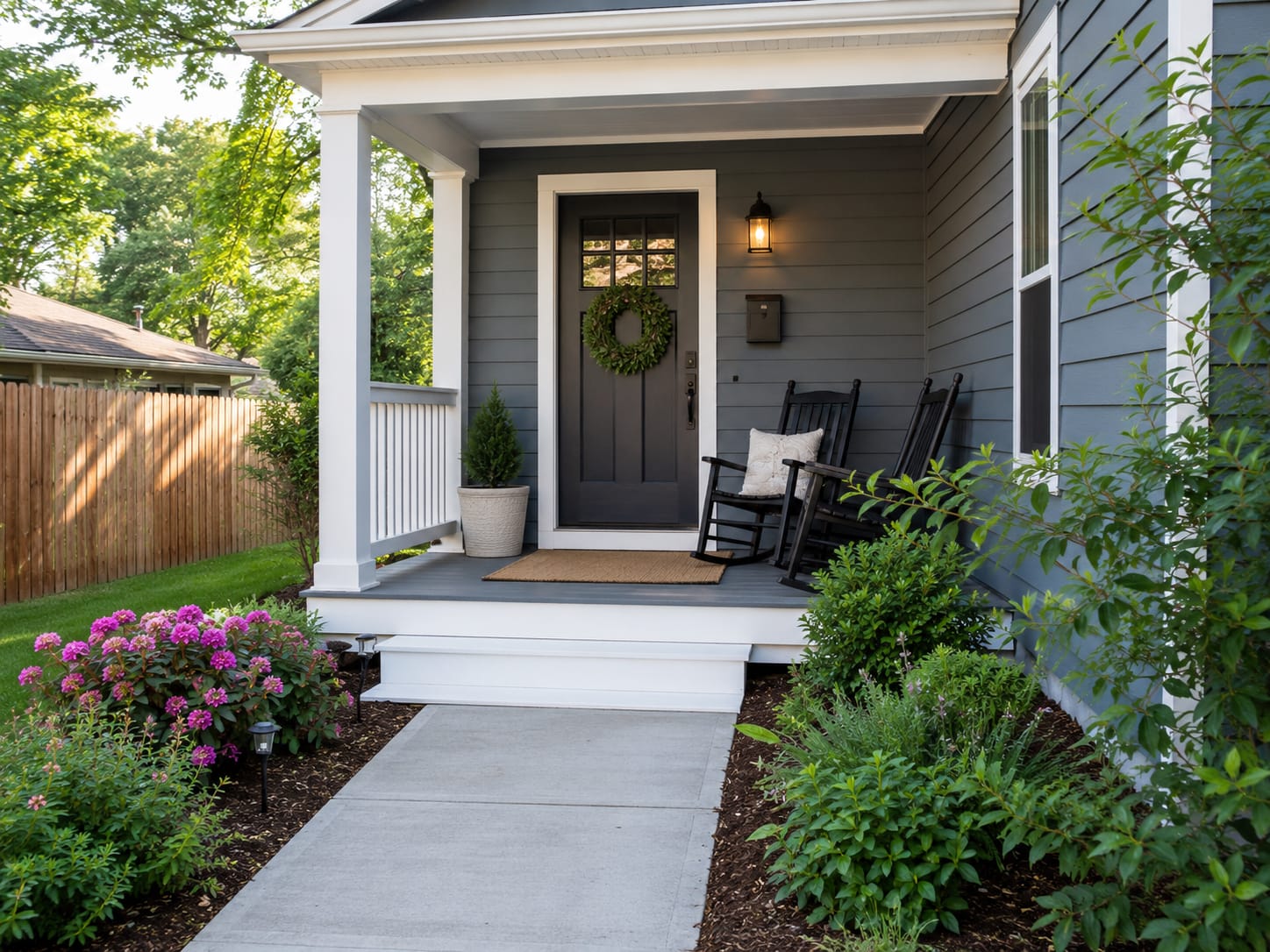
A small front porch does not need to be filled with furniture to feel useful.
In fact, adding too much is one of the quickest ways to make a compact porch harder to live with.
The front door needs room to open. People need a clear path between the steps or walkway and the entrance. Packages need somewhere to land. Chairs, benches, planters, rugs, and storage pieces are all competing for the same limited floor area.
So before choosing pillows, seasonal signs, or decorative planters, start with a more practical question:
What does this porch actually need to do every day?
For one household, the answer may be as simple as creating one comfortable place to sit for a few minutes. Another porch may need to handle shoes, outdoor cushions, packages, pet-walking gear, or a small conversation area.
The most useful small front porches tend to follow the same basic principle:
Protect the doorway and main walking path first, then use the remaining space for the few functions that matter most.
That is where a good small-porch layout begins.
Table of Contents
Quick Answer: How Do You Make a Small Front Porch More Useful?
Start with function, not decoration.
A small front porch usually works better when you:
- keep the full front-door movement area usable;
- preserve a clear, direct path to the entrance;
- choose furniture based on the usable floor area, not just how it looks online;
- decide whether you really need one chair, two chairs, or a bench;
- use storage furniture only when it solves a specific daily problem;
- move some decor onto walls, the door, or railings instead of using more floor space;
- choose the rug after the furniture layout is established;
- account for how much rain, sun, wind, and humidity actually reach the porch.
You do not need to fill every corner.
On a compact porch, open floor space is part of the design.
Start With the Door Swing
The front door should set the boundaries of the layout.
Before placing a chair, bench, storage box, or planter, open the door fully and watch how the entrance actually works.
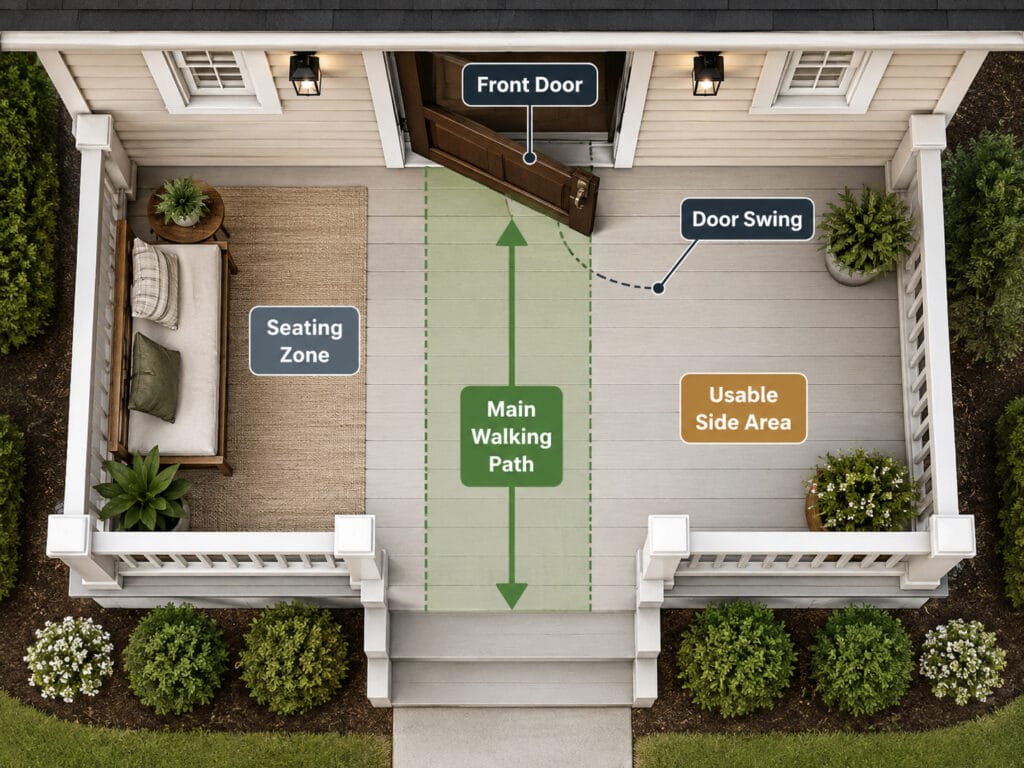
Check:
- which direction the door swings;
- where the door stops when fully open;
- how far the handle projects;
- where you naturally stand while unlocking the door;
- where you step when entering or leaving;
- where packages are usually placed;
- whether a screen door or storm door also needs room to move.
Furniture does not have to physically hit the door to create a problem.
A chair may sit just outside the door swing but still occupy the place where you naturally stand while opening the lock. A planter may not touch the door at all but force you to step around it while carrying groceries.
On a small front porch, this area should be treated as functional space first.
Furniture and decor come second.
Try a Simple Floor Test
Before ordering furniture, use painter’s tape or cardboard to mark its full footprint on the porch floor.
Then use the entrance normally.
Open the door several times.
Carry a bag inside.
Set down a package.
Walk through the area without consciously trying to avoid the taped outline.
If a flat outline already feels intrusive, the actual furniture will usually feel larger once it adds height, arms, cushions, legs, and visual mass.
Keep the Main Path Open
A front porch is not only an outdoor sitting area.
It is also the transition between the walkway, steps, front door, and the inside of the home.
That makes circulation one of the most important parts of the layout.
Stand at the steps or front walk and follow the route you would naturally take to the door.
That route should feel obvious.
Visitors should not need to weave around chairs, planters, stools, side tables, or storage boxes just to reach the entrance.
For a narrow porch, this often means placing most furniture along one side.
For a somewhat wider porch, you may be able to create a defined seating area while preserving a separate route to the door.
Avoid treating every empty corner as a place that needs furniture.
A porch can look full and attractive in a photograph while being frustrating every time you carry a box through it.
A useful HomyEntry principle is:
Open circulation space is part of the porch layout, not leftover space after the furniture is placed.
Choose Furniture to Scale
Small porches usually benefit from furniture that does one job well without dominating the entrance.
Practical options can include:
- one compact outdoor chair;
- two smaller chairs;
- a front porch bench;
- a compact rocking chair;
- a small bistro-style setup;
- a storage bench;
- a small side table.
The best choice depends on what remains after the door and main path have been protected.
A deep lounge chair may look comfortable on a product page but overwhelm a shallow porch.
A smaller upright chair may provide less of a “lounge” look but make the porch much easier to use every day.
Likewise, a bench can sometimes use a continuous wall more efficiently than two separate chairs because it reduces the number of individual furniture pieces occupying the floor.
Look at Visual Weight, Not Just Dimensions
Two pieces with similar outside dimensions can feel very different in a small space.
Furniture often looks visually lighter when it has:
- open legs;
- slim arms;
- visible floor beneath the seat;
- a lower or more open back;
- a simple frame.
Furniture tends to feel heavier when it has:
- thick arms;
- an enclosed base;
- oversized cushions;
- wide side panels;
- a bulky skirted or boxed-in form.
Physical dimensions should come first, but visual mass matters too.
For more detailed measurement guidance, see our front porch furniture size guide.
One Chair vs. Two Chairs vs. a Bench
Before deciding what type of seating to buy, decide how many people actually need to sit on the porch at the same time.
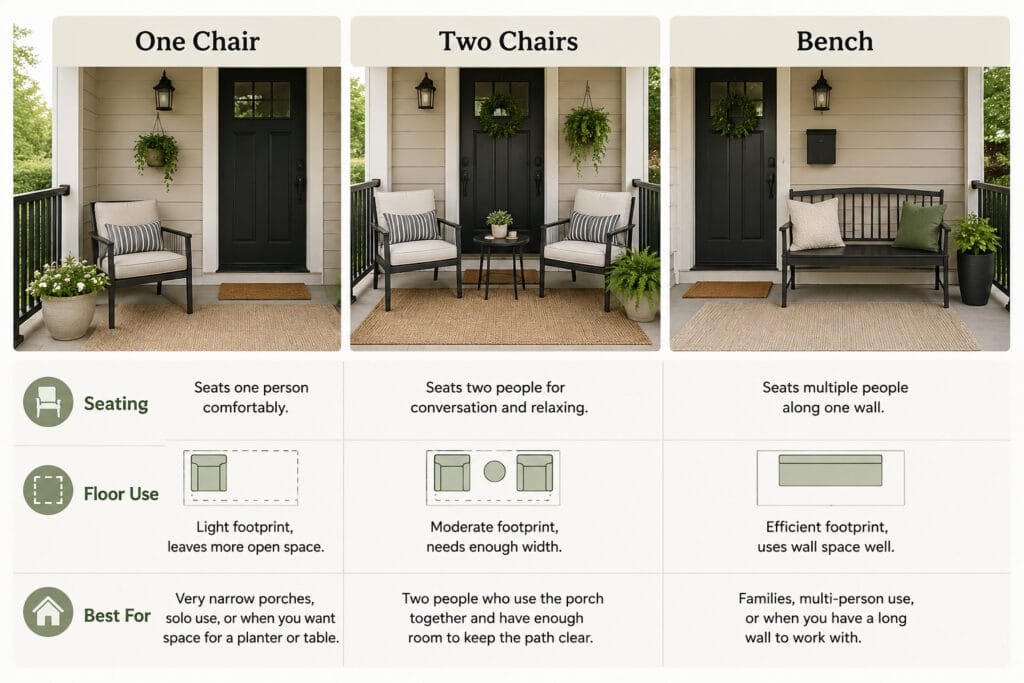
A small porch does not need to become a complete outdoor living room.
One Chair
One chair may be the best choice when:
- the porch is narrow;
- seating is mainly for one person;
- the door and walking path already use most of the floor area;
- you still want room for a planter or small surface.
A single comfortable chair can make the porch feel intentional without crowding it.
A rocking chair can also work, but only if there is enough room for the chair to move without interfering with the walkway or door.
Two Chairs
Two chairs make more sense when:
- two people regularly use the porch together;
- the seating area can be separated from the arrival path;
- the chairs can face slightly toward each other without blocking the door.
On a compact porch, two smaller chairs will often be easier to use than two oversized lounge chairs.
A small shared table can be useful, but it should not become something every visitor has to walk around.
A Bench
A bench can be especially effective when you have one useful wall and want continuous seating.
It may work well when:
- you want seating for more than one person;
- the wall is long enough;
- you prefer one continuous piece instead of several chairs;
- under-seat storage would solve a real need.
The important check is still depth.
A bench can fit perfectly along a wall and still project too far into the usable porch area.
For help choosing among porch furniture types, see how to choose furniture for a small front porch.
Use Storage Furniture Only When It Solves a Real Problem
Storage can be useful on a small front porch, but more storage is not automatically better.
A storage bench or compact outdoor box may make sense if you regularly need a place for:
- outdoor cushions;
- pet-walking items;
- frequently used outdoor shoes;
- small gardening supplies;
- porch accessories.
Before adding one, ask:
What actually needs to stay near the front door?
If the answer is only a few small items, a hook, small weather-resistant basket, or another compact solution may be enough.
Do Not Turn the Porch Into Overflow Storage
A front porch is one of the most visible areas of the home.
It can quickly become cluttered once it starts collecting:
- rarely worn shoes;
- empty planters;
- delivery boxes;
- unused garden supplies;
- off-season decorations.
Treat the porch as a daily-use zone, not general overflow storage for the rest of the house.
For more focused solutions, see our front porch storage ideas for small spaces.
Use Vertical Decor Instead of Floor Clutter
When floor space is limited, every freestanding decorative object has a circulation cost.
Walls, the front door, and railings may provide better places for visual interest without reducing the walking area.
Depending on the porch, consider:
- a wall-mounted planter;
- a wreath;
- house numbers;
- an outdoor wall light;
- a hanging basket;
- wall hooks;
- a narrow railing planter.
The goal is not to cover every vertical surface.
It is to avoid using valuable floor space for decor that could live somewhere else.
Let the Front Door Stay the Focal Point
The front door already provides a strong visual anchor.
A small porch may need little more than:
- one clear seating element;
- one or two vertical accents;
- a mat or modest rug;
- a restrained number of plants.
Adding more objects does not necessarily make the porch more welcoming.
Sometimes it simply makes the entrance harder to see and harder to use.
Choose a Rug That Fits the Layout
Choose the furniture layout first.
Choose the rug second.
A porch rug can visually define a seating area, but it should support the layout rather than dictate it.
Before selecting one, confirm:
- the main walking path;
- the seating location;
- the front-door movement;
- whether the porch receives direct rain;
- whether a storm or screen door opens outward.
A very small porch may need only a doormat.
A somewhat larger seating zone may benefit from an outdoor rug that visually connects two chairs or a bench with a small table.
Check Door Interaction
This is easy to miss.
An outward-opening storm door or screen door may catch on a thick rug.
Even if the main front door opens inward, make sure the rug does not curl or create a trip point along the primary entry route.
The decorative effect should never make the entrance harder to use.
Covered vs. Uncovered Porch
The amount of overhead protection affects which furniture and storage choices make sense.
Covered Porch
A roof can reduce direct rain and strong sun exposure, but a covered porch is not automatically weatherproof.
Furniture near the edges may still be affected by:
- wind-driven rain;
- humidity;
- temperature changes;
- angled sunlight.
Outdoor-rated materials still matter.
Uncovered Porch
An exposed porch requires more attention to weather performance.
Consider:
- outdoor-rated materials;
- drainage;
- corrosion resistance;
- cushion drying;
- storage ventilation;
- how quickly surfaces can dry after rain.
Do not assume indoor furniture will perform well outside simply because the entrance receives a little partial shelter.
For a more complete decision guide, see covered vs. uncovered porch furniture.
Three Small Front Porch Layout Ideas
Different porch shapes call for different layouts.
The goal is not to copy a single “perfect” arrangement.
It is to identify the biggest constraint in your own space.
| Porch Type | Good Starting Layout | Main Priority |
|---|---|---|
| Narrow porch | Furniture along one side | Direct route to the door |
| Small square porch | One or two compact seats | Door movement area |
| Porch with side seating area | Small seating group beside the door | Separate sitting from arrival |
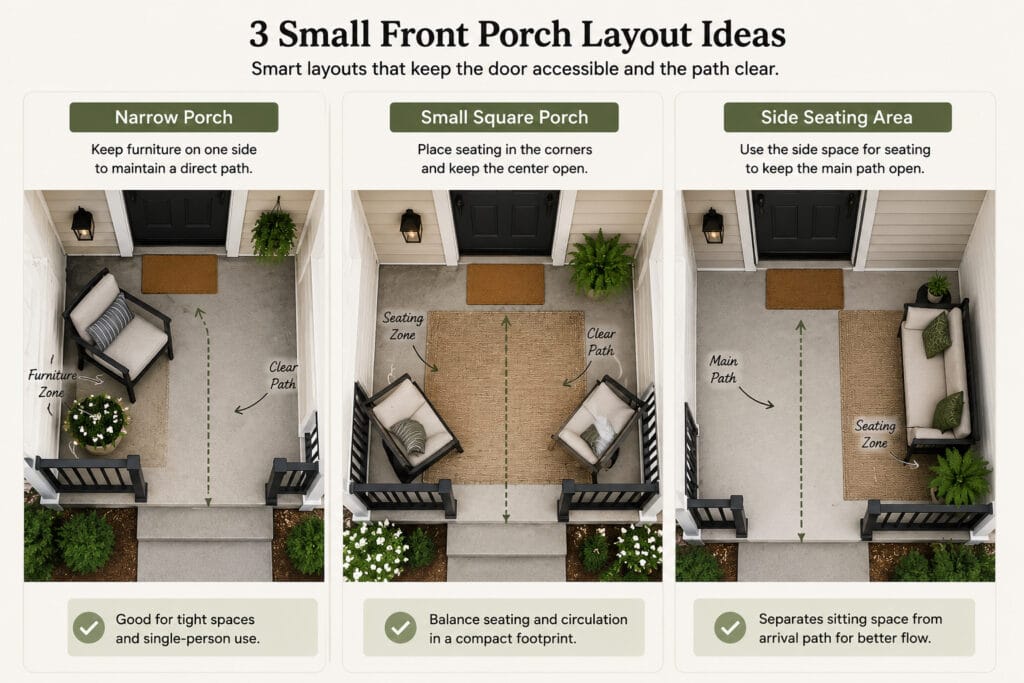
Layout 1: Narrow Front Porch
On a narrow porch, keep the route to the front door as direct as possible.
Place a compact chair or shallow bench on one side instead of trying to furnish both sides of the porch.
Use vertical decor to add interest without reducing the path.
If floor space is extremely limited, skip the coffee table.
A small ledge, wall-mounted surface, or no table at all may work better.
Layout 2: Small Square Porch
A small square porch may have enough depth for one or two chairs, but the door should still control the arrangement.
Keep seating closer to a corner or side wall and leave the central arrival area open.
If two chairs fit, angle them slightly toward each other rather than placing them directly across the route to the door.
Layout 3: Porch With a Side Seating Area
Some porches have a pocket of usable space beside the doorway.
That can be one of the easiest places to create a compact seating area.
Depending on the available space, it may accommodate:
- two compact chairs;
- a small bistro-style setup;
- a bench.
The advantage is functional separation.
Sitting space stays to the side while arrival space remains connected to the front door.
Whenever the porch layout allows it, separating those two functions can make a small entrance much easier to use.
Common Small Front Porch Mistakes
Blocking the Natural Route to the Door
If people regularly need to turn sideways or weave around furniture, the layout is probably overloaded.
Choosing Furniture by Wall Width Alone
A bench may fit along the wall while still projecting too far into the porch.
Depth matters just as much as available wall length.
Adding Too Many Small Pieces
Several planters, stools, tables, baskets, and signs can consume more practical space than one well-chosen piece of furniture.
Asking One Tiny Porch to Do Too Many Jobs
A compact porch does not need to be a lounge, garden, shoe-storage area, package station, and seasonal display at the same time.
Choose priorities.
Ignoring Door Movement
Furniture can interfere with normal entry even if it never physically touches the door.
Choosing Oversized Seating
Large lounge furniture may technically fit and still visually dominate the porch.
Turning the Porch Into Overflow Storage
Store items that support daily porch use rather than everything that has no other place to go.
HomyEntry Small Porch Fit Check
Before buying furniture for a compact front porch, run through this simple test.
1. Open the Front Door Fully
Identify the space used by the door, handle, and the person operating it.
2. Mark the Main Path
Keep the route between the steps or front walk and the door clear and direct.
3. Measure the Usable Floor Area
Exclude the door movement area and fixed obstacles.
4. Tape the Furniture Footprint
Mark the actual width and depth of the proposed furniture on the porch floor.
5. Test the Seating
Sit down, stand up, and let another person walk past.
6. Test Storage in Use
Open lids, doors, drawers, or baskets rather than judging the furniture only while closed.
7. Evaluate Weather Exposure
Look at how much rain, sun, wind, and humidity actually reach the proposed furniture location.
8. Add Decor Last
Only after the functional layout works should you add planters, rugs, pillows, or seasonal accents.
A small porch is working well when the seating and storage feel useful without making the doorway feel crowded.
Frequently Asked Questions
How do you arrange furniture on a small front porch?
Keep the main path to the front door open first, then place compact seating or storage in the remaining usable area.
What furniture works best on a small front porch?
Compact chairs, benches, bistro-style seating, and small multifunctional pieces usually work best when they fit the available floor depth.
Is a bench good for a small front porch?
Yes, if it fits along a usable wall without crowding the door or main walking path.
How can I make a small front porch look bigger?
Use fewer floor-standing pieces, choose visually lighter furniture, keep the main path open, and move some decor onto vertical surfaces.
What should I put on a very small front porch?
Start with only the essentials, such as a doormat, one compact seat or planter, and simple wall or door decor.
Final Thoughts: Make the Small Porch Do the Important Jobs Well
A small front porch does not need more furniture.
It needs the right furniture in the right place.
Start with the front door and the natural walking path.
Then decide whether the porch genuinely needs one chair, two chairs, a bench, storage, or a small conversation area.
Use vertical surfaces when floor space is limited.
Choose the rug after the furniture layout.
And consider how exposed the porch really is before choosing materials and storage.
The goal is not to fill every available square foot.
It is to create an entrance that feels welcoming while remaining easy to use every day.
When you’re ready to explore furniture, seating, and storage options for your space, Explore Porch Solutions →