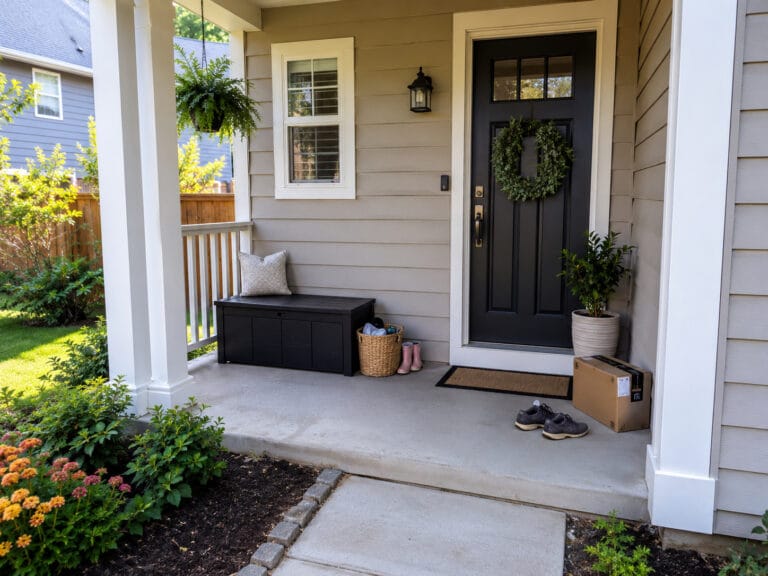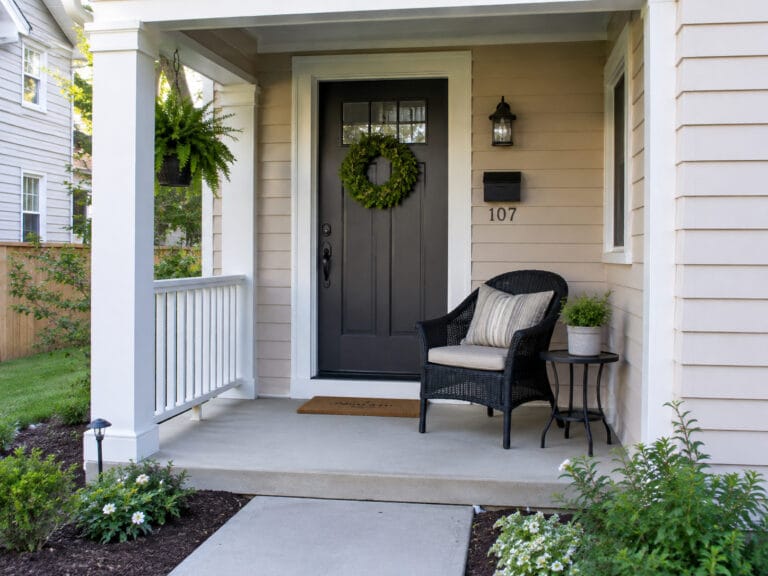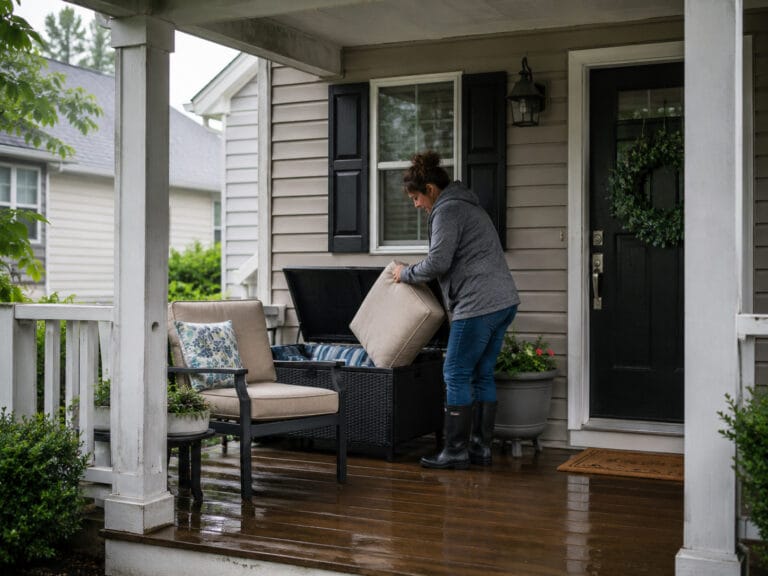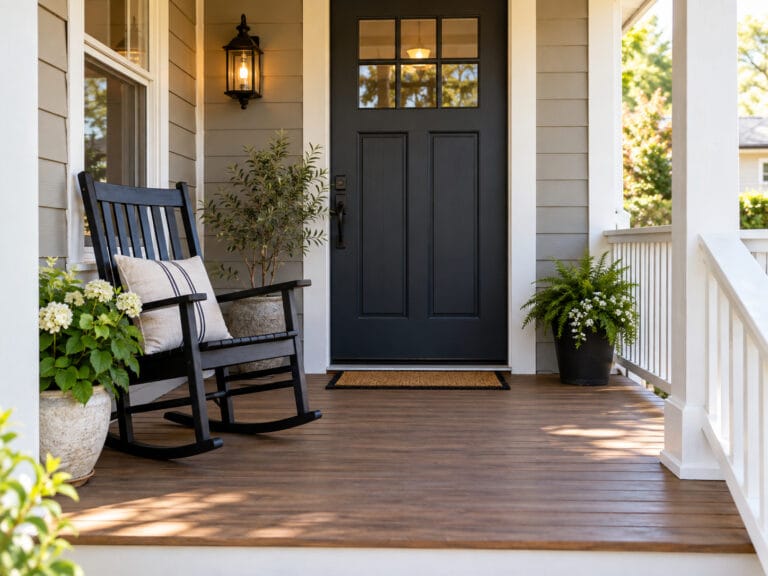
A deck box can offer plenty of storage and still be the wrong size for your front porch.
The reason is simple: gallon capacity tells you how much a box can hold, but not how much porch space it will use. It also does not tell you whether the lid can open fully, the front door can swing freely, or people can still move comfortably through the entrance.
That matters more on a front porch than on an open patio or deck. Near the front door, storage has to share limited space with everyday foot traffic, steps, railings, packages and the door itself.
A well-sized deck box should do two things:
- hold the items you actually need to store; and
- fit without making the entrance harder to use.
For most porches, that means comparing capacity, exterior dimensions, interior dimensions, lid clearance and walking space together.
HomyEntry Fit Check: For storage, look at interior dimensions. For porch layout, look at exterior dimensions.
Table of Contents
Quick Answer: What Size Deck Box Do You Need?
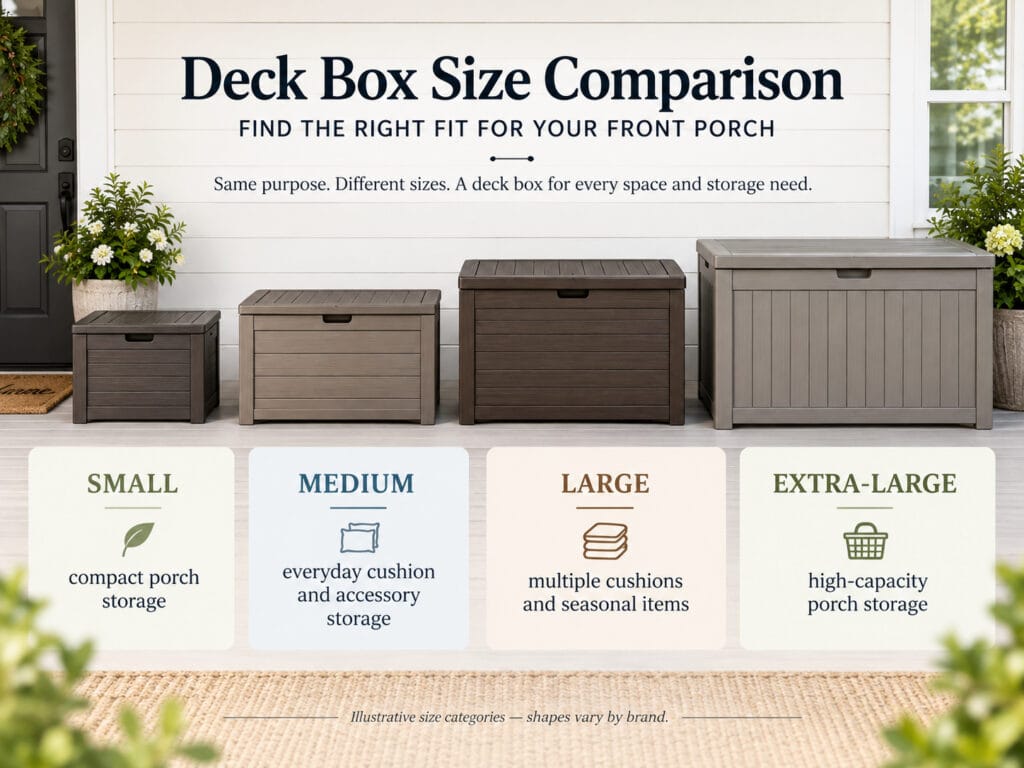
These ranges are useful starting points, but they are not universal standards.
| Capacity | Usually Best For | Typical Uses |
|---|---|---|
| Under 50 gal | Very small porches | Small accessories, gardening items, shoes, a few compact cushions |
| 50–100 gal | Small to medium porches | Outdoor pillows, several cushions, toys, small tools |
| 100–150 gal | Medium to larger porches | Multiple cushions, larger accessories, seasonal items |
| 150+ gal | Larger porches or high-storage needs | Bulky cushion sets, outdoor gear, larger seasonal storage |
Retail buying guides commonly group roughly 50–100 gallons as medium, 100–150 gallons as large, and 150+ gallons as extra-large, but the actual footprint can vary substantially from one design to another. Wayfair
That is why gallons should narrow your choices—not make the final decision.
Start With What You Actually Need to Store
Before choosing a capacity, make a short list of what will go inside.
Porch cushions
Cushions are one of the easiest things to underestimate because thick seat and back cushions take up much more volume than they appear to individually.
Instead of measuring one cushion and multiplying, stack the cushions the way you would actually store them. Measure the total:
- width;
- depth;
- height;
- and the size of the opening needed to get them in and out.
A box may have enough total volume but still be awkward if its opening is too narrow or its interior walls reduce usable space.
Everyday porch items
Deck boxes can also work well for:
- outdoor pillows;
- throws;
- gardening supplies;
- pet items;
- cleaning supplies;
- toys;
- seasonal porch decor.
If you store lots of small items, remember that an extremely deep box can become inconvenient when frequently used items end up buried underneath larger ones.
Packages
A deck box can sometimes provide temporary cover for deliveries, but if package security is the main goal, a purpose-built package delivery box is usually a better fit because access, locking and delivery use are designed around parcels.
Gallons vs. Dimensions: Why the Footprint Matters
A gallon rating describes volume. It does not describe shape.
Two boxes with the same capacity can use porch space very differently.
For example, Suncast lists one 50-gallon deck box at about:
36.75″ W × 20.25″ D × 21.75″ H
while another 50-gallon model measures roughly:
25.25″ W × 25.75″ D × 25.5″ H
Same nominal capacity, very different footprint. Suncast
For a narrow front porch, the first design may be easier to place because it projects less deeply into the walking path. In another layout, the shorter width of the second design might work better.
This is why four measurements matter:
- Exterior width — how much wall or railing length the box uses.
- Exterior depth — how far it projects into the porch.
- Exterior height — whether it interferes with windows or sightlines.
- Interior dimensions — whether your actual items fit.
On a tight front porch, depth is often the measurement that changes the space most.
Measure the Porch Before You Buy
Treat the deck box as part of the entrance, not as an isolated piece of furniture.
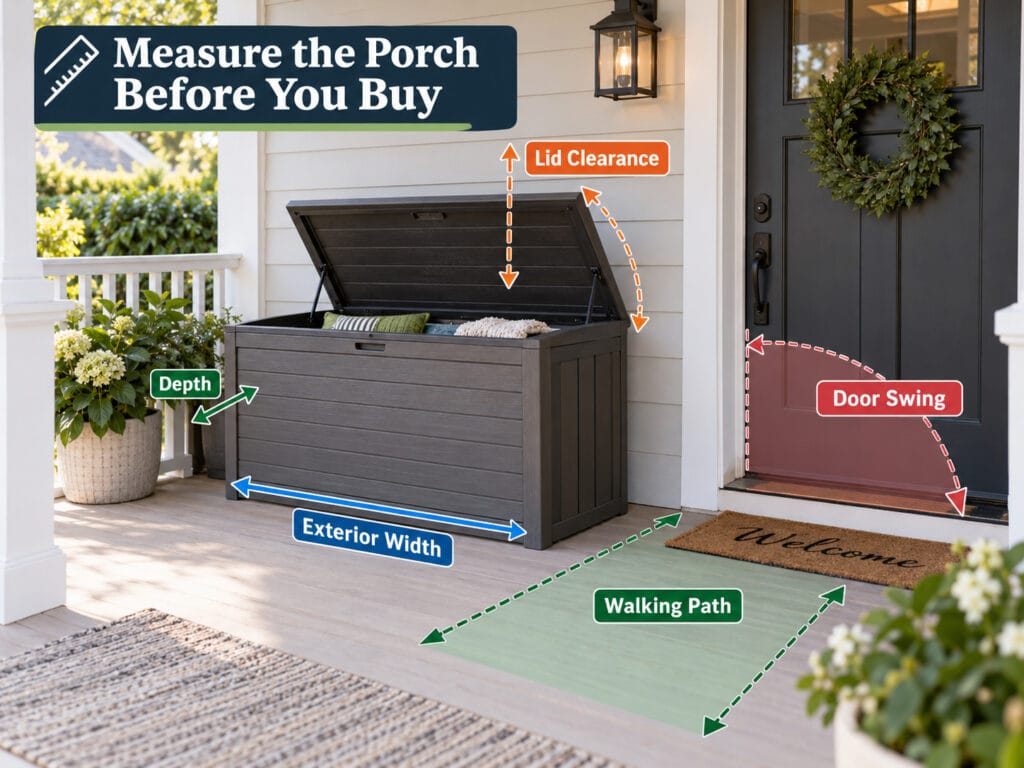
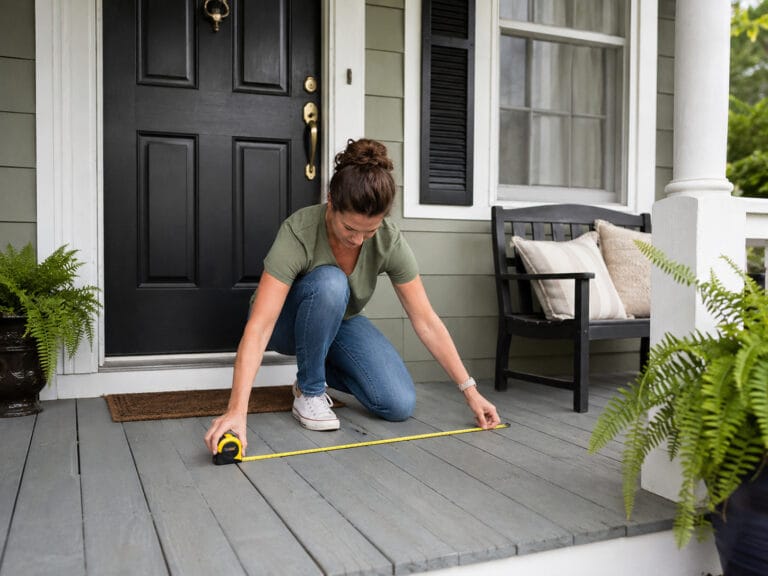
1. Measure usable wall width
Measure the actual space available along the wall or railing.
Do not count areas occupied by:
- door trim;
- windows;
- downspouts;
- railing posts;
- outlets;
- steps;
- permanent planters.
A box does not need to be wedged edge-to-edge into the available space. A little extra room makes placement, cleaning and lid operation easier.
2. Check the depth and remaining walkway
Measure from the wall to the front edge of the proposed deck box.
Then look at the usable path that remains.
Ask yourself:
- Can someone carrying groceries pass without turning sideways?
- Can two people use the entrance comfortably?
- Will shoes or delivered packages make the route tighter?
- Does the box narrow the main path to the front door?
For entrances designed to provide an accessible route, U.S. accessibility standards use 36 inches of continuous clear width as an important benchmark, although private residential requirements vary and local codes may differ. ADA.gov
For an ordinary home porch, do not treat 36 inches as a universal legal requirement. Use it as a useful reference, then judge the actual door, traffic pattern and local requirements.
Not sure how much room to leave? See our guide to clearance around front porch furniture.
3. Leave room for the lid
This is one of the easiest details to miss.
A deck box may fit perfectly while closed but hit:
- siding;
- a window sill;
- porch railing;
- another piece of furniture;
when opened.
Some lids rise nearly vertically. Others move backward as they open. Check the specific product design rather than assuming the box can sit flush against a wall.
4. Check the front-door swing
Open the front door fully and look at the entire swing area.
The box should not interfere with either the door or the person using it.
Remember that people also need room to:
- step inside and outside;
- carry bags;
- receive deliveries;
- wait beside the door.
For a step-by-step measuring process, see our front porch furniture size guide.
A Practical Fit Guide for Small, Medium and Large Porches
Small front porch
Prioritize:
- shallow depth;
- compact width;
- easy lid access;
- a clear entrance path.
A smaller box that holds the essentials is usually more useful than a larger model that makes the porch feel blocked.
Medium front porch
A medium porch gives you more flexibility, and 50–150 gallon models may become practical depending on the layout.
But do not assume that a wide porch is also deep. Exterior depth can still be the limiting factor.
Large front porch
If the porch is genuinely deep and spacious, a 150–200+ gallon box can work well for:
- bulky cushions;
- seasonal decor;
- multiple outdoor accessories.
Even then, place it away from the primary route to the front door whenever possible.
Is a 200-Gallon Deck Box Too Big for a Front Porch?
Not automatically.
A 200-gallon box can make sense on a large porch when you need to store a full cushion set or bulky seasonal items.
The question is whether the extra capacity still works with the entrance.
Before buying one, check:
- exterior width;
- exterior depth;
- lid-opening clearance;
- front-door swing;
- remaining walking space.
On a narrow porch, a 200-gallon box can dominate the space even when it technically fits along the wall.
On a large porch, the same box may replace several smaller containers and create a cleaner setup.
A larger deck box is only an upgrade when the extra storage does not make the entrance harder to use.
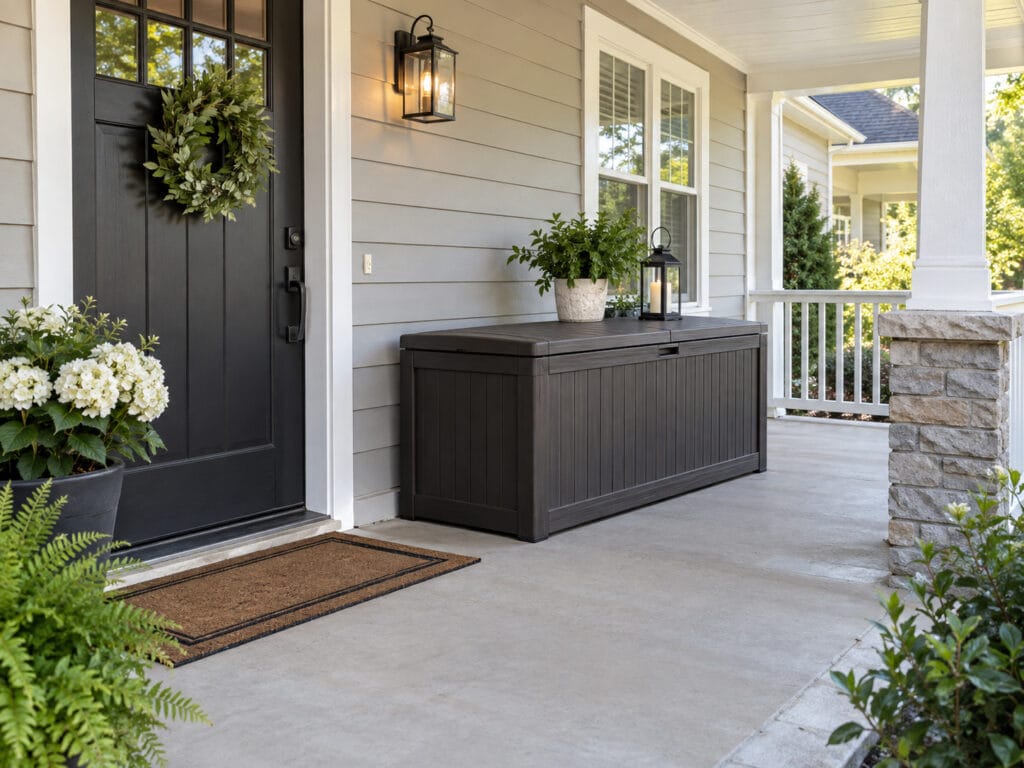
See the dimensions of our 200-gallon outdoor storage deck box.
A Simple Painter’s Tape Test
Before ordering, mark the deck box footprint on the porch with painter’s tape.
Then use the entrance normally.
Try:
- opening the door fully;
- carrying a grocery bag;
- carrying a medium package;
- standing where a visitor would normally wait.
This simple test gives you information that gallon capacity cannot.
If the taped outline already feels intrusive, the actual box will usually feel larger once height and visual weight are added.
Choosing a Deck Box for Cushions
If cushions are the main reason for buying the box, compare their stacked dimensions with the interior dimensions of the box.
Do not rely only on gallon capacity.
Also look at the opening.
A box can technically hold the cushions but still be frustrating to use if large back cushions have to be bent or forced through a narrow opening.
Manufacturers often publish both exterior and interior dimensions, and the usable interior space can be noticeably smaller than the outside measurements suggest.
That difference matters when storing bulky cushions, because a box that looks large from the outside may offer less usable width, depth, or opening space inside.
Learn more about protecting porch furniture from rain and weather.
Weather-Resistant Does Not Always Mean Waterproof
Do not assume every outdoor deck box is a sealed waterproof container.
Outdoor deck boxes are often described as weather-resistant or water-resistant, but those terms do not always mean the box is fully waterproof in every condition.
Before placing a box on an exposed porch, check the manufacturer’s information about:
- water resistance;
- lid design;
- drainage;
- ventilation;
- recommended outdoor use.
Also avoid locations where roof runoff, standing water or sprinklers repeatedly hit the box.
For more guidance, see our comparison of covered vs. uncovered porch furniture.
Five Deck Box Size Mistakes to Avoid
| Mistake | Why It Causes Problems |
|---|---|
| Choosing by gallons alone | Capacity does not tell you the footprint |
| Ignoring lid clearance | A box that fits closed may not work open |
| Blocking the entrance | Storage should not interfere with daily door use |
| Underestimating cushion thickness | Large cushions can exceed usable interior space |
| Buying more capacity than you need | Oversized storage can make a small porch less functional |
HomyEntry Fit Check: Five Things to Confirm
Before ordering a deck box, confirm:
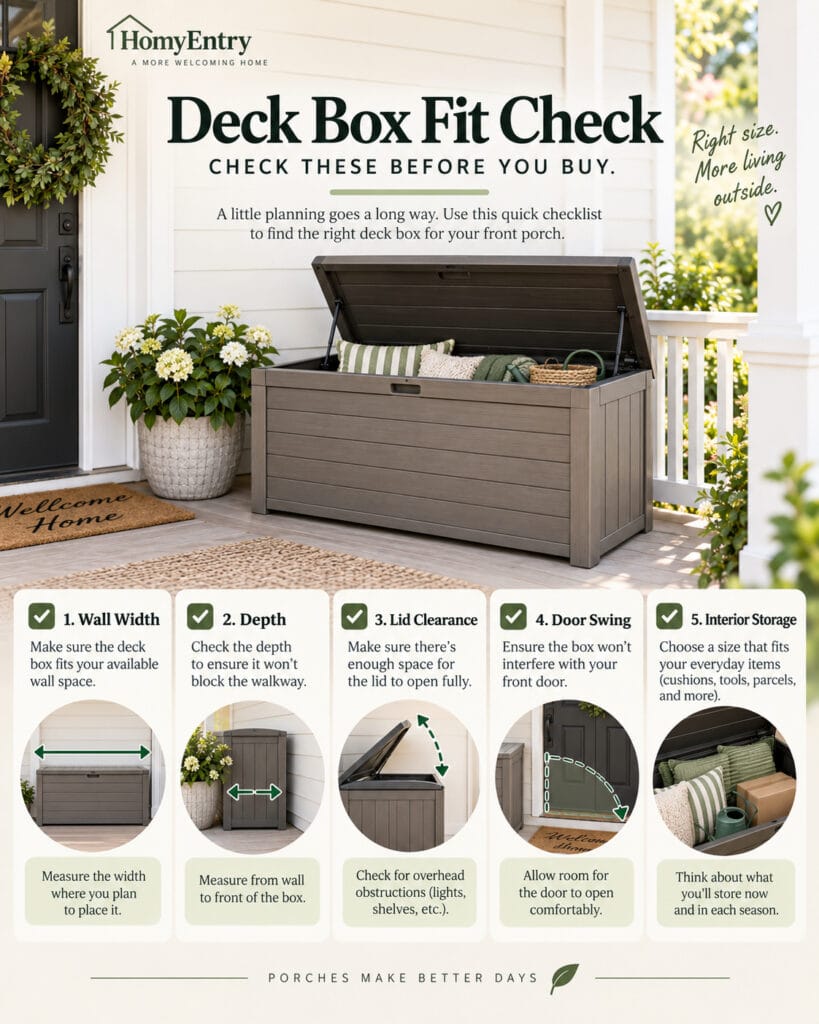
- Wall width — Does it fit the intended location?
- Depth — Is enough usable walking space left in front?
- Lid clearance — Can the lid open fully?
- Door swing — Can the front door operate normally?
- Interior fit — Will your actual items fit inside and come out easily?
If all five work, the box is far more likely to function as part of the porch rather than become an obstacle.
Final Recommendation
Choose the smallest deck box that comfortably meets your real storage needs without interfering with the front door, lid operation or main walking path.
Start with what you want to store. Then compare:
interior fit → exterior footprint → lid clearance → walking space
For a small porch, shallow dimensions and easy access usually matter more than maximum capacity.
For a larger porch, a 150–200+ gallon box can make sense when you genuinely need storage for bulky cushions or seasonal items.
The best size is not the one with the biggest gallon number.
It is the one that gives you useful storage while keeping the entrance easy to use.
Browse our Porch Storage & Protection collection.
Frequently Asked Questions
What Size Deck Box Do I Need For Porch Cushions?
Measure all of your cushions together in the way you plan to store them, then compare those measurements with the box’s interior dimensions and opening size. Thick back cushions can require more usable space than the gallon rating suggests.
Is A 100-Gallon Deck Box Big Enough?
A box around 100 gallons can work well for many medium storage needs, including several cushions and outdoor accessories. The actual fit depends on the shape of the box and its interior dimensions.
How Big Is A 200-Gallon Deck Box?
There is no standard exterior size for a 200-gallon box. The gallon rating describes volume, so always check the manufacturer’s listed width, depth and height.
Can A Deck Box Sit Directly Against A Wall?
Sometimes. It depends on how the lid moves as it opens. Check the hinge and lid design and leave enough clearance for full operation.
Should I Choose A Deck Box By Gallons Or Dimensions?
Use both. Gallons help estimate storage capacity, while exterior dimensions determine whether the box fits the porch. On a small front porch, width and especially depth are usually the better starting point.