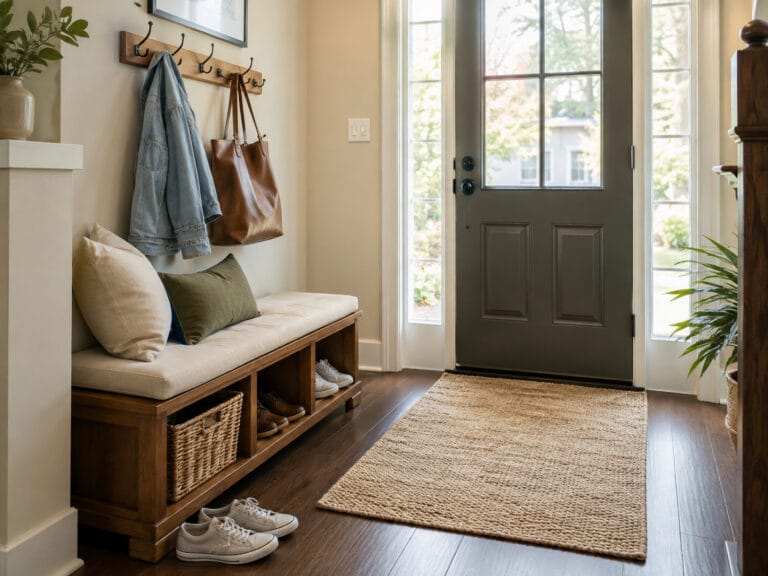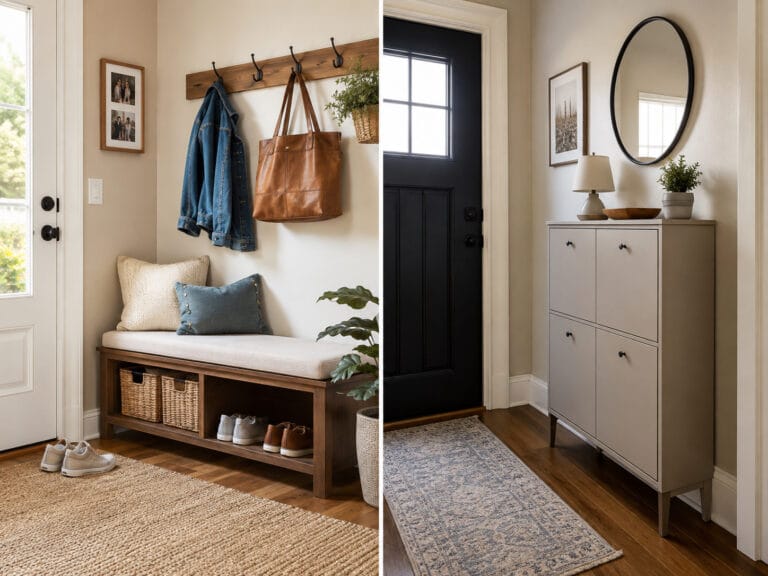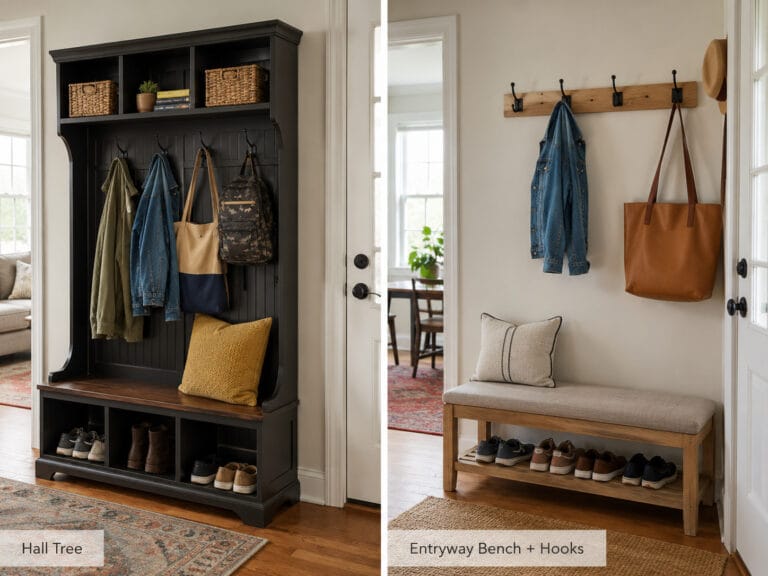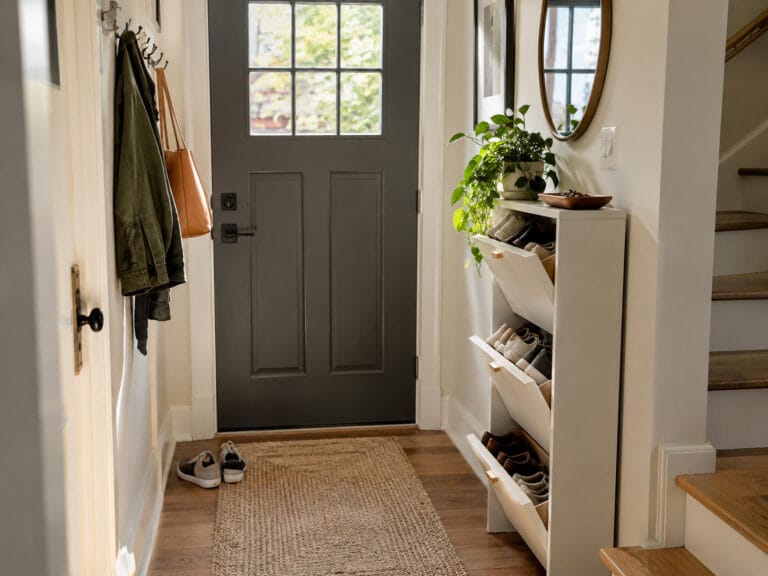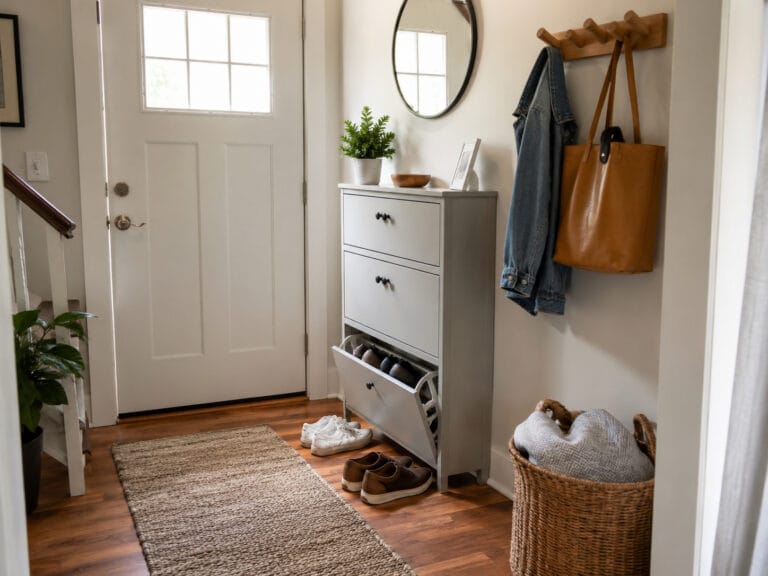
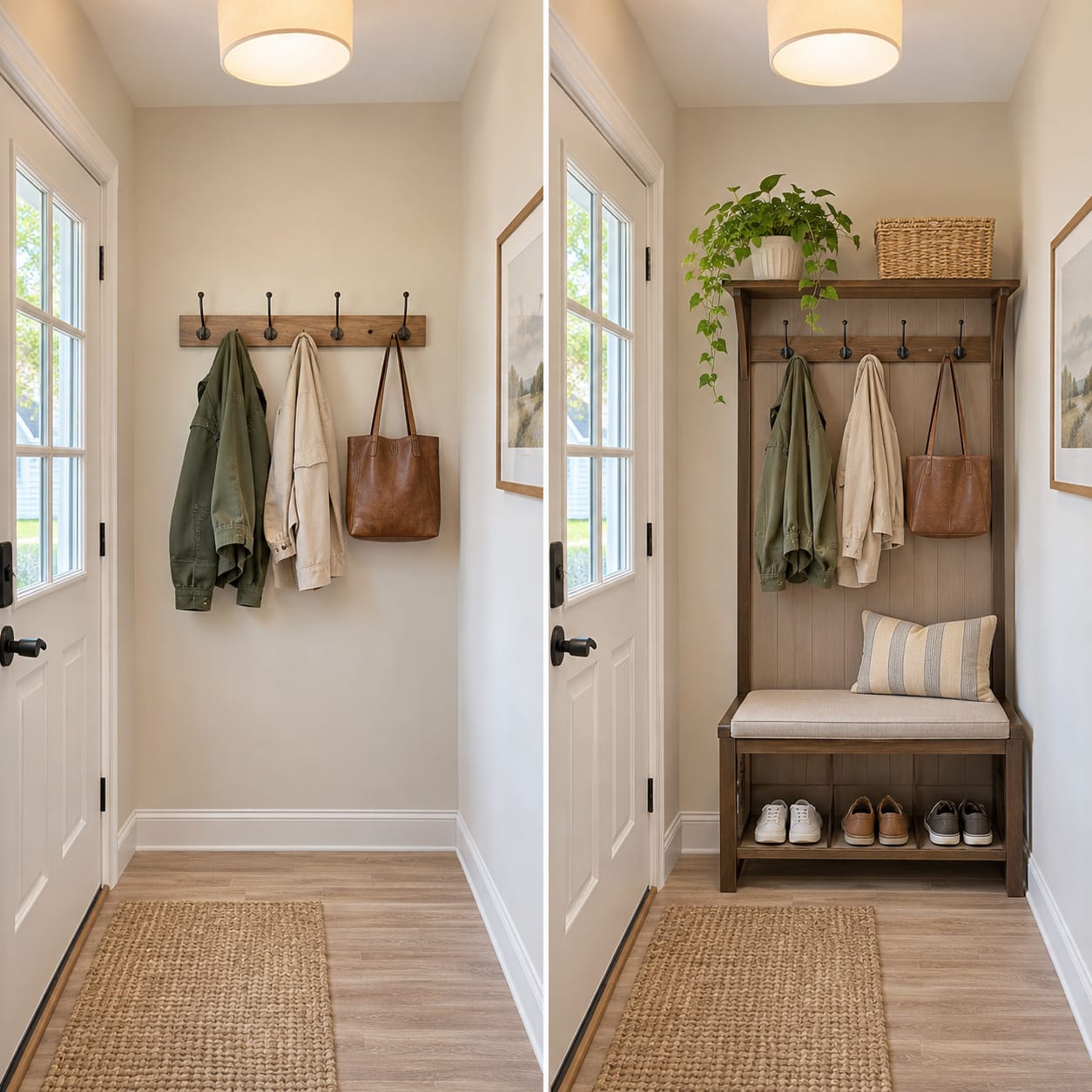
A coat rack and a hall tree can both keep jackets and bags near the door, but they solve different entryway problems.
A coat rack is usually the simpler option. It gives coats, hats, and bags a dedicated place without adding much furniture.
A hall tree does more. Depending on the design, it may combine hooks with a bench, shoe storage, shelves, cubbies, drawers, or cabinets.
That extra function also requires more room.
So the better question is not:
Which one stores more?
It is:
What does your entryway actually need to handle every day, and how much space should you give up to handle it?
For a small entryway, a coat rack often works better when hanging storage is the main problem. A hall tree becomes more useful when the same area also needs shoe storage, seating, and a family drop zone.
Table of Contents
Quick Answer: Coat Rack vs. Hall Tree
| Feature | Coat Rack | Hall Tree |
|---|---|---|
| Main purpose | Hanging coats, hats, and bags | Hanging plus seating and/or storage |
| Floor footprint | Usually smaller; wall-mounted styles use almost none | Usually larger |
| Shoe storage | Usually none | Common on many designs |
| Bench | No | Common, but not universal |
| Visual weight | Lighter | More furniture-like |
| Placement flexibility | High | Usually needs a defined wall area |
| Best for | Tight spaces and simple hanging needs | Entryways that need several functions in one place |
Start with a coat rack if coats and bags are the main source of clutter, floor depth is limited, or you already have shoe storage.
Start with a hall tree if coats, shoes, bags, and sitting down to change footwear all need to happen in the same area.
Neither is automatically better for a small entryway. The better choice depends on which problem you are actually trying to solve.
What Is the Difference Between a Coat Rack and a Hall Tree?
The easiest distinction is function.
A Coat Rack Is Mainly for Hanging
A coat rack may be:
- wall-mounted hooks;
- a horizontal rack with several hooks;
- a freestanding coat stand;
- a slim rack with limited shelving.
Its main job is to keep coats, jackets, hats, scarves, and bags off chairs, doorknobs, and the floor.
Wall-mounted hooks are particularly useful when floor space is scarce because the storage itself stays on the wall rather than occupying the walkway.
Some coat racks include a shelf or lower storage, but once a piece begins combining hooks, shoe storage, seating, and cabinetry, the distinction between a coat rack and a hall tree becomes less clear.
A Hall Tree Combines Entryway Functions
A hall tree usually organizes several activities vertically along one wall.
Depending on the model, it may include:
- coat hooks;
- a bench;
- shoe shelves or cubbies;
- drawers;
- cabinets;
- upper shelves.
That makes it closer to a compact entryway station than a simple place to hang a coat.
The tradeoff is straightforward:
More integrated functions usually mean a larger physical and visual footprint.
1. Coat Rack: Better When Floor Space Is the Main Constraint
For a very small entryway, simplicity has value.
If coats and bags are the main problem, adding hooks may solve the problem without adding a bench or storage cabinet to the walking path.
Wall-Mounted Coat Racks Preserve the Floor
This is the biggest advantage in a narrow hallway.
The rack itself does not occupy floor area, although the coats and bags hanging from it still extend into the room.
That makes wall-mounted storage especially useful for:
- narrow hallways;
- apartment entries;
- small foyers;
- short wall sections beside a front door;
- entryways that already have a shoe cabinet or bench.
When measuring, do not judge the setup while the hooks are empty. Hang your bulkiest everyday coat or backpack against the wall and see how far it projects into the path.
That gives you a much more realistic picture of the space the rack will use.
Freestanding Coat Racks Are Easier to Reposition
A freestanding coat rack needs floor space for its base, but it can usually be moved more easily than a hall tree.
That can be useful when:
- you rent;
- the layout changes seasonally;
- there is no long uninterrupted wall;
- a corner works better than a wall-mounted installation.
The tradeoff is stability. Loading heavy items unevenly can make a tall freestanding rack less stable, so weight distribution and the manufacturer’s instructions matter.
Coat Racks Keep the Entryway Visually Lighter
Small entryways can feel crowded before they are physically blocked.
An open rack or a row of hooks leaves more wall and floor visible than a full-height storage unit with side panels, cabinets, and upper shelving.
That can be especially useful when the entryway opens directly into a living room.
The Limitation: It Solves Only One Part of the Entryway
A coat rack is effective when hanging storage is the problem.
It does not automatically solve:
- shoes on the floor;
- backpacks;
- sports gear;
- baskets;
- items that need a shelf;
- the need to sit while changing shoes.
If you eventually add a separate bench, shoe rack, storage baskets, and console around the coat rack, its original small-footprint advantage can disappear.
2. Hall Tree: Better When One Area Needs Several Functions
A hall tree generally occupies more space, but it can also replace several separate pieces of furniture.
That is where its value becomes easier to see.
Vertical Integration Can Be More Efficient Than Several Small Pieces
Imagine an entryway where you need:
- hooks;
- a place for shoes;
- somewhere to sit.
One solution is three separate pieces.
Another is one hall tree that stacks those functions vertically.
If the room has only one practical furniture wall, the integrated option can sometimes create a cleaner overall layout even though the individual hall tree is larger than a coat rack.
This is an important distinction:
The smallest individual piece is not always the most space-efficient complete solution.
A Bench Changes How the Entryway Functions
Many hall trees include a bench.
That gives you somewhere to:
- sit while putting on shoes;
- help a child with footwear;
- set down a bag temporarily;
- pause with groceries when entering.
If people regularly change shoes at the door, that daily-use function may justify additional floor depth.
But do not assume every hall tree has a bench. Compare the actual configuration rather than shopping by the label alone.
Hall Trees Can Create a Family Drop Zone
Multiple people using the same entrance usually create more than coat clutter.
The entry may also need to handle:
- backpacks;
- work bags;
- footwear;
- hats and gloves;
- umbrellas;
- pet leashes;
- sports gear.
A coat rack organizes the hanging items but leaves the lower part of the entryway unresolved.
A well-chosen hall tree can give those everyday categories more defined places.
The goal is not maximum storage capacity.
It is giving the things that actually enter and leave through that door a predictable home.
3. Real Products Do Not Always Fit Neatly Into One Label
One useful shopping lesson is that “coat rack” and “hall tree” are not always strict product categories.
Hybrid furniture is common.
-
Sale!

Narrow Shoe Cabinet with Coat Hooks – 3 Flip Drawers, 27″ Bamboo Entryway Organizer
Original price was: $188.19.$162.09Current price is: $162.09.
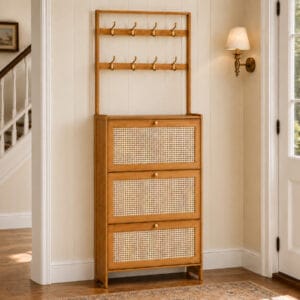
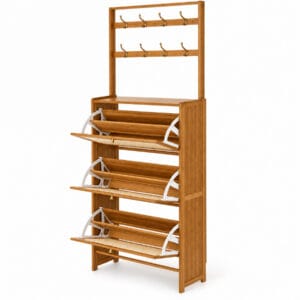
For example, HomyEntry’s Narrow Shoe Cabinet with Coat Hooks combines three flip-down shoe drawers and eight upper hooks in a 27-inch-wide vertical unit. It is only 9.4 inches deep, but it does not include a bench.
Functionally, it sits somewhere between a shoe cabinet with coat storage and a compact hall-tree-style organizer.
That is why product labels should not make the decision for you.
Instead, compare the functions:
Does it hang what you need?
Does it store shoes?
Do you need a bench?
How much floor depth does it use?
A product can be useful for your entryway even if it does not fit perfectly into one furniture name.
4. Which One Actually Takes Less Space?
If you compare only the furniture itself, the answer is usually a coat rack—especially a wall-mounted one.
But there are three different ways to think about space.
Furniture Footprint
This is the physical size of the rack or hall tree.
Loaded Footprint
This includes coats, bags, and backpacks after the furniture is actually being used.
Complete Layout Footprint
This includes any other furniture required to finish the job.
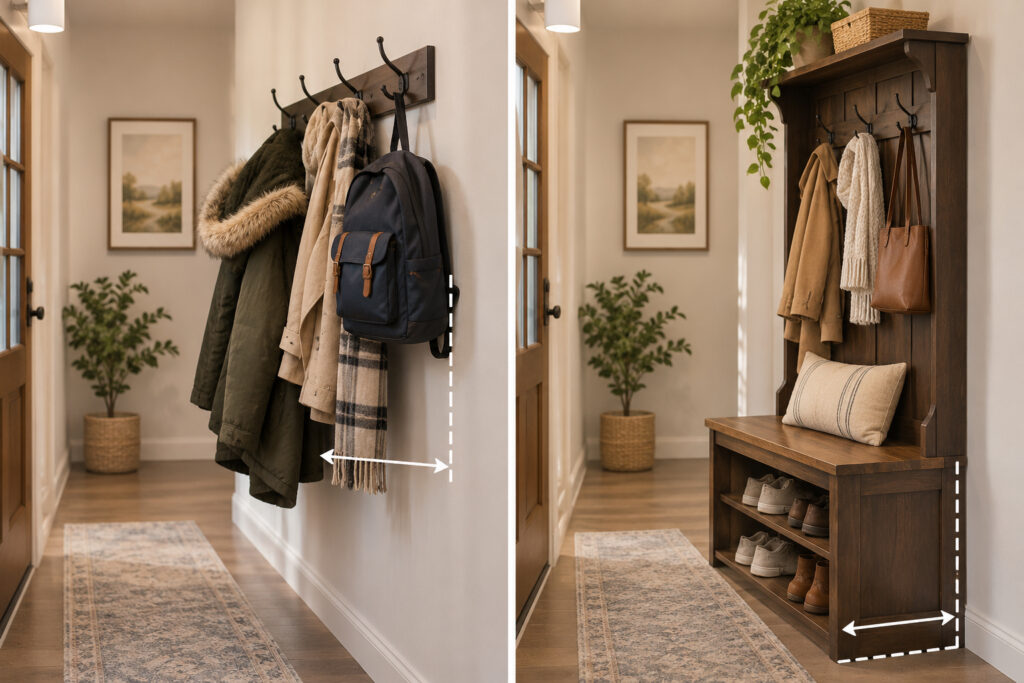
A wall rack may be extremely compact on its own.
But if it still requires:
- a shoe rack;
- a bench;
- storage baskets;
the complete setup can use more wall and floor area than expected.
A hall tree starts larger but may replace some of those separate pieces.
For hall trees specifically, Home Depot currently describes 12–18-inch-wide models as slender options suitable for hallways and tight entryways. Width alone, however, does not tell you whether the piece will work; depth and surrounding circulation still matter.
For the full measuring process, see our Hall Tree Size Guide: How Much Space Do You Need?
5. Which Is Better for a Narrow Entryway?
If floor depth is the tightest constraint, a wall-mounted coat rack usually has the advantage.
The floor stays clear, and you can choose exactly where the hooks go.
A narrow hall tree can still work when:
- there is enough usable wall;
- the furniture does not interfere with the front door;
- the loaded hooks stay out of the main walking path;
- the bench or lower storage can be used comfortably.
The important question is not:
Is this hall tree narrow?
It is:
What happens to the entryway after the furniture is installed and being used?
That distinction prevents a common mistake: buying a narrow piece that still projects too far into the room.
6. Which Is Better If You Already Have Shoe Storage?
Usually, the coat rack becomes more attractive.
Suppose your entryway already has a shoe cabinet that works well.
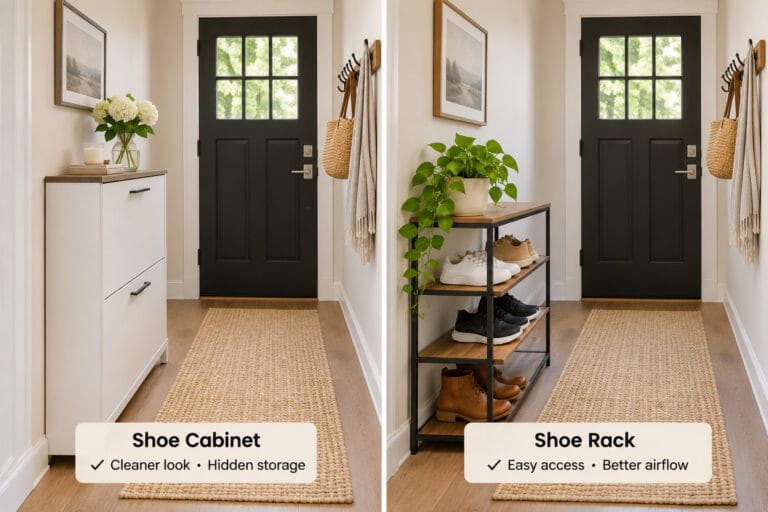
If you’re still deciding between enclosed and open shoe storage, our shoe cabinet vs. shoe rack comparison can help you choose the better fit before adding hanging storage.
The remaining problem may simply be:
coats and bags need somewhere to go.
Adding a full hall tree might duplicate the shoe storage you already have and make the room heavier.
The same logic works in reverse.
If you currently have:
- a coat rack;
- a separate shoe rack;
- a separate bench;
and all three are competing for the same wall, replacing them with one integrated hall tree may simplify the room.
A useful question is:
Am I adding a missing function, or duplicating one I already have?
This is often more useful than comparing the number of shelves each product offers.
7. Coat Rack + Bench vs. Hall Tree
A separate coat rack and bench can be an excellent alternative to an integrated hall tree.
This modular approach works particularly well when the wall has:
- a window;
- switches or outlets;
- HVAC elements;
- an awkward corner;
- a short usable section.
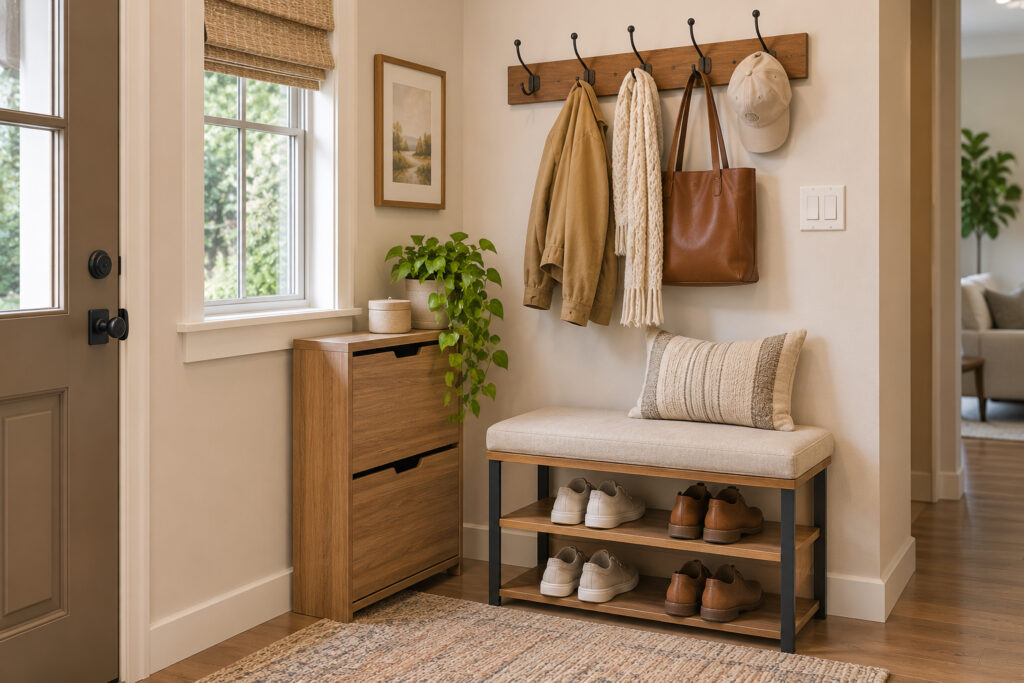
You can place hooks where the wall allows and choose a bench depth separately.
It also lets you replace one component later without replacing the whole entryway setup.
But modular does not automatically mean smaller.
A coat rack + bench + shoe rack can eventually occupy more total space than one compact hall tree.
Compare the finished arrangement, not the dimensions of each piece in isolation.
8. Which Works Better for Different Entryways?
| Entryway Situation | Better Starting Point | Why |
|---|---|---|
| Very narrow hallway | Wall-mounted coat rack | Preserves floor space |
| Small apartment entry | Coat rack or compact hall tree | Depends on whether seating and shoe storage are also needed |
| Existing shoe cabinet | Coat rack | Adds the missing hanging function without duplicating storage |
| Family entry | Hall tree | Can organize hanging items plus lower storage |
| Shoes and bags collect by the door | Hall tree | Addresses more than hanging clutter |
| Entry opens directly to living space | Depends | Coat rack feels lighter; contained storage may look tidier |
| Awkward wall with switches/windows | Modular coat rack + bench | Components can be positioned independently |
| Only one useful storage wall | Hall tree may work better | Vertical integration can consolidate several functions |
9. What Should You Measure Before Choosing?
This is a comparison article, so you do not need a full measuring worksheet.
But check four things before buying.
Usable Wall Width
Measure between real obstructions such as:
- door trim;
- windows;
- switches;
- outlets;
- vents;
- nearby closets.
Floor Depth
For a hall tree, ask how much walking space remains after the furniture is installed.
For a coat rack, account for whatever will actually hang from it.
Door Movement
Open the front door and nearby closet doors completely.
Furniture should not compete with the door swing or with the space someone needs immediately after entering.
Daily Load
Count what normally needs to be stored at the same time.
Not every coat or shoe you own.
Just the everyday items that repeatedly enter and leave through this doorway.
That is the storage requirement that matters most.
HomyEntry Fit Check: Coat Rack or Hall Tree?
Before ordering, answer these six questions.
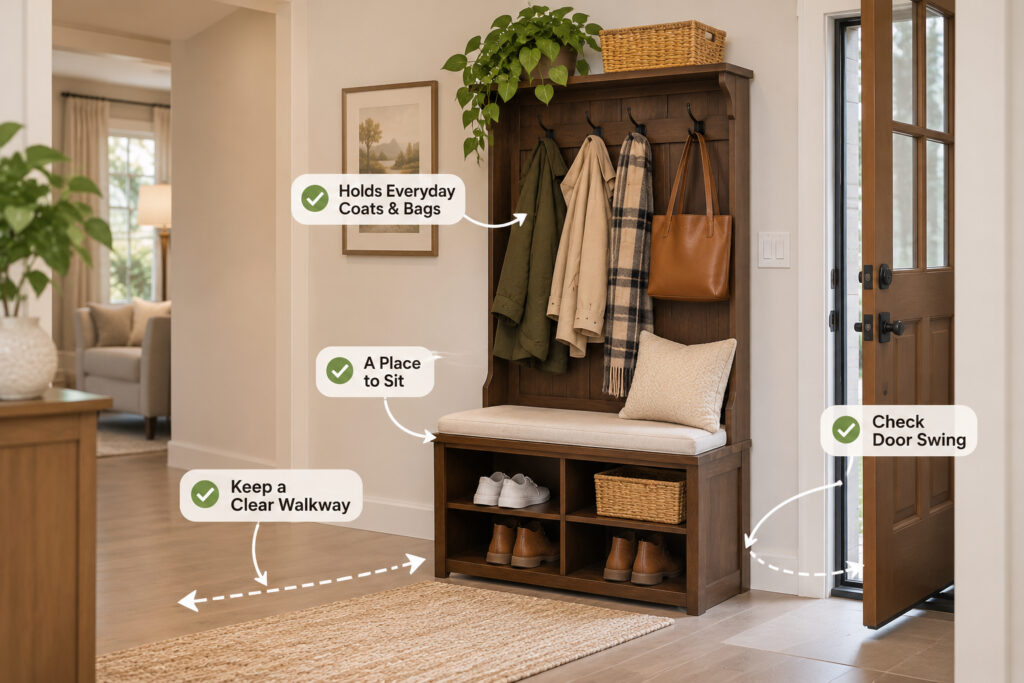
1. What Is the Main Problem?
Mostly coats and bags?
Start with a coat rack.
Coats, shoes, bags, and seating?
A hall tree deserves consideration.
2. How Much Floor Depth Can You Give Up?
Very little?
Wall-mounted storage has the advantage.
Enough for a bench-depth piece without disrupting circulation?
A hall tree becomes more realistic.
3. Do You Actually Need a Seat?
If nobody sits down at the entrance, do not automatically pay for and make room for a bench.
If changing shoes at the door is part of the daily routine, seating may be worth the space.
4. Where Will Shoes Go?
Already organized elsewhere?
Do not duplicate shoe storage unless there is a reason.
Shoes constantly pile beneath the coats?
An integrated solution may work better.
5. How Many Different Items Need a Home?
Think in categories:
- hanging items;
- footwear;
- bags;
- small everyday gear.
The more categories the same small area needs to handle, the stronger the case for integrated storage.
6. Can It Be Installed Safely?
Follow the manufacturer’s installation instructions.
Tall furniture should be secured when the manufacturer requires wall anchoring or provides anti-tip hardware.
Wall-mounted coat racks also need appropriate fasteners for the wall construction and the expected load.
Safety and Wall Anchoring
Storage furniture should not be considered stable simply because it stands upright when empty.
The U.S. Consumer Product Safety Commission’s Anchor It! guidance recommends securing top-heavy furniture and following manufacturer instructions for anchoring furniture properly.
That is particularly relevant when a tall hall tree carries weight higher up on the unit.
For wall-mounted coat racks, mounting strength matters for a different reason: coats and bags repeatedly load and pull on the attachment points.
Use the hardware and installation method recommended for the product and your wall construction rather than relying on a generic fastener.
Common Mistakes When Choosing
Choosing the Piece With the Most Storage
More storage is not automatically better in a small entrance.
Unused cabinets and shelves still occupy space.
Comparing Width but Ignoring Depth
A narrow hall tree can still project too far into the walking path.
Measuring Empty Furniture
Coats and backpacks change the usable footprint.
Plan around the loaded setup.
Buying a Hall Tree When Hooks Are All You Need
If shoes and bags already have good storage, a full hall tree may duplicate functions.
Adding Hooks When the Real Problem Is on the Floor
If shoes and bags are the main source of clutter, more hanging capacity alone will not solve the entryway.
Final Recommendation
Choose a coat rack when hanging storage is the main need and preserving floor space matters most.
It is especially useful for:
- narrow hallways;
- apartments;
- entryways that already have shoe storage;
- rooms where a visually lighter solution works better.
Choose a hall tree when one piece of furniture needs to manage several entryway functions.
It is particularly useful when the same area needs:
- hanging storage;
- shoe organization;
- a bench;
- a more defined family drop zone.
And consider a modular coat rack + bench combination when the wall is irregular or you want more control over where each function goes.
For a small entryway, do not automatically choose the piece that looks smallest—or the one that offers the most storage.
Choose the setup that solves the everyday problem without making the entrance harder to use.
For more examples of how these features are combined in real products, browse our Hall Trees & Coat Racks collection.
Frequently Asked Questions
What is the main difference between a coat rack and a hall tree?
A coat rack primarily provides hanging storage. A hall tree typically combines hooks with additional entryway functions such as seating, shoe storage, shelves, cubbies, or cabinets.
Is a coat rack better for a small entryway?
It often is when floor depth is very limited and hanging storage is the main need. A hall tree can be more efficient, however, when it replaces several separate pieces of furniture.
Can a hall tree fit in a narrow entryway?
Yes. Check the actual depth, the space left for walking, nearby door movement, and the additional space created by coats and bags rather than relying on width alone.
Does every hall tree include a bench and shoe storage?
No. Hall tree configurations vary considerably. Some combine hooks, seating, and shoe storage, while others are much simpler.
Can I use a coat rack with a separate bench?
Yes. A modular setup can work especially well around windows, switches, or awkward wall sections. Compare the total finished footprint rather than assuming separate pieces will always use less space.
Which is better if I already have a shoe cabinet?
Usually a coat rack is the more logical addition because it supplies the missing hanging function without duplicating shoe storage.