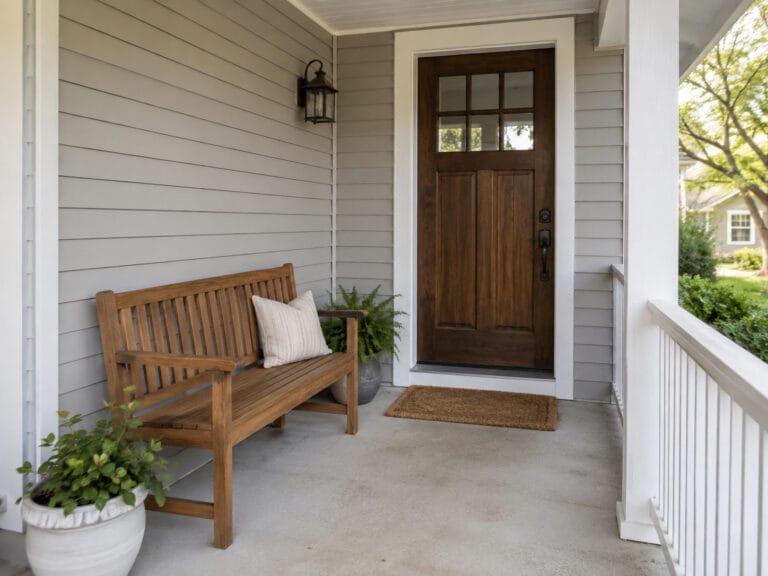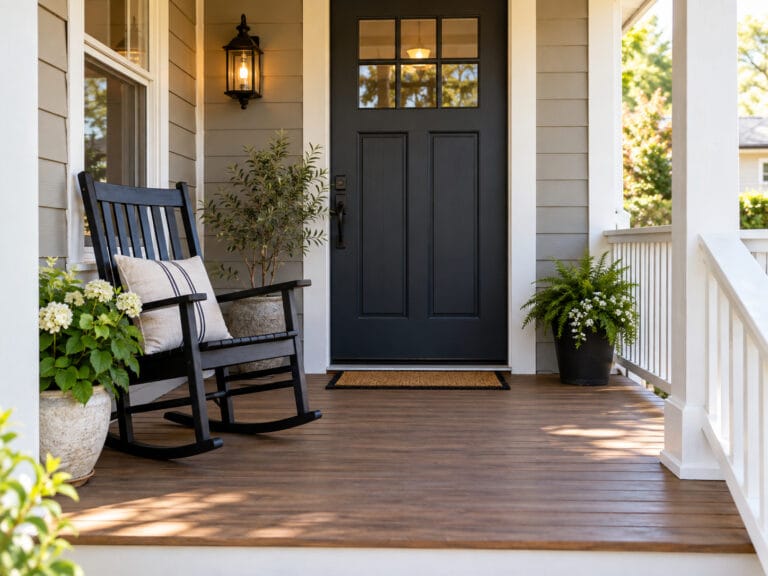
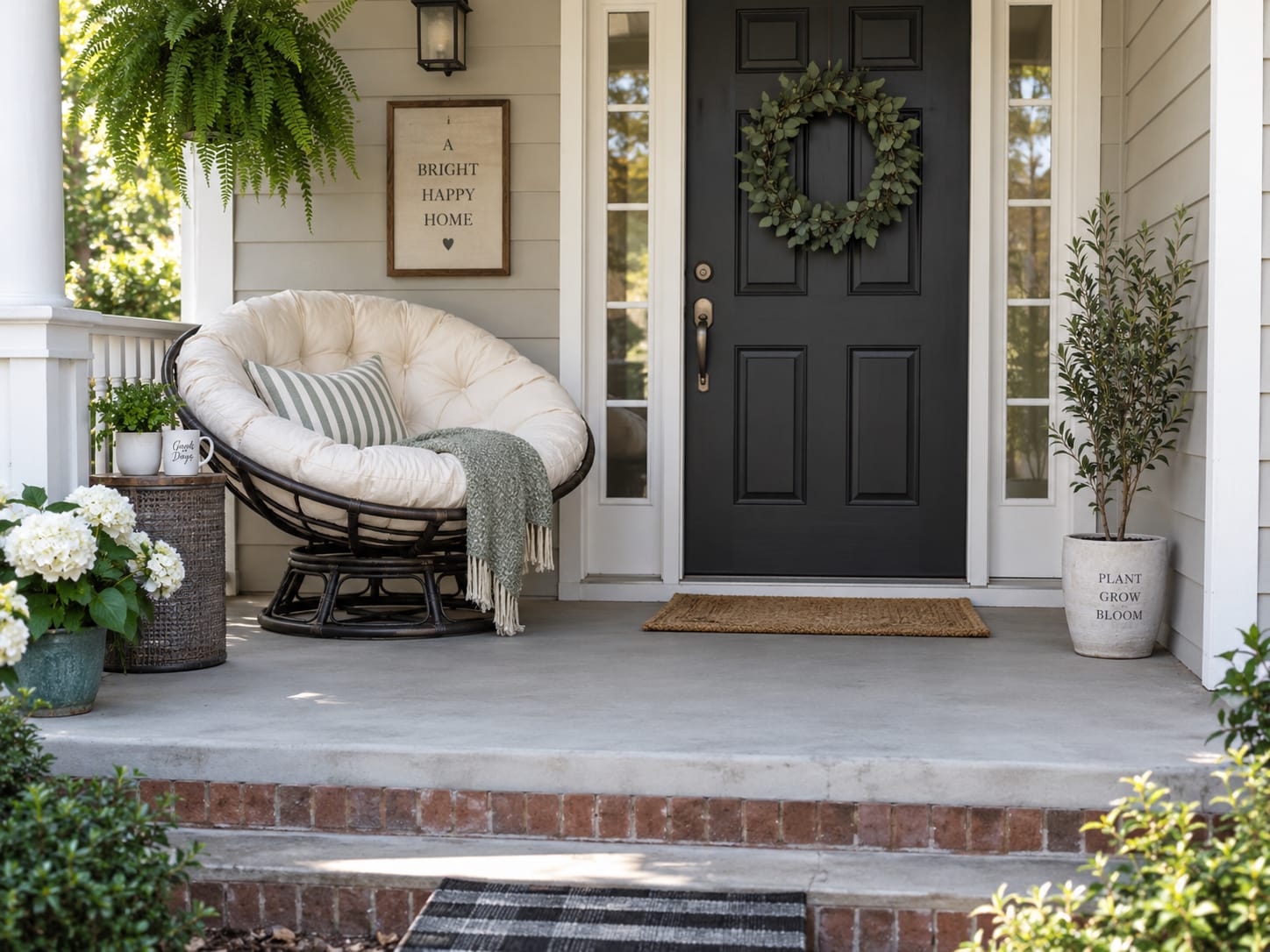
A swivel papasan chair can look surprisingly compact in product photos, but the space it needs in a real front porch is often larger than expected.
The reason is simple:
The chair itself is only part of the space you need to plan.
A comfortable setup also needs room for:
- the chair’s full width and depth;
- 360° swivel movement;
- getting in and out of the chair;
- walking around the porch;
- opening the front door;
- nearby furniture such as side tables or planters.
That means the better question is not:
“Can this chair physically fit in this corner?”
It is:
“Will the porch still feel comfortable and easy to use after the chair is placed there?”
For a front porch, this difference matters. A chair that technically fits may still make the entrance feel crowded if there is no room to move.
This guide explains how much space a swivel papasan chair needs, how to measure your porch before buying, and how to create a comfortable layout without sacrificing your entryway.
Table of Contents
Quick Answer: How Much Space Does a Papasan Chair Need?
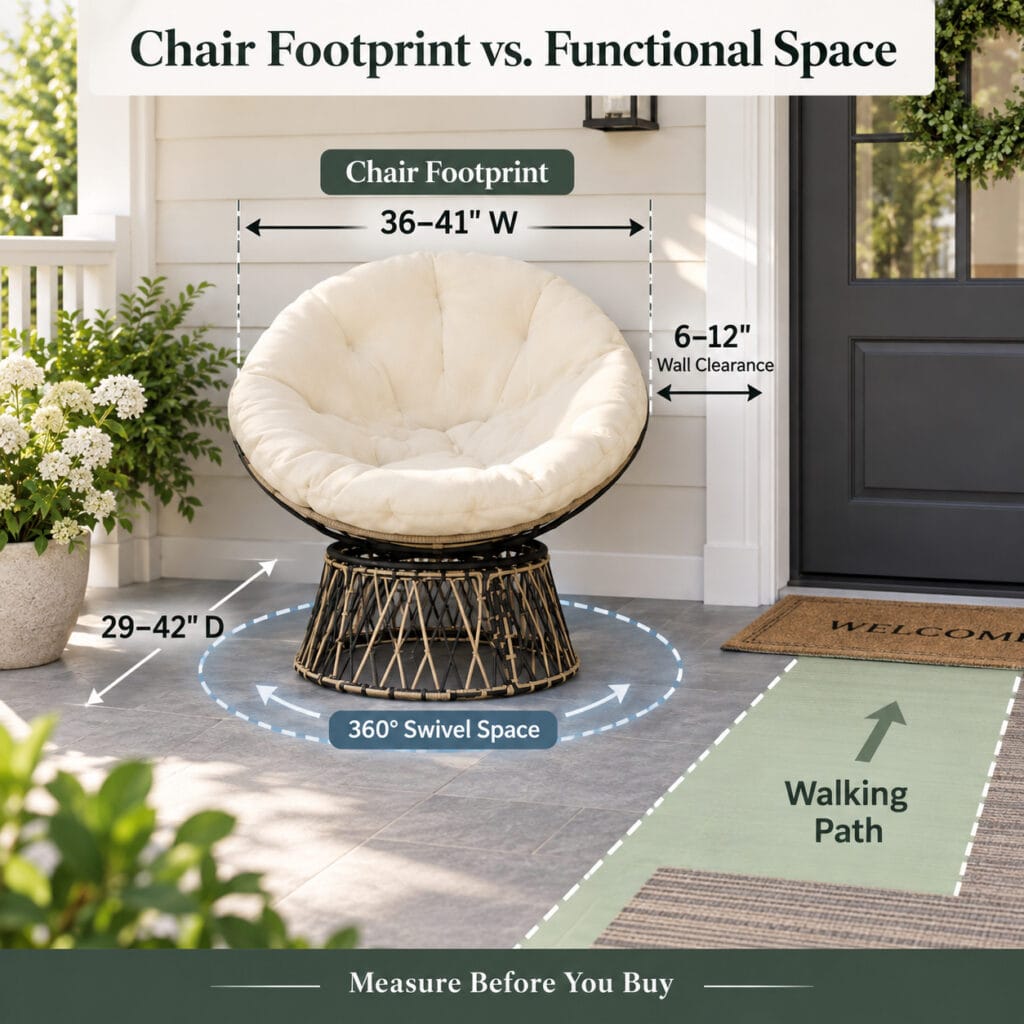
Most outdoor swivel papasan chairs are approximately:
| Measurement | Typical Range |
|---|---|
| Width | 36–41 inches |
| Depth | 29–42 inches |
| Height | 34–40 inches |
However, these measurements only describe the chair itself.
For comfortable use, you also need additional space around the chair for:
- swivel movement;
- sitting and standing;
- walking paths;
- nearby furniture;
- door clearance.
A practical starting point:
| Space Consideration | Planning Guide |
|---|---|
| Chair footprint | About 3–3.5 feet wide |
| Wall or railing clearance | Around 6–12 inches or more depending on use |
| Small side table | Around 16–20 inches wide |
| Main walkway | Keep the primary path open |
These are layout guidelines, not building requirements. The exact space depends on your chair design, porch shape, door location, and how you use the area.
Chair Size vs. Usable Space: The Difference Most Buyers Miss
When shopping for furniture, many people focus only on the product dimensions.
But a swivel papasan chair has two different footprints.
Static Footprint
The static footprint is the space the chair occupies when it is sitting still.
This includes:
- overall width;
- overall depth;
- frame size;
- base size.
This is usually the measurement shown on product pages.
Functional Footprint
The functional footprint is the real space needed for comfortable daily use.
It includes:
- swivel rotation;
- space to sit down and stand up;
- room to walk around the chair;
- clearance from walls and furniture.
A chair can fit inside a measured area but still feel uncomfortable once someone actually uses it.
This is especially important with swivel papasan chairs because the purpose of the chair is movement. If the chair is squeezed between a wall and a railing, the swivel feature becomes difficult to enjoy.
Typical Swivel Papasan Chair Dimensions
Papasan chairs are a style category, not a standardized size.
Different manufacturers use different frame designs, cushion thicknesses, and base structures, so two chairs with similar descriptions can have very different footprints.
Many outdoor swivel papasan chairs fall within:
- 36–41 inches wide
- 29–42 inches deep
For example, current outdoor furniture listings show that some compact designs may be around:
38″W × 28″D
while larger bowl-style designs may extend beyond:
40″W × 40″D
The important takeaway:
Do not estimate size based only on the name “Papasan chair.” Always check the actual product dimensions.
A chair marketed as “compact” may still require significant depth because of its curved backrest and deep seating design.
Why Swivel Papasan Chairs Need More Space Than Regular Chairs
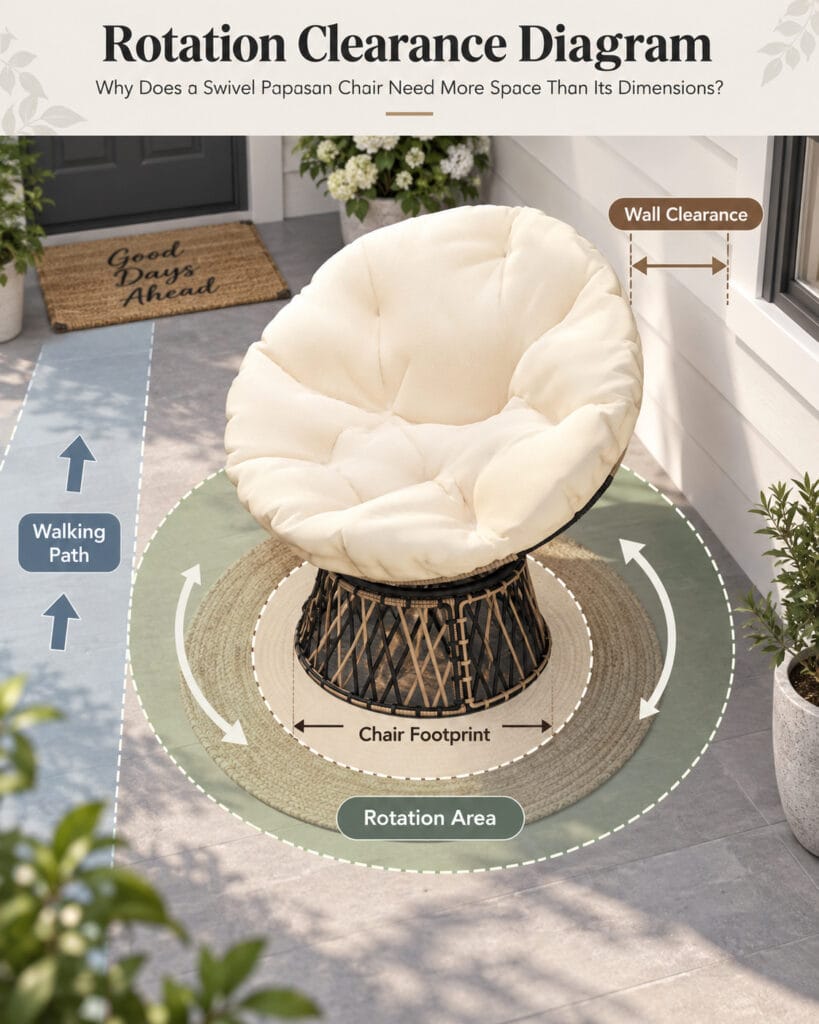
A standard chair usually has one fixed position.
A swivel papasan chair adds another factor:
movement.
When the chair rotates, the seating area changes position relative to:
- walls;
- railings;
- tables;
- plants;
- nearby furniture.
This creates what can be thought of as a rotation envelope — the total area needed for the chair to rotate without hitting anything.
A chair may fit perfectly when facing forward but become uncomfortable when:
- turned toward the sun;
- rotated toward another person;
- moved away from the doorway;
- adjusted while sitting.
This is why measuring only the chair width is not enough.
Why Measuring Only the Base Can Be Misleading
Many swivel papasan chairs use a relatively compact circular base.
However, the seat itself is often much larger than the base.
The widest point may come from:
- the bowl-shaped seat;
- thick cushions;
- curved back support;
- extended side areas.
A common mistake is measuring only:
- the swivel mechanism;
- the base diameter;
- the bottom frame.
This can underestimate the real space needed.
For accurate planning, measure:
overall chair width × overall chair depth
not just the base.
How to Measure Your Front Porch Before Buying
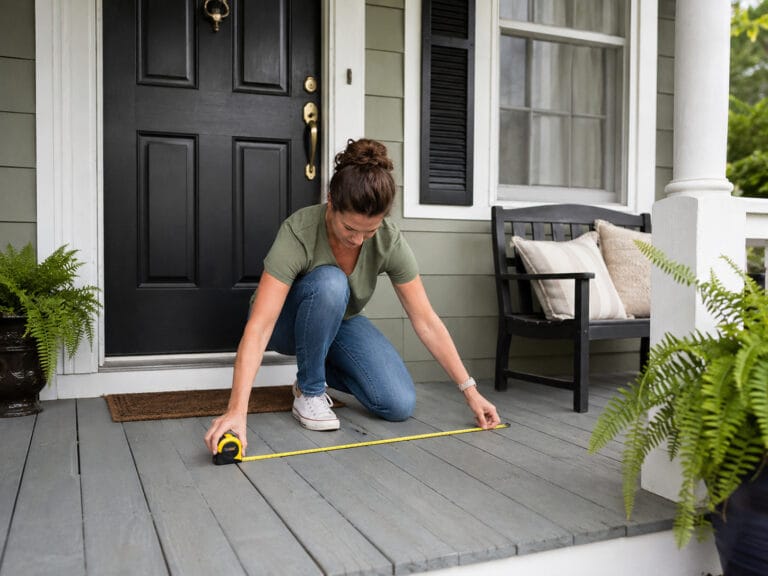
Before ordering a swivel papasan chair, measure the actual area where it will be placed.
A porch is not an empty room. Furniture has to share space with:
- the front door;
- walking paths;
- railings;
- steps;
- columns;
- outdoor accessories.
1. Measure Available Width
Start with the area where the chair will sit.
Measure between:
- walls;
- railings;
- posts;
- other fixed objects.
Also consider:
- door frames;
- windows;
- outdoor outlets;
- planters;
- existing furniture.
A chair that technically fits between two objects may still feel too tight if there is no room to use it comfortably.
2. Measure Available Depth
Depth is often the limiting factor on smaller porches.
A papasan chair usually has:
- a deep bowl-shaped seat;
- a reclined back position;
- thick cushions.
This means it may extend farther into the porch than a traditional upright chair.
Before buying, measure:
from the wall or back edge to the furthest point where the chair will extend.
Then check whether people can still comfortably walk through the area.
Ask yourself:
- Can someone carry a grocery bag past the chair?
- Can two people pass without squeezing?
- Does the chair block the main entry path?
3. Check Front Door Swing
A front porch is still an entrance.
If the chair is near the door, open the door completely and check:
- door swing area;
- standing space near the entrance;
- package delivery space;
- normal entering and exiting movement.
Furniture should work with the entryway, not force people to walk around it.
For more detailed planning, see our guide:
Front Porch Furniture Size Guide: How to Measure Before You Buy
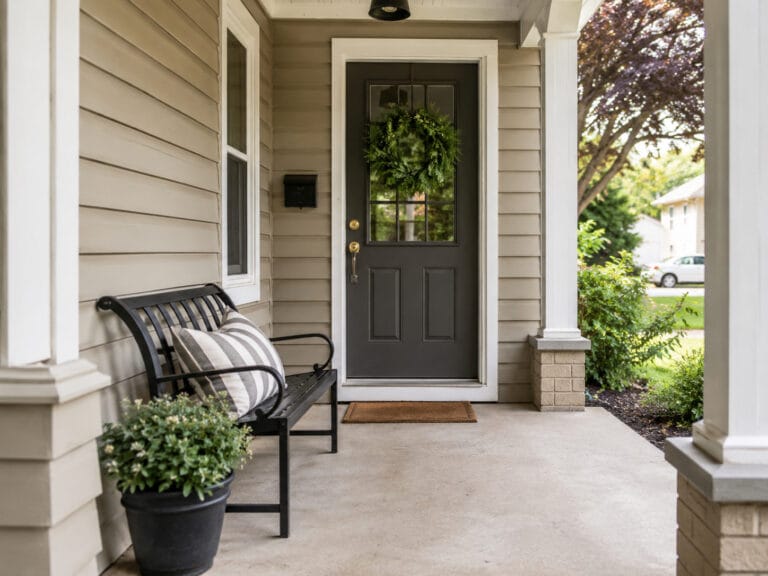
4. Protect the Walking Path
After marking the chair location, look at the remaining open space.
Consider:
- Can someone walk naturally?
- Does someone sitting in the chair block others?
- Would guests need to turn sideways?
- Does the porch still feel open?
A comfortable porch is not just about fitting furniture. It is about maintaining easy movement.
Not sure how much open space you should leave around porch furniture? Our porch furniture clearance guide explains the spacing considerations that help keep outdoor areas comfortable and easy to use.
Use Painter’s Tape to Test the Real Space
One of the easiest ways to avoid buying the wrong size chair is a simple floor test.
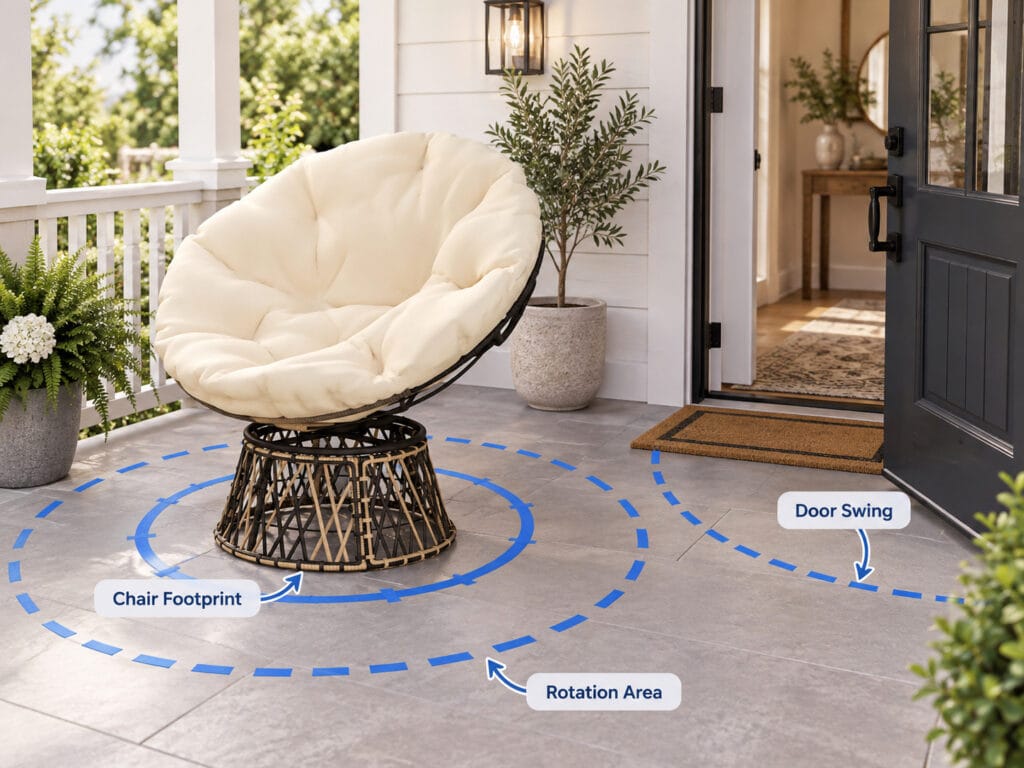
Before ordering:
- Mark the chair’s width and depth on the porch floor with painter’s tape.
- Add extra space around the outline for swivel movement.
- Open the front door.
- Walk through the area.
- Pretend to sit, stand, and rotate.
This gives a much better idea than looking at product photos.
If the taped outline already feels crowded, the real chair will usually feel even larger because of:
- height;
- cushion thickness;
- visual weight.
Small Porch vs. Large Porch: Different Layout Strategies
The same swivel papasan chair can feel completely different depending on the porch size.
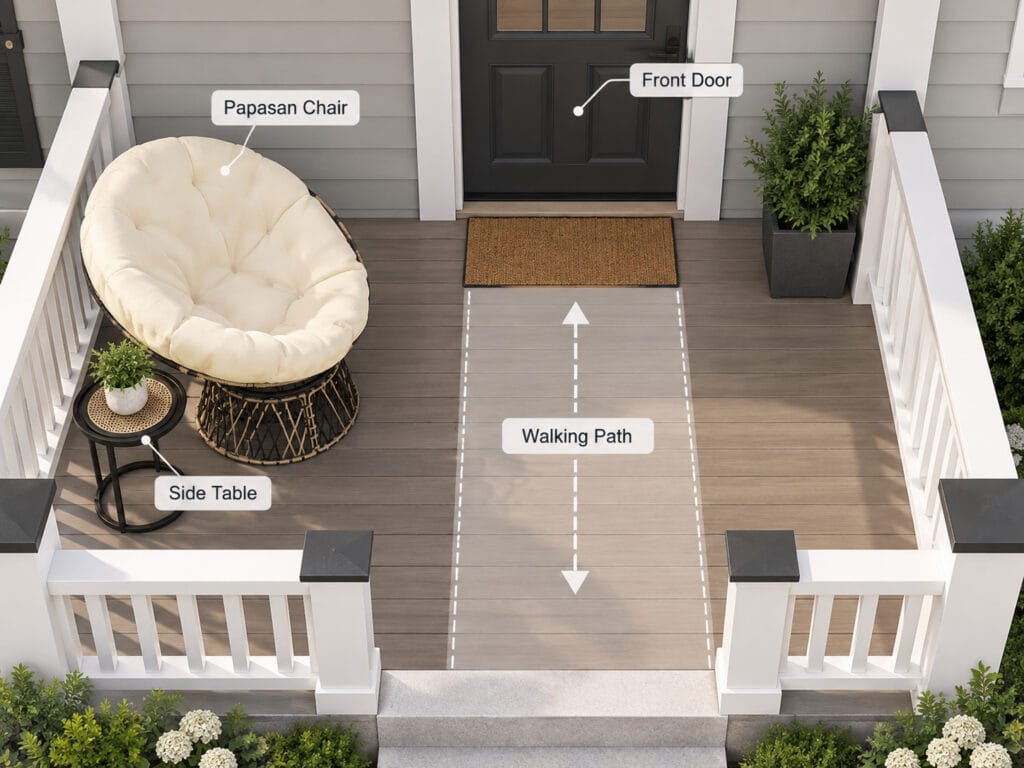
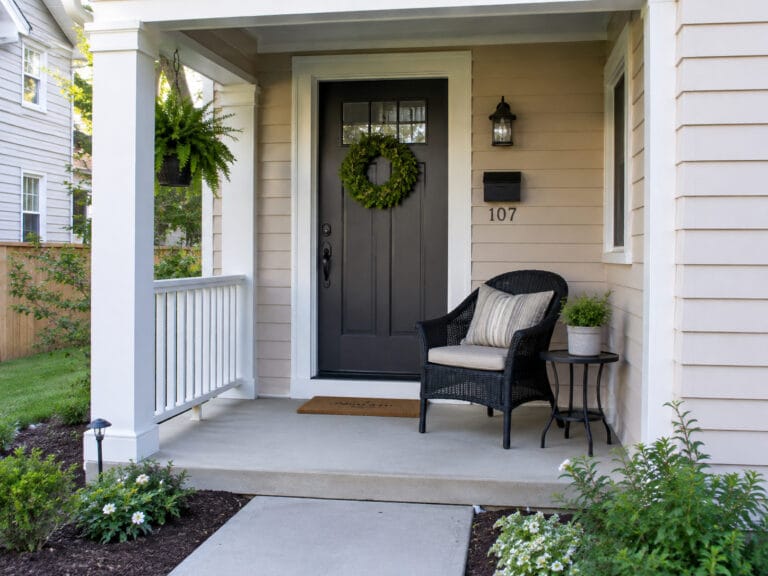
Small Front Porch
For smaller porches, the priority should be:
protecting movement first, adding furniture second.
A good layout usually means:
- one swivel papasan chair;
- a small side table;
- clear walkway;
- minimal extra furniture.
Good placement options:
- against a wall;
- near a corner;
- away from the main door path.
Avoid filling a small porch with too many large pieces.
A comfortable single-chair setup often works better than trying to create a full outdoor living room.
If you are planning a complete small porch layout, our small front porch ideas guide covers furniture placement, space-saving ideas, and ways to make a compact porch feel more comfortable.
Large Front Porch
A larger porch gives you more flexibility.
You may have room for:
- more swivel movement;
- a side table;
- plants;
- additional seating.
A larger porch can comfortably support a relaxing seating area while keeping the entrance open.
However, even large porches benefit from empty space. Leaving some breathing room helps the area feel more inviting.
How Much Clearance Does a Swivel Papasan Chair Need From a Wall?
There is no universal clearance number because every chair design is different.
The required space depends on:
- backrest shape;
- seat depth;
- cushion thickness;
- swivel range;
- nearby furniture.
A practical starting point:
Mostly Fixed Position
If you rarely rotate the chair:
- leave some space from walls;
- avoid pressing cushions directly against surfaces;
- allow room for cleaning.
Frequent Swivel Use
If you regularly rotate the chair:
- leave more open space;
- check the widest point of the seat;
- test the full rotation path.
Remember:
The seat is often wider than the base, so the outer edge may move closer to nearby objects than expected.
Leave Room for a Side Table
Many homeowners pair a swivel papasan chair with a small table for:
- coffee;
- books;
- phones;
- drinks.
However, the table changes the total footprint.
For smaller porches, a compact side table around:
16–20 inches wide
often works better than a large coffee table.
A good planning order is:
- Place the chair.
- Check swivel clearance.
- Protect walking paths.
- Add the side table.
Many layout problems happen because people buy accessories first and discover later that the chair has no usable space.
Does a Swivel Rocking Papasan Chair Need More Space?
Yes.
A swivel rocking papasan chair requires two types of movement:
- Horizontal rotation;
- Front-to-back rocking.
This means you need to consider:
- side clearance;
- front clearance;
- rear clearance.
A chair that works in a stationary position may not work well when both movements are used.
For swivel rocking designs, always test:
rotation range + rocking range
before final placement.
Does Cushion Thickness Affect Space?
Yes.
Two chairs can have similar frame dimensions but feel completely different.
A chair with:
- thick cushions;
- large pillows;
- wide rounded arms;
can feel much larger than a chair with:
- thinner padding;
- open framing;
- lighter visual design.
This is called visual weight.
For small porches, measurements matter, but visual weight matters too.
A lighter-looking chair can make a compact porch feel more open.
Common Swivel Papasan Placement Mistakes
Mistake 1: Only Checking Width
A chair may fit by width but still block movement because of its depth.
Better approach:
Measure width, depth, and swivel clearance together.
Mistake 2: Placing It Too Close to Walls
Corners can seem like the perfect space-saving location.
But if the chair is surrounded by walls or railings, rotation becomes limited.
Mistake 3: Ignoring Door Movement
A chair near the entrance should never interfere with:
- opening the door;
- standing at the doorway;
- receiving packages.
Mistake 4: Adding Too Many Pieces
A papasan chair already has a strong visual presence.
Adding:
- large tables;
- multiple chairs;
- oversized planters;
can quickly overwhelm a small porch.
Mistake 5: Ignoring Visual Weight
Two chairs with similar measurements can create different feelings.
For compact spaces, consider both:
- actual dimensions;
- how large the chair looks in the space.
Swivel Papasan Chair Fit Check Before Buying
Use this checklist before ordering:
✅ Measure the chair’s full width, depth, and height.
✅ Mark the footprint with painter’s tape.
✅ Add space for swivel movement.
✅ Check the front door opening area.
✅ Confirm the walking path remains comfortable.
✅ Test the layout before adding tables or decorations.
A properly sized chair should feel like part of the porch, not an obstacle.
If you are looking for a comfortable swivel seating option for your porch, explore our outdoor swivel papasan chair designed for relaxing outdoor spaces.
Final Recommendation: Plan the Space Before Buying the Chair
A swivel papasan chair is popular because it combines comfort, relaxation, and flexible positioning.
But the best setup is not simply the largest chair that fits.
The goal is a chair that allows you to:
- sit comfortably;
- rotate freely;
- move naturally around the porch;
- keep the entryway functional.
Before buying, follow this order:
- Measure the chair.
- Calculate swivel clearance.
- Protect the door and walkway.
- Test the layout with painter’s tape.
- Add tables and accessories afterward.
A comfortable papasan corner does not require a huge porch.
It requires a layout where the furniture works with the space.
Explore more front porch furniture, storage, and practical ideas for the space around your front door.
Frequently Asked Questions
How much space does a papasan chair need?
Most outdoor swivel papasan chairs are about 36–41 inches wide and 29–42 inches deep. However, additional space is needed for swivel movement, walking paths, and door clearance.
Is a swivel papasan chair good for a small porch?
Yes, if the porch has enough depth and the chair does not block the entrance. Smaller porches usually work best with one chair and minimal accessories.
Does a swivel papasan chair need more space than a regular chair?
Usually yes. A swivel chair needs additional clearance because the seating area moves during rotation.
Can a swivel papasan chair be placed against a wall?
It can, but you should test the swivel range first. The seat or backrest may contact the wall even if the base fits.
Does a swivel rocking papasan need more space?
Yes. It needs room for both rotation and rocking movement.
What is the best way to check if a papasan chair fits my porch?
Use painter’s tape to mark the chair footprint, add swivel space, open the front door, and walk through the area before buying.