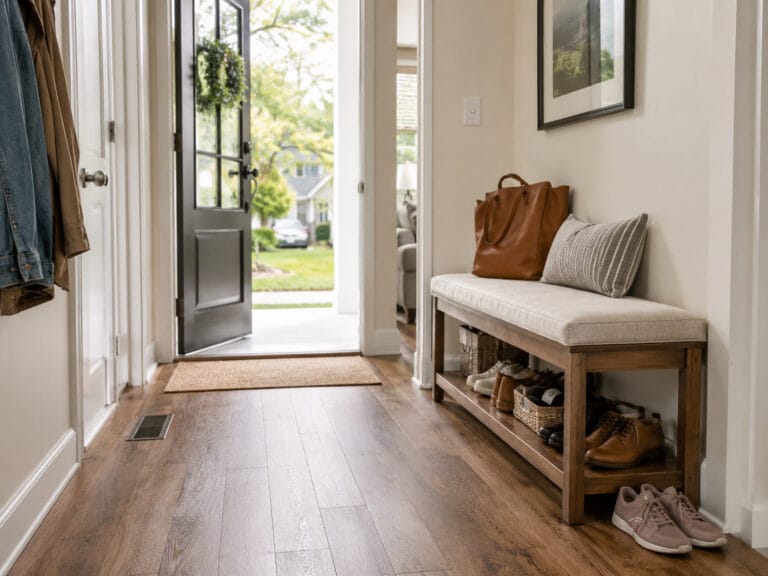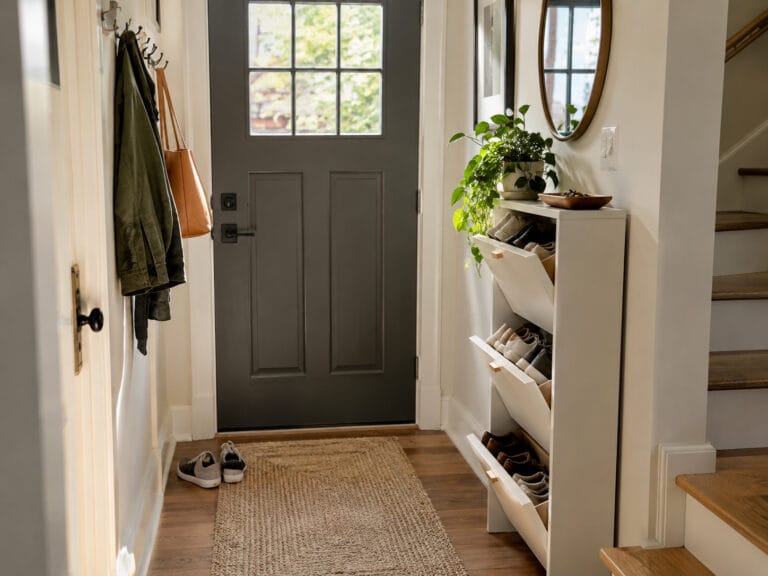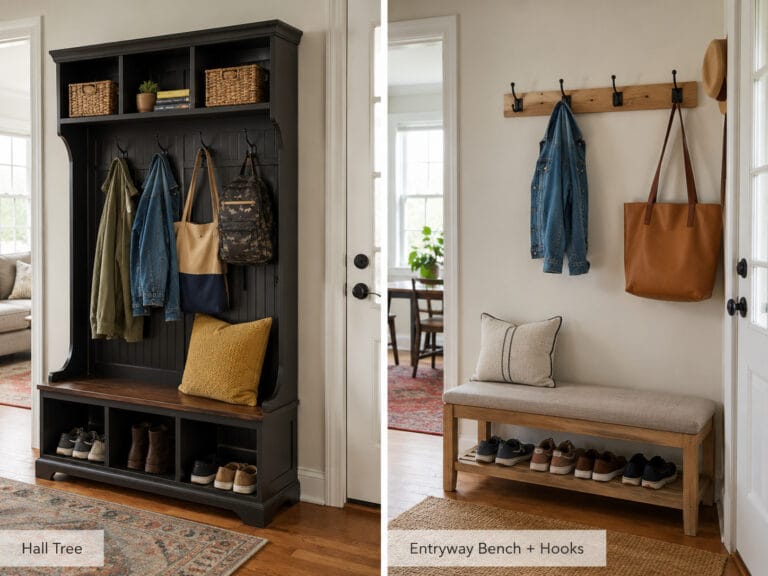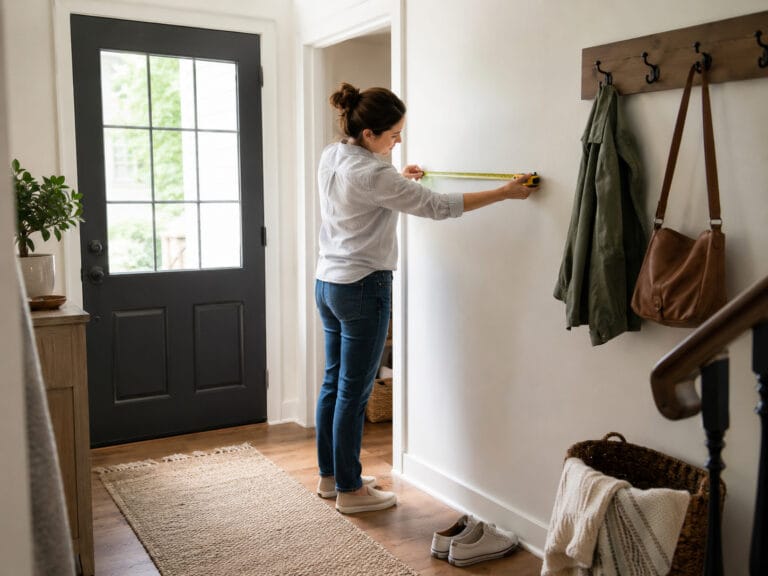
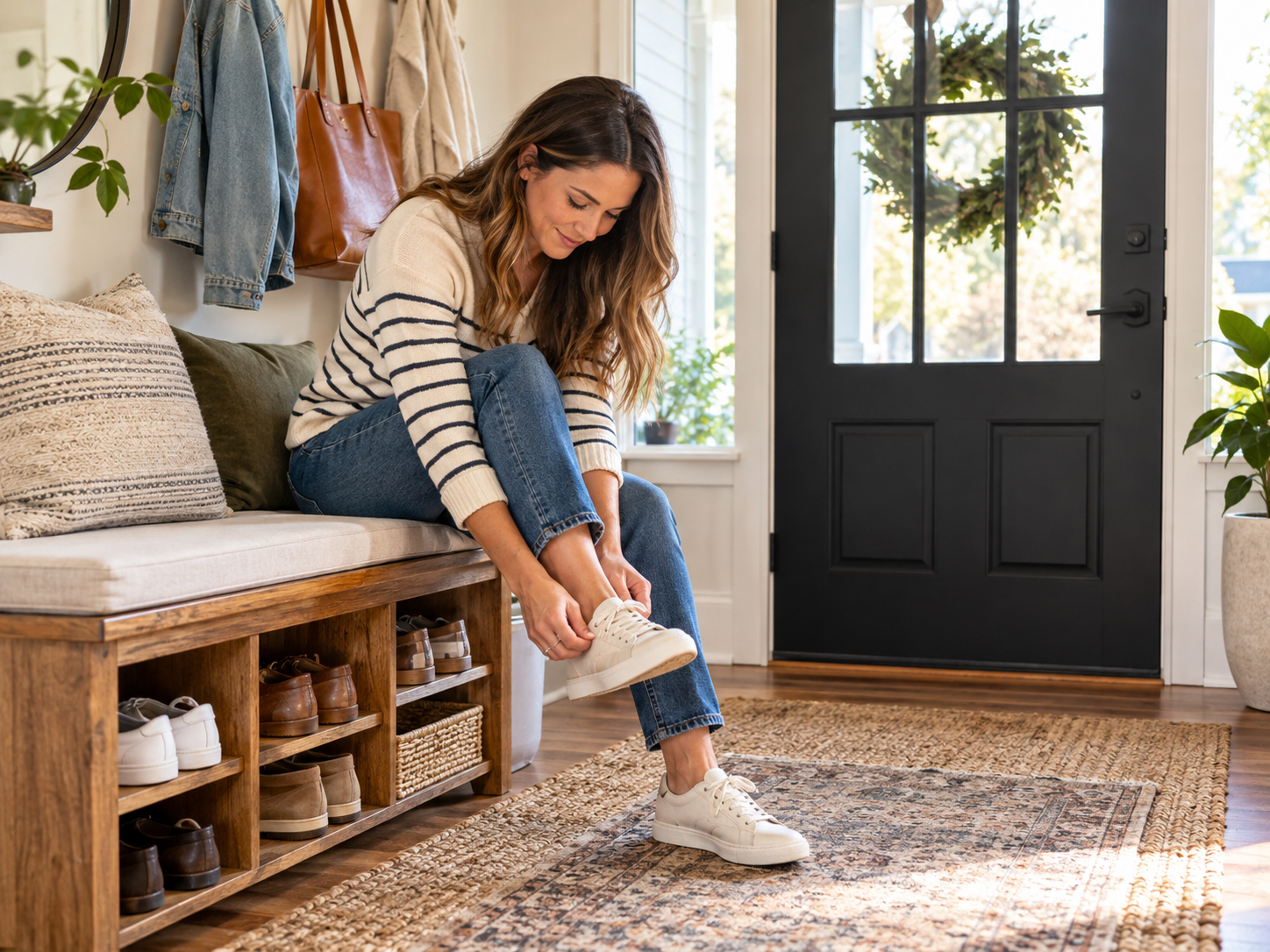
An entryway bench can fit perfectly against the wall and still feel awkward every time you sit down to put on your shoes.
The problem is often not the bench’s width or overall size.
It is the seat height.
If the bench is too low, standing back up can require more effort. If it is too high, your feet may not rest comfortably on the floor while you tie your shoes. Add a thick cushion, shoe shelves, or storage underneath, and the height you actually sit at may be very different from what the product photo suggests.
So the more useful question is not:
“How tall is the bench?”
It is:
“How high is the seat when someone actually sits down to put on shoes?”
This guide focuses specifically on entryway bench seat height, shoe-changing comfort, cushion thickness, adults and children, and how under-seat storage can affect the way a bench feels in everyday use.
Table of Contents
Quick Answer: What Is a Comfortable Entryway Bench Height?
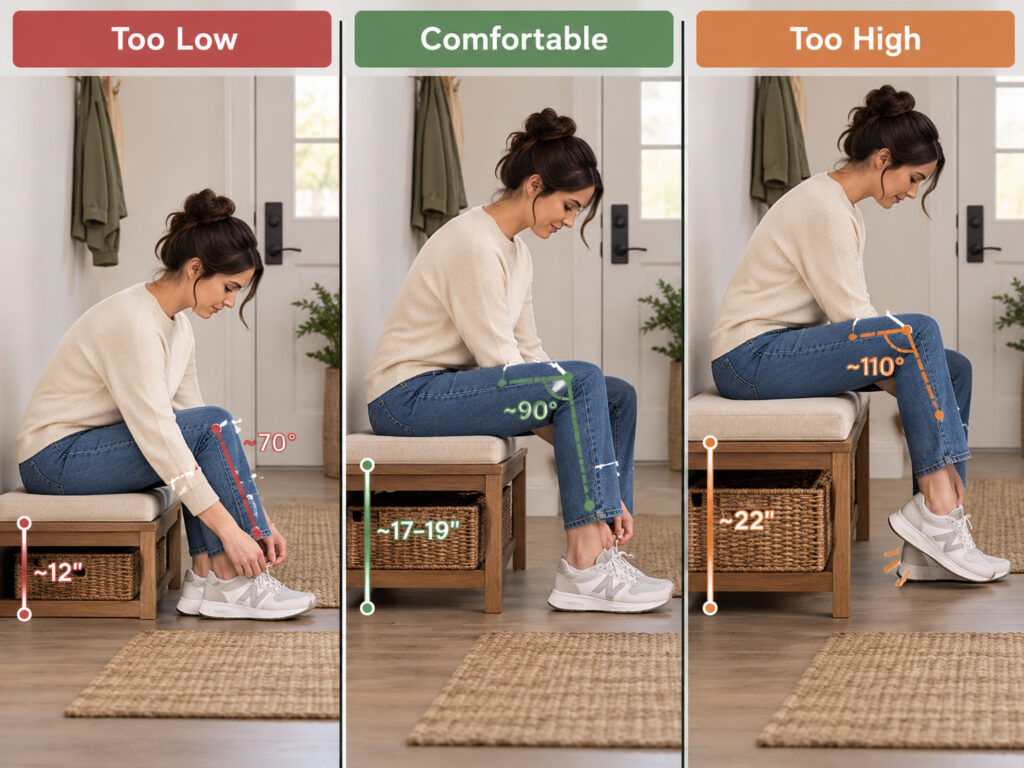
For many adults, an entryway bench with a finished seat height around 17 to 19 inches is a practical place to start.
That is not a universal standard. It is simply a useful planning range that overlaps with common household seating and many real shoe-storage benches.
For example, IKEA currently lists its compact RAGGBERG shoe-storage bench at about 17¾ inches high, while the TJUSIG bench with shoe storage is about 19⅝ inches high. These products do not establish a standard, but they show why the high-teens range appears so often in real entryway seating. IKEA
| User or Bench Type | Useful Starting Point | Main Consideration |
|---|---|---|
| Most adult entryway benches | About 17–19 in. | Balance between sitting low enough to reach shoes and high enough to stand comfortably |
| Lower bench | About 16–17 in. | May suit shorter adults or users who prefer a lower seat |
| Taller bench | About 19–20 in. | May feel better for taller adults or people who dislike deep knee bend |
| Shared family bench | Usually a moderate adult height | Adults need comfort; children also need reachable shoe storage |
| Cushioned bench | Measure finished seat height | Cushion thickness and compression both matter |
The most comfortable height is the one that works for the people who will actually use the bench.
Seat Height Matters More Than Overall Bench Height
When shopping online, product dimensions may list:
- overall height;
- seat height;
- bench height;
- cushion thickness;
- back panel height.
These are not the same measurement.
For sitting comfort, the most useful number is:
the distance from the floor to the top of the surface you actually sit on.
On a simple backless bench, that may be almost the same as the product’s overall height.
On a hall tree or storage bench with:
- a tall back;
- coat hooks;
- upper shelves;
- side panels;
- a cushion;
the overall product height tells you very little about how the bench will feel when you sit down.
If you also need to compare the furniture’s width, depth, and overall footprint, see our entryway bench size guide. This article focuses specifically on seat height and shoe-changing comfort.
Why 17 to 19 Inches Is a Useful Starting Range
There is no official U.S. “entryway bench height standard.”
That matters.
A lot of furniture advice online presents one number—often 18 inches—as if it were universally correct. In reality, body size, shoes, cushion firmness, and the task being performed all affect comfort.
Still, the high-teens range is a useful starting point.
Cornell University’s ergonomics guidance describes about 17 inches as a reasonable compromise for fixed-height seating. It also notes that a seat that is too high can increase pressure behind the knees, while a seat that is too low changes how body weight is supported. Cornell University Ergonomics Web
That does not make 17 inches the perfect entryway-bench height.
It simply supports the broader idea that a comfortable fixed seat needs to balance:
- foot support;
- knee angle;
- thigh support;
- ease of sitting and standing.
For an entryway bench, there is one more factor:
you are not just sitting. You are changing shoes.
Why Putting on Shoes Changes the Ideal Bench Height
An entryway bench does a more active job than a decorative bench or dining chair.
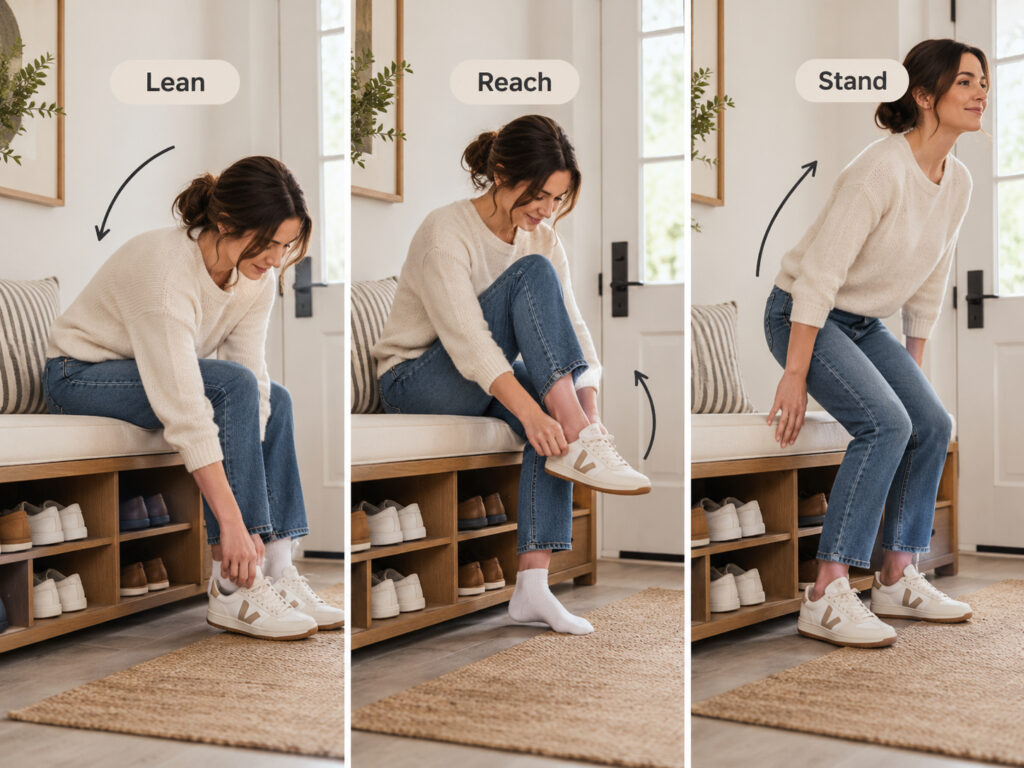
You may sit for only a minute, but during that minute you perform several movements.
Leaning Forward
Tying sneakers or lace-up shoes usually means bending toward the floor.
If the bench is too high, your feet may feel farther away and the front edge of the seat may press more firmly into the backs of your thighs.
If it is extremely low, the knee bend can become uncomfortable and standing afterward may require more effort.
Lifting One Foot
Some people raise one foot toward the opposite knee when putting on a shoe.
The bench needs to feel stable while allowing enough freedom around the knees and lower legs.
Pulling on Boots
Boots often require more movement than slip-on shoes.
You may need to:
- lean forward;
- brace one foot on the floor;
- pull upward on the boot;
- shift your weight on the seat.
A height that feels fine while sitting still may feel awkward during this motion.
Standing Up Again
This is easy to overlook.
Unlike a dining chair, an entryway bench is usually used for a short sequence:
sit → reach → put on shoes → stand → leave
The best bench height should support that entire sequence, not just the sitting portion.
What Happens If the Bench Is Too Low or Too High?
A simple way to think about bench height is to look at the problems created at either extreme.
| If the Bench Is Too Low | If the Bench Is Too High |
|---|---|
| Deeper knee bend | Feet may not rest fully on the floor |
| More effort when standing | More pressure behind the thighs |
| More trunk movement may be needed | Leaning toward shoes may feel less natural |
| Taller adults may feel cramped | Shorter adults may feel unsupported |
| Under-seat storage may be limited | Children may need to climb onto the seat |
The goal is not to hit a perfect number.
It is to avoid either extreme.
Measure the Finished Seat Height, Not Just the Bench Frame
This is especially important with cushioned benches.
Suppose the wooden seat platform is 17 inches above the floor.
Add a 2-inch cushion and the unloaded finished height becomes about 19 inches.
But that is still not necessarily the height you experience while sitting.
Cushions compress.
A soft cushion may sink noticeably. A firmer cushion may retain more of its thickness.
So it helps to think about two measurements.
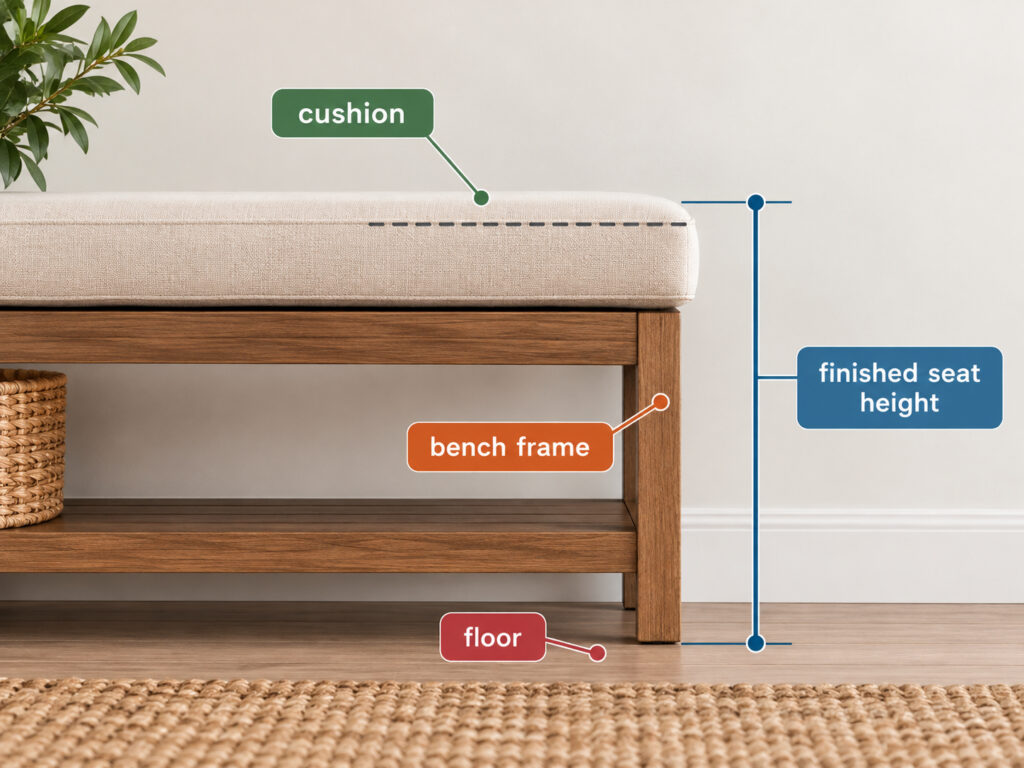
Unloaded Seat Height
The floor-to-seat measurement before anyone sits down.
This is what many product listings show.
Sitting Height After Cushion Compression
The approximate height after the cushion compresses under body weight.
You do not need to calculate this precisely.
The practical lesson is simpler:
Do not judge a cushioned entryway bench by the wooden frame height alone.
Research on chair design has also found that seat compressibility can affect how easily people rise from a chair, particularly older adults. PubMed
Replacing the Cushion Later?
If you plan to replace the original cushion, recheck the height.
A thicker replacement cushion can turn a comfortable bench into a noticeably taller seat.
Before buying a new cushion, compare:
current finished seat height + difference in cushion thickness
with a chair or bench you already find comfortable.
Taller Adults vs. Shorter Adults
A single bench can feel completely different to two people.
Taller Adults
Taller adults may prefer a seat toward the upper end of the typical range.
A slightly higher seat reduces how deeply the knees need to bend and can make standing feel easier.
But a taller user also needs enough space to:
- place the feet naturally;
- move the knees forward;
- lean toward the shoes;
- reach any storage underneath.
Seat height alone cannot compensate for cramped lower storage.
Shorter Adults
Shorter adults may prefer a slightly lower seat.
The key sign that a bench is too high is not simply the number on the product page.
It is what happens to the feet.
If the user sits back and:
- the feet barely reach the floor;
- the heels lift;
- the front edge presses into the backs of the thighs;
the seat is probably too high for comfortable shoe changing.
In a household with users of very different heights, a moderate bench height usually works better than choosing an extreme.
What About Older Adults?
For anyone who finds standing from a low seat difficult, a slightly higher and firmer bench may be easier to use.
Research on sit-to-stand movement consistently shows that lower seating increases the physical challenge of standing.
One study of older adults tested chair heights from 17 to 22 inches and found that chair-rise success improved and reported difficulty decreased as seat height increased. PubMed
Other research has similarly found that lower chair heights increase the demands of standing, especially for older adults. PubMed
That does not mean every older adult should buy a 20- or 22-inch entryway bench.
A bench that is too high can create a different problem if the feet lose stable contact with the floor.
A better approach is:
- avoid an unnecessarily low seat;
- choose a reasonably firm sitting surface;
- make sure both feet can still be supported;
- test the sit-to-stand movement before deciding.
If mobility is a significant concern, individual needs matter more than a generic furniture-height recommendation.
What About Children?
Children generally need lower seating than adults.
An adult-height entryway bench may work for older children, but younger children may:
- climb onto the seat;
- sit with their feet hanging;
- have difficulty getting down;
- struggle to reach shoes stored below.
If the bench is primarily for children, a lower seat can make sense.
For a shared family entryway, however, a separate children’s bench is often unnecessary.
A more practical setup may be:
- a moderate adult bench height;
- children’s daily shoes on the lowest shelf;
- open storage they can reach;
- no need to climb into upper cubbies.
For children, being able to reach their own shoes can be just as important as the exact bench height.
Storage Under the Bench Can Change Sitting Comfort
Many entryway benches combine seating with shoe storage.
Common designs include:
- one open shelf;
- two shoe shelves;
- cubbies;
- drawers;
- baskets;
- enclosed cabinets.
This creates a real tradeoff:
more storage underneath vs. comfortable seat height above it
Every extra shelf needs vertical space.
That can push the seat higher.
A taller bench may hold more shoes, but if it becomes uncomfortable to sit on, the added storage is not necessarily an improvement.
Do Not Count Every Inch Under the Seat as Useful Storage
The total floor-to-seat height is not the same as usable shoe-storage height.
Space may be taken up by:
- shelf thickness;
- structural framing;
- drawer hardware;
- base trim;
- floor clearance.
If shoe capacity matters, look at the actual interior shelf dimensions rather than assuming a taller bench automatically holds more shoes.
For more detail on real shoe-storage capacity, see our shoe storage capacity guide.
Check Where Your Feet Go
This is one of the easiest details to miss when shopping online.
A bench may have a perfectly reasonable seat height and still feel awkward because the storage underneath projects too far forward.
A shelf, basket, or cabinet directly under your legs can reduce the space where your feet naturally want to go.
Ask:
- Can my heels sit slightly under the front edge?
- Can I move one foot forward while tying the other shoe?
- Do my knees hit the cabinet or storage front?
- Can I reach the shoes without twisting around the bench?
The seat and storage should work together.
They should not compete for the same legroom.
Backless Entryway Bench vs. Hall Tree Bench
A backless bench and a hall tree bench can have nearly the same seat height and still feel different.
A backless bench usually:
- feels more open;
- can be approached from more angles;
- has less visual weight.
A hall tree bench may:
- have side panels;
- include a tall back;
- combine seating with hooks and upper storage;
- feel more enclosed around the user.
The correct seat height may be similar, but the overall furniture experience is different.
If you are deciding between the two furniture types, see our Hall Tree vs. Entryway Bench guide.
Does an Entryway Bench Need to Be Taller Than a Shoe Bench?
No.
“Entryway bench” and “shoe bench” are often just different labels for overlapping products.
What matters is the task.
If the main job is:
Putting on shoes
Prioritize comfortable finished seat height.
Storing many shoes
Balance storage capacity with seat comfort.
Occasional decorative seating
Exact shoe-changing ergonomics may matter less.
The product name does not determine comfort.
The actual seat height does.
Test the Height at Home Before You Buy
This is the most useful test in the article, and it costs nothing.
You do not need the actual bench.
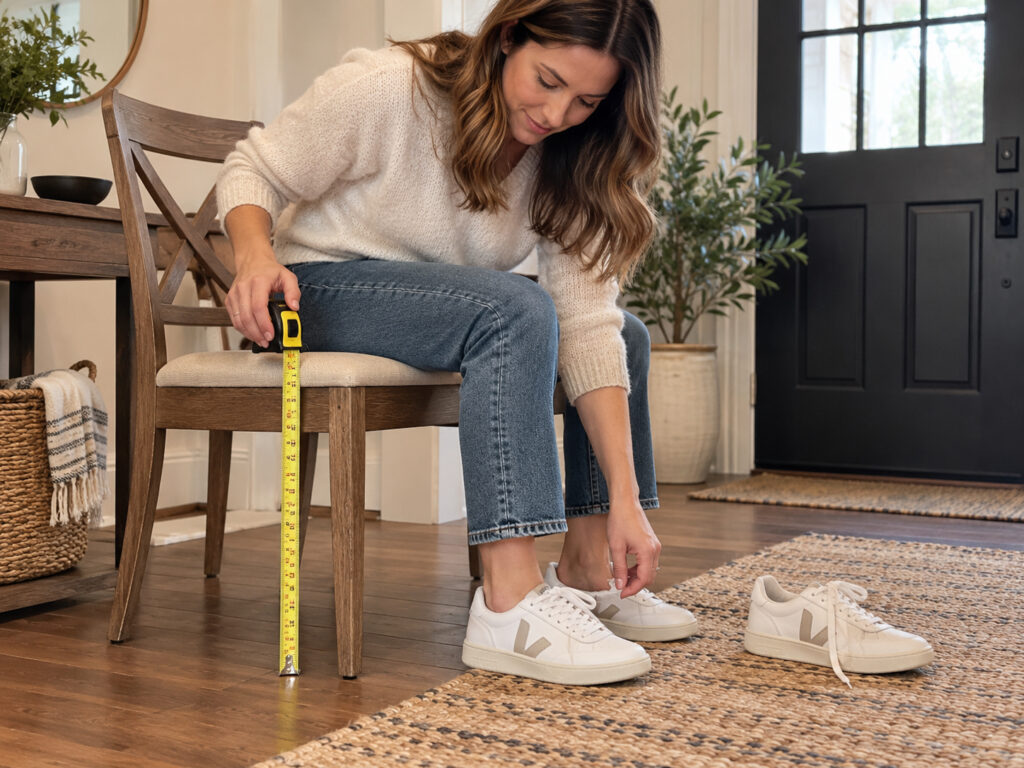
Step 1: Find a Similar Seat
Use something already in your home:
- dining chair;
- kitchen chair;
- firm ottoman;
- sturdy stool.
Step 2: Measure the Seat Height
Measure from the floor to the top of the sitting surface.
Step 3: Wear the Shoes You Actually Use
Do not test the seat barefoot if you normally use the bench while wearing shoes.
Try the kinds of footwear you commonly put on near the door:
- sneakers;
- slip-ons;
- work shoes;
- boots.
Step 4: Actually Put the Shoes On
Do not simply sit and decide whether the chair feels comfortable.
Lean forward.
Tie the laces.
Lift one foot if that is how you normally put shoes on.
Step 5: Stand Up
Can you rise naturally?
Do you need to:
- rock far forward;
- push heavily on your thighs;
- reposition your feet several times?
Step 6: Use That Height as Your Personal Reference
If a 17½-inch dining chair feels natural for your shoe-changing routine, that is more useful information than a generic recommendation that every entryway bench should be 18 inches high.
You can also use your lower-leg height as a rough personal reference. The goal is not to follow a precise formula—it is simply to avoid a seat that leaves your feet unsupported or forces an unusually deep knee bend.
HomyEntry Entryway Bench Height Fit Check
Before buying, check these six things.
1. Finished Seat Height
Measure from the floor to the surface you will actually sit on, including the cushion.
2. Adult Comfort
Can the main users keep their feet supported and stand naturally?
3. Child Use
If children use the bench, can they get on and off comfortably and reach their everyday shoes?
4. Cushion Compression
Does the cushion noticeably change the sitting height?
5. Shoe-Changing Movement
Can you lean forward, lift a foot, tie shoes, and stand without fighting the furniture?
6. Under-Seat Storage
Does the shoe storage still leave natural room for your feet and lower legs?
The practical rule is:
Choose the seat height for the people using the bench, not for the maximum amount of storage you can fit underneath it.
Common Entryway Bench Height Mistakes
Looking at Overall Furniture Height
A hall tree can be more than 70 inches tall while the actual seat remains around ordinary chair height.
Overall height does not tell you sitting comfort.
Ignoring the Cushion
A thick cushion can raise the finished seat by several inches before compression.
Maximizing Storage at the Expense of Comfort
An extra shoe shelf is not always worth making the sitting surface noticeably higher.
Assuming One Height Works for Everyone
Tall adults, shorter adults, children, and older users may experience the same seat differently.
Testing Only by Sitting Still
An entryway bench should be tested by performing the actual task:
put on a pair of shoes and stand back up.
Final Recommendation
For many adults, an entryway bench seat around 17 to 19 inches high is a sensible starting range.
But it should be treated as a starting point, not a universal standard.
The most comfortable bench depends on:
- who uses it;
- whether their feet stay supported;
- whether they can lean forward naturally;
- whether standing feels easy;
- whether a cushion changes the finished height;
- whether shoe storage interferes with the feet and knees.
If the main purpose of the bench is putting on shoes, prioritize finished seat height and movement comfort first, then decide how much storage you can fit underneath.
A good entryway bench should make one simple routine feel easy:
sit down → reach your shoes → put them on → stand up comfortably
You can also compare the finished seat height and under-seat storage of our entryway bench with a chair you already find comfortable.
For broader furniture sizing, see our Entryway Bench Size Guide, or explore more entryway furniture and storage options on our Entryway page.
Frequently Asked Questions
What is a good height for an entryway bench?
For many adults, about 17 to 19 inches is a useful starting range. The best height depends on the user’s leg length, footwear, cushion thickness, and how easily they can sit, reach their shoes, and stand again.
Is 20 inches too high for an entryway bench?
Not necessarily. A 20-inch seat may feel comfortable for taller adults or someone who prefers less knee bend. For shorter users, it may feel too high if the feet do not rest securely on the floor.
Is 16 inches too low for a shoe bench?
Not necessarily. Some shorter adults may find 16 inches comfortable. Taller users or people who find standing from low seating difficult may prefer something higher.
Does cushion thickness count toward bench height?
Yes. Measure to the top of the finished sitting surface, not just the wooden frame. Also remember that a soft cushion may compress more than a firm one.
What bench height is easier for older adults to stand from?
Research shows that lower seats generally make standing more demanding. A slightly higher, reasonably firm bench may be easier for some older adults, but the feet should still remain securely supported.
What height works best for a shared family entryway bench?
A moderate adult seat height is usually the most practical compromise. Rather than making the entire bench child-sized, keep children’s everyday shoes on lower, easy-to-reach shelves.